





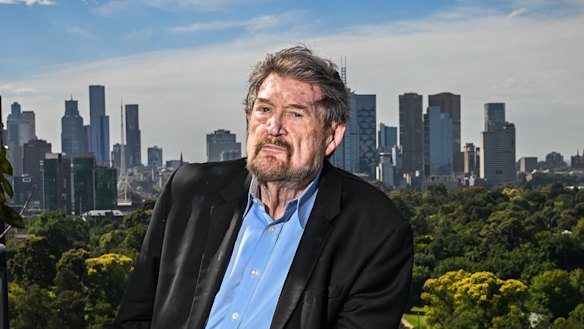
Of the many tributes to the late broadcaster, politician and activist Derryn Hinch since his death on Friday, the most salient was delivered by the former television executive Peter Meakin.
Meakin, who spent five decades leading news and current affairs coverage at the Seven, Nine and Ten networks, described his friend as one of the last practitioners of the “information business”.
“I won’t say news business, because Derryn was a lot more than just news,” he said. “But in the information business, there’s not too many colourful characters left.”
Meakin’s analysis touches on one of the many reasons why the 82-year-old Hinch’s death has resonated across Australia.
Yes, Hinch lived an extraordinary life. Yes, his personal and professional ups and downs are etched in Australian history. And yes, his work confronting child sexual abuse and violence against women led to real change.
But Hinch also represented a breed of journalist and communicator the nation now struggles to replicate. As Meakin rightly noted on Friday: “I think the television networks would prefer it if everyone drifted towards beige.”
Hinch thrived in an industry that embraced big personalities and news risk-takers. That’s not to say he always got it right. He was polarising, sometimes made false claims without evidence, had several failed marriages, and struggled with alcoholism even after a life-saving kidney transplant. But many viewers, listeners and readers rewarded his approach with loyalty and admiration.
Australian media was not without its troubles during Hinch’s prime – no one would miss the rampant sexism that dominated boardrooms and newsrooms – but it was also an era responsible for producing some of the greatest names of journalism and entertainment, or what Meakin calls the information business. Hinch, George Negus, Ray Martin, Jana Wendt, Laurie Oakes, Caroline Jones and Mike Willesee are but a few examples.
Reporters and presenters produce some sensational work today, but Hinch and others cast a spell over audiences that is difficult to replicate in 2026 as trust hovers at alarming lows and viewing habits transform.
As Hinch might say: “That’s life”. It is true that things change and there is a risk of over-sentimentalising the past.
But the Herald believes there are lessons to be learnt from Hinch’s popularity and longevity. Despite the massive structural changes facing Australian media, audiences will still gravitate towards journalists who call a story as they see it, and own up to any missteps.
A genuine connection also requires a willingness to champion a cause. Hinch was never a passive observer. His campaigns against paedophiles and domestic violence perpetrators often came at personal and legal cost, but Hinch understood the media should be a powerful vehicle for advocacy.
While good newsrooms rightfully guard their objectivity, Hinch demonstrated that taking a stand on important issues can actually build trust, not erode it.
The modern media landscape may never produce another so-called “Human Headline”. But the blueprint Hinch leaves behind remains entirely relevant.
Australian public life will be quieter, and a little more beige, without him.
Jordan Baker sends an exclusive newsletter to subscribers each week. Sign up to receive her Note from the Editor.


From our partners
Read the full article here