





Published on
The European Commission will develop new tools to counter macroeconomic imbalances, most notably the growing and “unsustainable” trade deficit with China, including a diversification instrument, European Commission President Ursula von der Leyen told reporters on Friday.
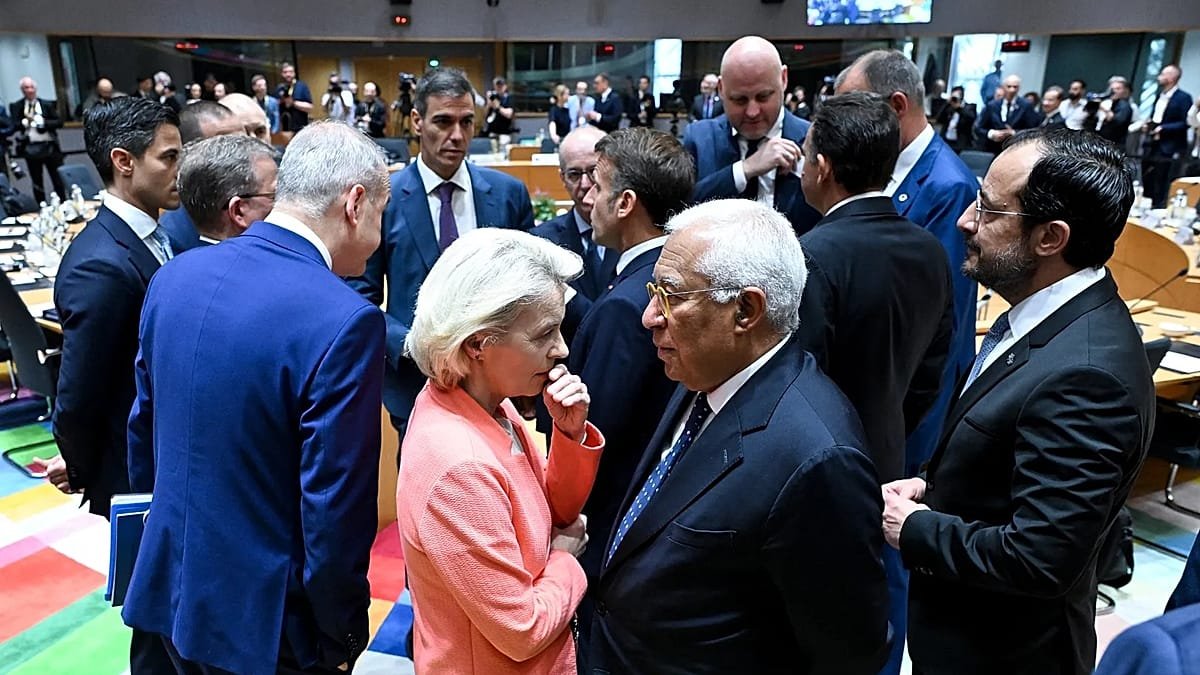
“Europe has already built an extensive toolbox in recent years. Now we must use it more proactively and more strategically to defend our European interests,” she said at a press conference closing this week’s European Council summit.
According to von der Leyen, EU leaders showed unity and clear support for a European response to the current situation, while also stressing that dialogue with China remains crucial.
At the same press conference, European Council President António Costa emphasised that the status quo cannot continue.
“Our strategy is clear: de-risking, not decoupling, while we engage in dialogue,” he said. “But we need to address the challenges we are facing. €1 billion in trade deficit per day is simply unsustainable. We cannot continue to raise these issues without any concrete results.”
Von der Leyen said the diversification instrument would be country-agnostic, focusing on helping European companies in specific sectors de-risk faster, as supply chain diversification has so far been too slow.
According to early media reports, the idea would be to require companies to diversify the supply of critical components from one or two countries, to avoid critical chokepoints that can be weaponised.
The Commission has not specified when the new trade defence instruments will be presented, but several EU officials have suggested the State of the Union, the programmatic speech von der Leyen delivers every September, would be the most likely occasion.
Whether unity holds when push comes to shove remains to be seen.
‘The figures speak for themselves’
Not all member states favour a more aggressive trade policy toward Beijing, which has already threatened retaliation. Germany is heavily dependent on exports to China, while Spain has positioned itself as Europe’s hub for Chinese investment; both are generally wary of provoking Beijing.
As a result, diplomatic sources stressed the importance of keeping dialogue with China open, as commercial relations may become even more important given the erratic behaviour of the US government and its assertive trade agenda.
France, by contrast, has led calls for stronger tools to contain China’s overcapacity and market-distorting subsidies, and suggested the leaders’ summit shows Brussels is taking a harder line on Beijing.
“We want to modernise these [trade] tools, and the Commission now has the mandate to respond more quickly – to say that as soon as there is a suspicion of unfair competition, or when we see positions that pose problems, we must be able to react and protect,” French President Emmanuel Macron said at a press conference on Friday.
Other EU leaders said Europe needs to strengthen its own economic competitiveness, notably by reforming the internal market, and must be ready to absorb the retaliation that would inevitably follow if Brussels imposes serious countermeasures.
“The pressure is high. And if the pressure is high, the instrument will be used, because there is a need for it. The figures speak for themselves, and we have to rebalance them,” von der Leyen said.
Read the full article here