




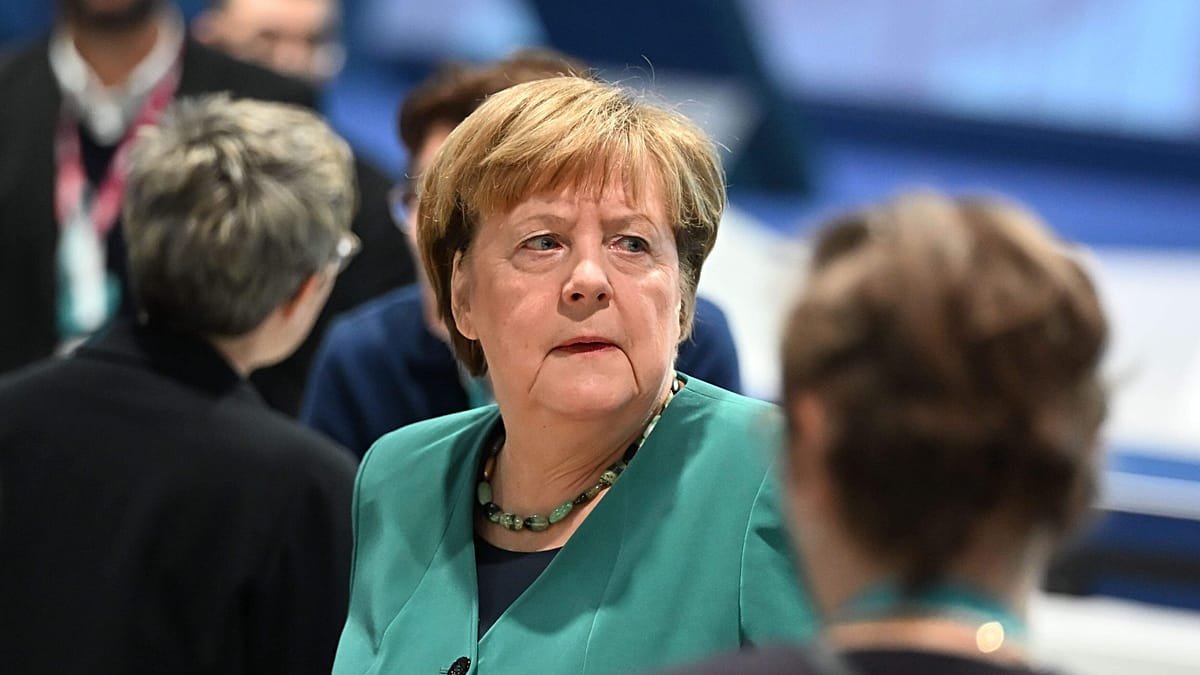
When Angela Merkel receives the new European Order of Merit in Strasbourg this week, the ceremony will not simply celebrate a former German chancellor.
It will render a broader European judgment about an era — and about the kind of leadership the European Union believes it needs in an age of instability.
The European Parliament says the award honours individuals who made “significant contributions to European integration” and to the defence of “democracy and values.”
Merkel was elevated to the highest category of “Distinguished Member,” alongside Volodymyr Zelenskyy and Lech Wałęsa — a symbolic trio linking democratic resistance, European unity, and political endurance.
That choice says much about how Brussels now interprets Merkel’s legacy.
During her 16 years in power, Merkel rarely spoke in grand ideological terms about Europe.
She governed through caution, compromise, and crisis management.
Germans gave her the nickname “Mutti” (Mom) which suggests trust in a quiet way, without drama, but also without experiments.
With Merkel at the helm, people felt assured that the German boat would not be rocked.
Yet, precisely because the EU endured a succession of existential shocks under her watch – the eurozone debt crisis, Russia’s annexation of Crimea, Brexit, Donald Trump’s first presidency, the migration crisis, and the COVID-19 pandemic – many European leaders came to see her as the indispensable stabilizer of the European project.
A judgement even political opponents still consider worth pointing out.
Merkel “made an essential contribution to Europe’s collective handling of crises, including the pandemic,” said Terry Reintke, a German co-chair of the Greens in the European Parliament. “Her successors could learn a thing or two from that approach.”
For supporters, Merkel’s greatest achievement was preserving European cohesion at moments when fragmentation seemed likely.
During the euro crisis, she insisted on keeping Greece inside the eurozone despite enormous political pressure in Germany.
During Brexit, she helped maintain a remarkably united EU front against London.
Under Trump’s attacks on NATO and the EU, she increasingly became the de facto political anchor of liberal Europe.
Her famous declaration in 2017 that Europeans must “take our destiny into our own hands” captured the dawning realization that the transatlantic relationship could no longer be taken for granted.
The award also reflects a distinctly European appreciation for Merkel’s governing style itself.
In an era dominated by populists, strongmen, and ideological polarization, Merkel, who holds a PhD in physics, represented technocratic democracy: cautious, incremental, fact-driven, and institutionally minded.
European institutions – especially the Parliament – see this as part of the EU’s political DNA.
That’s why her fellow Christian Democrat Manfred Weber, chair of the European People’s Party (EPP) called her “a great European”.
Honouring Merkel is therefore also a defence of consensus politics at a time when that model is under strain across the continent.
Yet, the award will inevitably reignite fierce debate over the darker side of Merkel’s record.
Critics argue that her approach often stabilized crises without solving their underlying causes – an approach that was consensus-driven (she always led coalition governments) and made her look like a walking reconciliation committee where her own opinions were often blurred.
“Angela Merkel is a fascinating contradiction: on the one hand, an impressive stateswoman, of rare stature; on the other, a poor legacy for Europe,” said French Socialist MEP Chloé Ridel.
“Nothing was done to build the future and the sovereignty of the European Union. We are paying a heavy price for it today,” she added.
Merkel’s insistence on fiscal austerity during the euro crisis left deep resentment in southern Europe.
At a party event in May 2011, Merkel used Greece, Spain, and Portugal as examples of countries that needed to raise their retirement age and take fewer vacation days to restore economic balance.
These comments sparked widespread backlash, with Greeks, who were already reeling from strict austerity measures, widely expressing frustration at the invocation of the “lazy southern European” cliché.
Her 2015 decision to open Germany’s borders to hundreds of thousands of refugees particularly from Syria, Iraq and Afghanistan became maybe the most polarizing issue for years to come.
On the one hand, supporters saw in Merkel’s decision (“Wir schaffen das” / “We can manage this”) a humanitarian statement of extraordinary leadership in line with Christian faith.
On the other hand, critics accused Merkel of effectively encouraging large migration flows into Europe and then attempted to distribute responsibility across the EU afterward.
The dispute poisoned relations inside the EU for years, intensified East-West divisions over sovereignty and migration and strengthened far-right movements across Europe.
Even Chancellor Friedrich Merz, a fellow Christian Democrat, distanced himself from Merkel’s policy. “In many ways, Germany didn’t manage it,” he said on the tenth anniversary of the decision to open the border to refugees.
Most consequentially, Merkel’s long pursuit of economic interdependence with Russia and China now looks deeply controversial.
Germany’s dependence on Russian gas – symbolized by the Gazprom-backed Nord Stream pipelines – is widely viewed in hindsight as a strategic vulnerability that helped finance the Kremlin before the invasion of Ukraine.
Critics say Merkel underestimated the geopolitical ambitions of Vladimir Putin and prioritized economic stability over strategic resilience – like many German leaders before her.
Her apparent closeness to China and heavy reliance on Germany’s export-driven economy are regarded by some as mistakes of historic proportions.
“We cannot help but think of decisions that, in the medium and long term, proved harmful to the European economy: offshoring, excessive dependence on China, as well as the enormous German trade surplus accumulated under her governments, which helped strain transatlantic relations with the United States,” said Paolo Borchia from the far-right Patriots for Europe in the European Parliament where he heads the Italian League delegation.
The current European push for “strategic autonomy” is, in many ways, a reaction against assumptions embedded during the Merkel era.
This contradiction explains why Merkel remains such a uniquely European figure.
She is admired not because Europeans think she was always right, but because she came to embody the EU’s central tension: the attempt to reconcile peace, prosperity, democracy, and interdependence in an increasingly hostile world.
Even some of her harshest critics like former Greek finance minister Yanis Varoufakis and former Belgian prime minister Guy Verhofstadt concede that Europe emerged from her tenure more unified institutionally than many expected.
The timing of the award is also politically revealing.
Europe today faces renewed uncertainty: Russia’s war against Ukraine, pressure to massively increase defence spending, fears about a second disruptive Trump presidency, and intensifying competition with China.
By honouring Merkel now, the European Parliament is signalling continuity with a political tradition centred on multilateralism, democratic institutions, and European integration — even as the continent shifts toward a more geopolitical and security-driven posture.
In that sense, the ceremony in Strasbourg is about more than Merkel herself.
It is about Europe’s attempt to define what kind of leadership deserves recognition in the 21st century.
The EU is effectively canonizing a leader associated not with charisma or revolutionary change, but with endurance, restraint, and the preservation of the European centre.
Whether history ultimately judges Merkel as the woman who saved Europe through crisis management – or as the leader who postponed Europe’s reckoning with geopolitical realities – remains to be seen.
The European Order of Merit suggests that, for now, Brussels believes her contribution to holding Europe together outweighs the mistakes that became visible afterward.
Read the full article here