




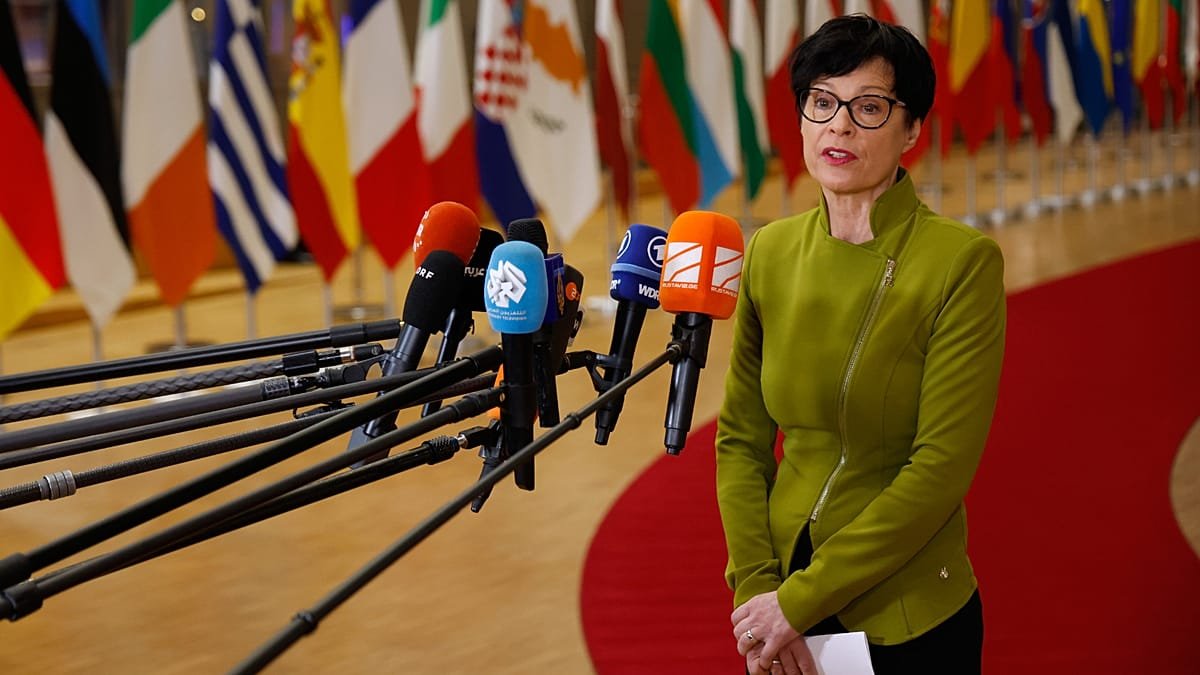
EU enlargement chief Marta Kos on Tuesday previewed the European Commission’s proposal to overhaul the bloc’s enlargement process, outlining plans for gradual integration, stricter candidate vetting and a new methodology as the process enters what she called a new “Helsinki Moment”.
“The world has changed. And enlargement must change with it,” European Commissioner for Enlargement Marta Kos told the Croatian Ambassadors Conference in Zagreb on Tuesday.
In her speech, Kos outlined the main elements of the upcoming pre-enlargement policy review — a long-shelved initiative examining what a European Union of more than 30 member states could look like. The Commission has revived the issue to regain the initiative ahead of a critical discussion among EU leaders in October.
For the Slovenian Commissioner, the EU is facing a new “Helsinki Moment”, referring to the gathering of European leaders in the Finnish capital that paved the way for the post-Cold War “Big Bang” enlargement, when 10 new countries joined the bloc.
She pointed in particular to Montenegro’s swift progress as the frontrunner to join the Union, Albania’s progress in meeting key rule-of-law benchmarks, significant technical advances by Ukraine and Moldova, and Iceland’s vote to resume its accession process.
“The Commission will present its ideas on how the European Union must prepare as candidate countries approach the finish line of accession negotiations,” Kos said. “In my view, we need to address four issues to build consensus at the highest level to welcome new member states.”
Internal reforms
For the EU’s enlargement chief, a larger Union will need significant reforms to remain capable of acting and adapting swiftly in times of crisis.
Importantly, she argues that changes to decision-making processes and institutional arrangements could be introduced without amending the treaties, which would require lengthy negotiations and an unpredictable ratification process among member states.
“We should use this to make decision-making leaner and more flexible. This could also mean reducing the number of areas where a single member state can block everyone else. It could also mean making our institutions smaller,” Kos said.
She also pointed to enhanced cooperation, a legal mechanism that allows a smaller group of EU countries to move ahead with an initiative when other member states are not ready to do so. The mechanism has been used in areas including the Schengen agreement and the euro.
Democratic safeguards
Another element highlighted by the Commissioner is the strengthening of existing safeguards to prevent new members from backsliding on democratic standards and the rule of law — an idea floated by five EU founding members as a lesson from Hungary under Viktor Orbán.
“We need to take it one step further. We must make sure we do not let in Trojan horses. Not today, not in 10 or 20 years from now. Recent experience has shown that stronger safeguards may be required to pre-empt – and, if needed, correct – violations of the fundamental principles and values of our Union,” Kos said.
However, the proposal has proved controversial, as it risks running counter to the EU’s core principle that member states should be treated equally, potentially creating second-tier members.
Montenegro’s EU ambassador, Petar Marković, told Euronews that Podgorica would be favourable to such safeguards, provided they were based on objective criteria assessed on a case-by-case basis.
“Such measures are a must-have, not a nice-to-have. This is crucial to build confidence and unity inside our Union to accept new members,” Kos added, suggesting that stronger safeguards could also ease the ratification process.
Enlargement methodology
Several EU countries, most notably France and Germany, have also suggested that the bloc needs to revisit its enlargement methodology, particularly through “gradual integration” that would offer candidate countries tangible benefits at an earlier stage.
“EU enlargement needs to evolve to respond to the realities of today,” Kos said, pointing out that while the accession process can take decades, the EU’s adversaries could exploit the uncertainty and exert political pressure to derail the process.
“We must therefore move away from an ‘all or nothing’ logic in enlargement. We need a more structured approach to bridge the time we no longer have. We need to look for more ambitious ways of gradual integration,” she said.
The urgency to rethink the bloc’s enlargement methodology stems largely from the start of Ukraine’s accession process, as EU capitals are wary that some form of membership and security guarantees may need to be part of an eventual peace deal with Russia to anchor Kyiv firmly to Europe.
Kos noted that there are already some early benefits that EU hopefuls can reap, such as joining the Single Euro Payments Area (SEPA) and being connected to the bloc’s energy grid. “These are positive steps. But it is not enough,” she continued.
Transitional measures
Finally, the EU’s enlargement chief noted that Brussels needs to understand the impact newcomers will have on existing member states and protect the bloc’s interests against potential risks.
“We have experience with far-reaching transitional measures to make sure the integration of newcomers runs smoothly. And we must make sure that the EU budget can continue to finance our priorities,” she added.
How new member states should be factored into the EU budget is a point of contention among European governments, further complicating the already tense negotiations over the next Multiannual Financial Framework.
Read the full article here