






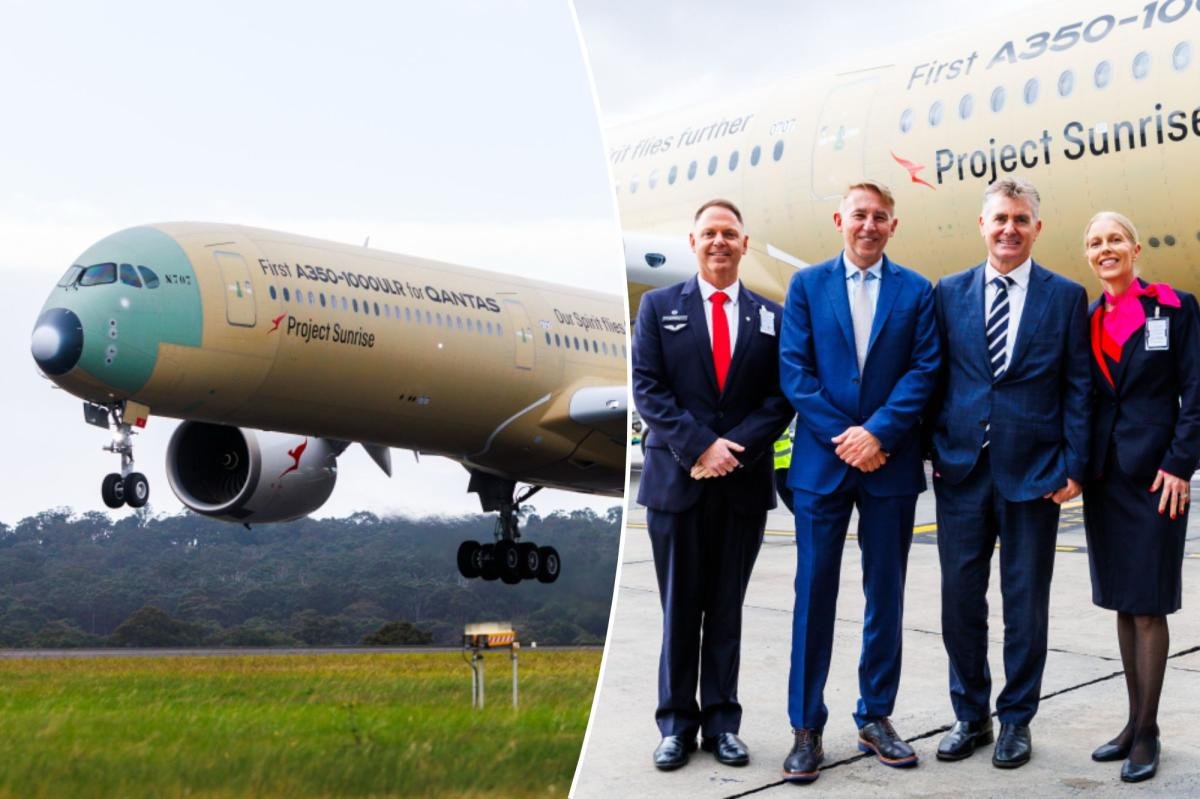
Nine years ago, Qantas challenged Airbus and Boeing to create an aircraft capable of flying from Australia’s East Coast to anywhere in the world, nonstop. Airbus responded by building the A350-1000ULR, outfitted with a fifth fuel tank to enable long-distance flying of up to 22 hours nonstop.
Now, Qantas has announced that this aircraft will be wheels up with the world’s first nonstop flight between Sydney and London debuting in October 2027. Dubbed “Project Sunrise,” a Sydney-New York route is also coming next year.
Along with the game-changing engineering design, the A350-1000ULR will transport 238 passengers across four cabins (including a spiffy first class with six enclosed suites boasting an 80-inch flat bed, a reclining armchair and a flexible work and dining space for up to two people), a new inflight entertainment system available in 15 languages with fast Wi-Fi and Bluetooth pairing.
Wellness is also front and center on the new aircraft.
“Working closely with Charles Perkins Centre over many years, we’ve designed the experience around the science of what the body needs on a long flight, so customers arrive feeling their best,” said Qantas Group CEO Vanessa Hudson.
The new aircraft will have a “wellbeing zone” complete with stretching handles, a digital movement program and hydration station.
“Qantas’s Project Sunrise is one of the most significant developments in commercial aviation because it tackles one of the last true frontiers of scheduled passenger flight: economically and practically connecting almost any two major cities on Earth nonstop,” said Lachlan Hyde, president of the Royal Federation of Aero Clubs of Australia.
As the aviation consultant pointed out, when Qantas first flew Sydney to London in 1947, the journey took four days and seven stops. “Project Sunrise removes the final stop,” he said of the landmark route.
Of course, connectivity impacts tourism opportunities. New Zealand has benefited from relatively strong nonstop access from North America while Australia has historically required many US travelers to endure connections or significantly longer total travel times, said Michael McCormick, co-founder of Travel Again Advisory, based in Washington DC.
“Project Sunrise removes much of that friction for Australia’s largest gateway and makes Sydney substantially more competitive for premium leisure travelers and business travelers alike,” he said, noting that this route won’t erase every advantage New Zealand enjoys, but it narrows one of Australia’s biggest historical barriers: accessibility.
“The most innovative part may not be the distance alone. It is the attempt to make a 19- to 22-hour flight commercially viable, operationally reliable and comfortable enough that passengers actively choose it over a one-stop journey,” said Hyde. “If Qantas gets that right, Project Sunrise could reshape the way airlines think about the world map.”
Read the full article here