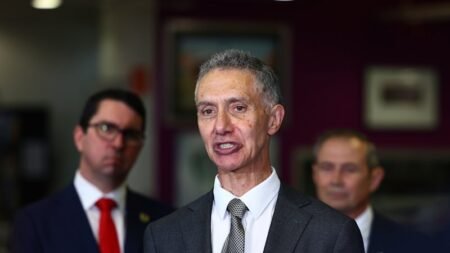





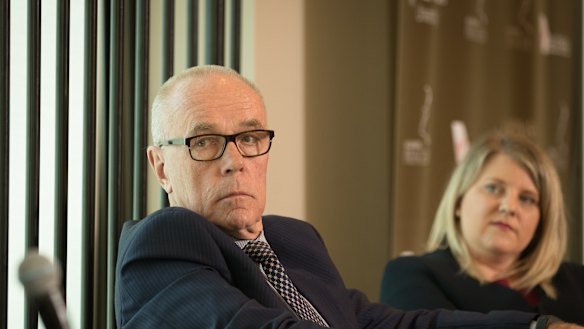
Former Supreme Court judge Lex Lasry has opened fire on politicians and the media in a public speech made just days after leaving the bench, claiming the justice system is being compromised by cynical “performative outrage” and “political theatre”.
It was a significant public intervention in what is shaping up in Victoria to be a potential law-and-order state election in November, with the Allan government under sustained pressure over its handling of street crime, youth crime and bail.
Lasry, a judge for nearly 20 years in Victoria and the Northern Territory, also warned Australia was headed down the pathway of America under President Donald Trump, where the judiciary was being actively undermined by personal attacks and delegitimised of their authority.
“When judges are publicly criticised or vilified, the attacks reveal a problem … They illustrate how thin – or how robust – our commitment to judicial independence really is. If you want to understand a nation’s constitutional character, watch how its politicians speak about its judges,” Lasry said.
“It is important to understand that judicial independence matters because courts are places where rights are protected and power is constrained.”
Lasry delivered his speech at the Criminal Lawyers Association NT conference in Bali last week, just three days after stepping down from the Supreme Court of the Northern Territory.
The speech was originally titled “Separation of Powers: Then and Now”, but Lasry changed it to what he said was “a more appropriate title”: “The Ritualised Art of Shouting at the Scoreboard.”
Having joined the bench in 2007, Lasry sat in judgment on some of the biggest cases in Victoria’s history, including triple child murderer Robert Farquharson, prison gang boss Matthew Johnson and sex killer Sean Price.
As a lawyer, Lasry was involved in controversial cases such as terrorist “Jihad Jack” Thomas, defending Van Nguyen, Andrew Chan and Myuran Sukumaran in foreign death penalty prosecutions, and was junior counsel assisting the Costigan royal commission.
His motive for delivering the critical speech, Lasry said, was his significant concern with “the ever-increasing level of personal criticism – and, at times, personal vilification – of judges” exhibited by the media and politicians.
It was part and parcel of an attempt to make criticism of the judiciary as normal and acceptable as political criticism, he said.
“Media critics of the judiciary and politicians require that judges be in touch with ‘community expectations’ – whatever that means, and however it might be measured,” Lasry said.
This is likely to be interpreted as a shot across the bow for the Allan government, which has sent warnings to the judiciary around community expectations that have been subsequently publicly leaked via the media.
This included a letter from Attorney-General Sonya Kilkenny to the Chief Justice of the Supreme Court Richard Niall around the toughening of bail decisions in March 2025, where she said the judiciary needed to help re-establish trust with the public.
“It is imperative that police, government and the courts are all working together to meet community expectations of what their justice system should deliver and to keep them safe,” Kilkenny wrote.
There have been dramatic changes to the state’s bail laws and the way the justice system manages youth offenders over the past two years, following a spate of high-profile violent crime sprees and sometimes controversial bail and sentencing decisions made by magistrates and judges.
The number of bail breaches soared to nearly 16,900 in the year to March 2026 – up nearly 70 per cent since the government created new offences for committing crimes while on bail – according to the Crime Statistics Agency.
The recently introduced “adult time for violent crime” laws were implemented in part as a response to perceptions that the system was treating young repeat offenders too leniently. As part of the laws, responsibility for handling serious violent crimes moved from the Children’s Court to the County Court.
In his speech, Lasry noted the high-profile example in 2018 when then-federal Home Affairs Minister Peter Dutton blamed a perceived epidemic of street crime in Victoria on “civil libertarians” on the bench, “lily-livered judges and magistrates” who go “weak at the knees”.
More recently, Lasry laid into the comments by Victorian Liberal shadow attorney-general James Newbury, who claimed in April that if Liberals were elected, the system would change.
“Our new judges will know that a Wilson government expects they meet community expectations when it comes to consequences and punishment for serious offending,” Newbury said.
Lasry responded: “Frankly, community expectations have come to mean what angry media commentators want it to mean: heavier sentences as though you can have that view globally.
“Despite what some media commentary suggests, the most important qualities are impartiality and independence, anchored in a commitment to doing justice and properly fulfilling the court’s role in the separation of powers from the parliament and the executive.”
Lasry, who resigned from Victoria’s Supreme Court as a reserve judge in 2024, also had some pointed criticism for the oversight work of judicial commissions – of which he was the subject of an investigation ahead of his decision to step down.
In February 2024, Lasry quit after learning he had been the subject of a complaint by then Victoria’s Director of Public Prosecutions (DPP) Kerri Judd, over the trial of the supervisor at the trucking company involved in the Eastern Freeway case, in which four police officers died.
Judd’s complaint came after Lasry was strongly critical in open court of the DPP’s decision to withdraw charges after lengthy delays and without an explanation to the court.
From our partners
Read the full article here