



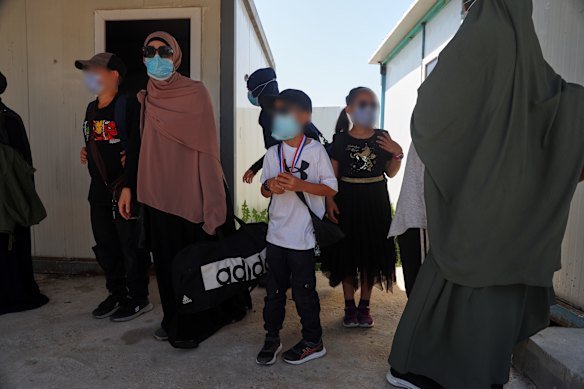
A group of women and children linked to the Islamic State who have been attempting to return to Australia have plane tickets to Australia and hope to depart Damascus within the next few days.
The group, which includes four women and nine children, are all Australian citizens. They left al-Roj camp in north-eastern Syria on Saturday. They had been detained there for seven years following the fall of the Islamic State caliphate.
A source close to the repatriation process confirmed to this masthead that the women and children had plane tickets to Australia and would be flying out of Damascus in coming days.
The source asked to remain anonymous due to the sensitive nature of the situation.
The group intends to get on a plane in coming days but their path home remains uncertain. Authorities in Syria or stopover countries may attempt to block their journey.
The group has been held in the camps since the fall of the so-called caliphate and the death or capture of their husbands and fathers, who allegedly fought for Islamic State.
It comes after Lana Hussein, an official with the women’s protection unit of the Kurdish-led Syrian Democratic Forces, which manages the camp’s security, on Saturday said the four families were expected to be “deported under security procedures”.
This is the second attempt by the group to return to Australia since February.
Their first attempt involved a larger cohort of 11 families including 34 women and children, but they were turned back 50 kilometres down the road.
Distressed at their situation, the mothers said at the time they would willingly go to prison in Australia for terrorism offences if it meant they could get their children out of Syria.
The repatriation of Australians who moved to the Islamic State caliphate last decade has been a headache for successive governments. In recent months, the group’s potential return has fed into a broader debate on extremism and migration settings.
Prime Minister Anthony Albanese and Home Affairs Minister Tony Burke have been trying to balance the country’s obligations to Australian citizens against the risk of being seen to aid people who might pose a security threat due to their involvement with a terror group.
Advocates for the families say many were either children or young women pressured by their husbands at the time they left Australia. But the government has previously said security agencies believed the current cohort contained some particularly radical individuals, making it more risky than groups that had returned in previous years.
In 2022, the Albanese government said it was incumbent on Australia to bring the group home to give them a chance at rehabilitation. Yet this year, at a moment when community attitudes towards migration are hardening and after the Bondi massacre sparked anxiety about extremism, Albanese has taken a more uncompromising approach, declaring the group had “made their bed” and that he would not actively help them to return.
Labor frontbencher Mark Butler said on Sky News’ Sunday Agenda: “If they manage to get to Australian borders and they have committed any crimes, they will be met by the full force of law at those borders.”
Opposition Leader Angus Taylor, who has spoken regularly about the need to “shut the door” to extremists, on Sunday said Labor must make “every possible effort to not accept these people back into the country”.
“It’s clear that they have been providing assistance, whether it’s through issuing and distributing passports, whether it’s doing DNA tests,” he said, also pointing to Home Affairs Minister Tony Burke’s relationship with Dr Jamal Rifi, one of the most prominent advocates in the campaign to bring the families home.
Burke’s office declined to comment on this story.
Taylor questioned why the government had used its powers to block the return of only one member of the cohort. However, the Liberal leader ducked questions on whether he trusted Australia’s security agencies to provide appropriate advice on which people should be blocked.
The group would not be the first to be repatriated from Syria.
The Morrison government brought back eight orphans and one newborn in 2019. In 2022, the Albanese government repatriated four Australian women and their 13 children to Sydney, sparking criticism from political opponents.
Dr Rifi, who helped facilitate the group’s first attempt at returning, has previously said Australia would be “safer if the families can return in an orderly fashion to our shores, where the children may receive proper support”.
“Children should not suffer the consequences of a parent’s evil deeds,” he wrote at the time.


From our partners
Read the full article here