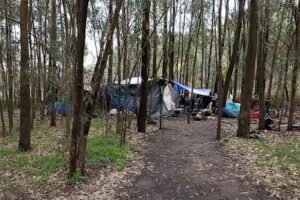



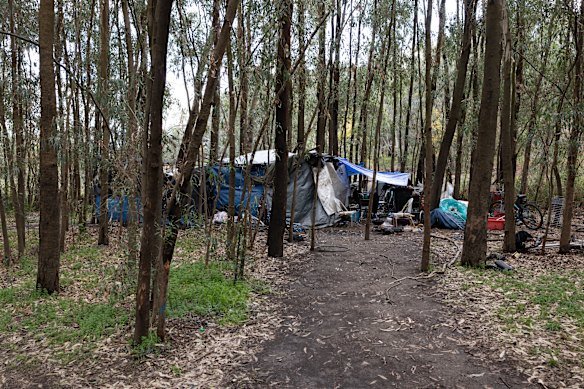
The 37-year-old mother lay at her camp next to the river, her labour rapidly progressing. Rain pattered around her, falling on the blue tarp she and her partner had set up around their campsite in the NSW Riverina.
She was giving birth to twins in the makeshift home she had been living in for more than five months along the Murrumbidgee River, her belongings scattered on the dirt near a princess play tent.
It was not her first birth, though her other children were not living at the camp. She was known to Wagga Wagga social services and had previously held tenancies with Homes NSW.
As her partner dialled triple zero, a neighbour rushed from a nearby tent to assist. Paramedics arrived at 4.20pm, navigating a dirt path to find one newborn dead and a second in a critical condition. Locals whose apartment building overlooks the camp say they saw a paramedic carrying the surviving infant wrapped in a white bundle.
The second newborn and the mother were both taken to Wagga Wagga Base Hospital. The newborn has since been transferred to a Sydney hospital and is now in a stable condition. The mother left the hospital on Monday.
A report will be prepared for the coroner, who will investigate if it is found that the baby was alive at birth. Police believe there are no suspicious circumstances.
The Herald has chosen not to name the woman or her partner.
The news left residents of the riverside camp rattled. There are nine people living along the riverfront. One resident said the couple were quiet and friendly but mostly kept to themselves. He said the man who had helped deliver the baby came to his site after paramedics left and was “completely in shock”.
“He had tried to do his best,” the resident said.
The news sent shockwaves throughout Australia. Many have asked how such a wealthy country could allow a woman to give birth in such terrible conditions.
Neighbours warned of ‘squalid’ conditions
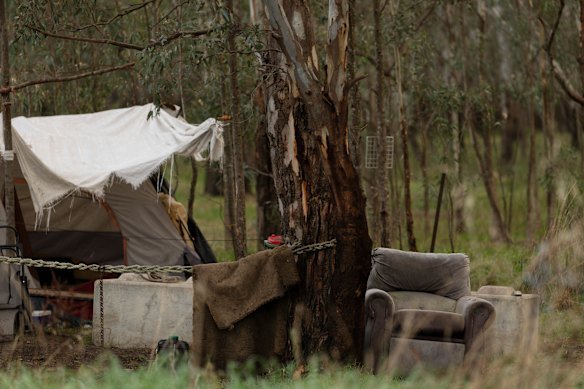
Locals knew about the squalid conditions at the makeshift camp where there is no toilet, no onsite running water and little alternative to sitting household items in the dirt. Social workers frequented the camp conducting outreach, and the tent cities were frequently brought up in council meetings.
Neighbours had watched the camp grow to nearly a dozen people. Just days before the fatal birth, residents had written to the council, complaining about the campers yelling, defecating, and using their water by hanging a hose over the fence into the campsite.
Two residents told this masthead they’d called police about violent behaviour, including domestic violence.
Camp residents spoken to by this masthead said they tried to remain peaceful, hosting campfire nights to work through issues.
Jeff Donlon’s apartment overlooks the riverfront. The nearest toilets are a few hundred metres away, there’s no rubbish collection, and one of the camp residents has developed a brutal, hacking cough. “It’s worse than a refugee camp,” he said.

He is urging the council to add sanitation measures until the campers can be found long-term accommodation.
Marathon Health general operations manager Kylie Falciani, who oversees outreach in the Murrumbidgee region, said staff visited the Wagga homeless camps, caravan parks and shelters weekly to offer referrals and support.
She said these vulnerable communities could be hesitant to engage with services, due to previous trauma or poor experiences, or concerns about being taken into a psychiatric facility or having children taken away from them.
“Some people do not want to engage, and that’s their choice,” she said. “We can’t force people to go to the hospital without their consent. That’s a simplistic view. At the end of the day, that is kidnapping.”
Falciani confirmed the 37-year-old mother would not have been a client of Marathon Health but that she may have been referred by staff to other services that offer prenatal care.
It’s understood the mother had declined to engage with housing, health and social services programs.
A surge of rough sleepers
Wagga Wagga is facing a surge in rough sleepers, fuelled by record-low rental vacancies and a cost-of-living crisis. In January 2025, the council recorded over 250 people sleeping rough. With a seven-year social housing waitlist and nearly 700 people seeking homes, tent cities have become semi-permanent fixtures.
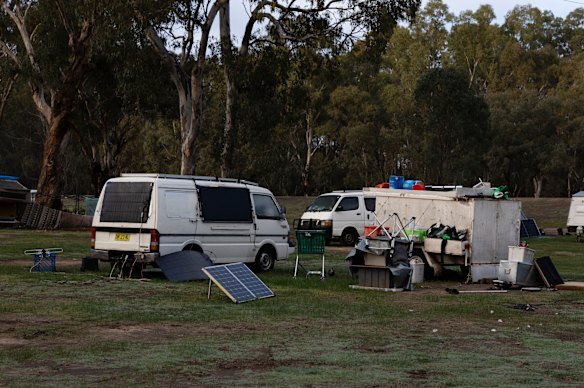
Mia* lives at Wilks Park campground, less than a kilometre from the riverfront camp, where about two dozen residents have set up in the campground.
Camping is supposed to be limited to 72 hours but many residents have been there for more than a year, with solar panels, gardens, and armchairs set up around their structures. The council faced heavy scrutiny when it last evicted residents in 2022.
At 19 years old, Mia is one of the youngest residents. She arrived a few weeks ago from near Sydney.
Mia lost her hospitality job and her rental after breaking her wrist in a motorcycle accident, and is fleeing domestic violence. She chose Wagga Wagga because she heard it was a place where she could safely camp. She’s on the social housing waitlist.
“They said it’s going to take a couple of years for housing,” Mia said. She’s now trying to save up enough money for a deposit from her Centrelink payments to rent a place on her own.

“It’s not as bad as it seems,” she said. “We have a fire most nights, and we all know each other.”
Many of the women in the camps are mothers, and children visiting or staying overnight is not uncommon. Several residents said their children had been removed by child services after setting up at the camp.
Pregnancy is also a common topic. Mia’s camp mate, Rina, recently took a pregnancy test. She said she knew if she fell pregnant again, departmental services would get involved.
Social services frequent the area, but with a lack of brick-and-mortar homes, there are few long-term solutions. While temporary or transitional housing, including stays in hotels and motels, is available through Homes NSW, these are often offered on a weekly basis, and residents must contribute financially unless they are escaping domestic violence and have a support plan.
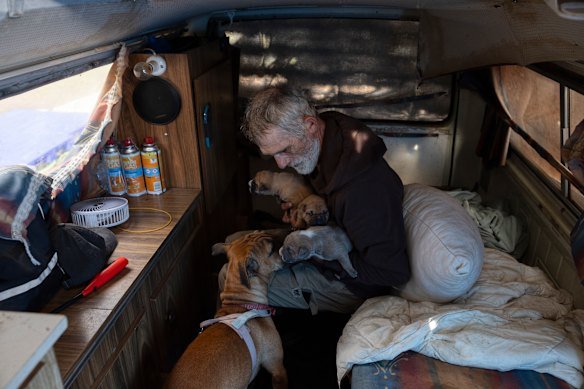
John Bryce, who has been living in the camp for more than a year, said he wasn’t on a waiting list for social housing because there was nowhere that could accommodate him, his four dogs, and the seven puppies recently born.
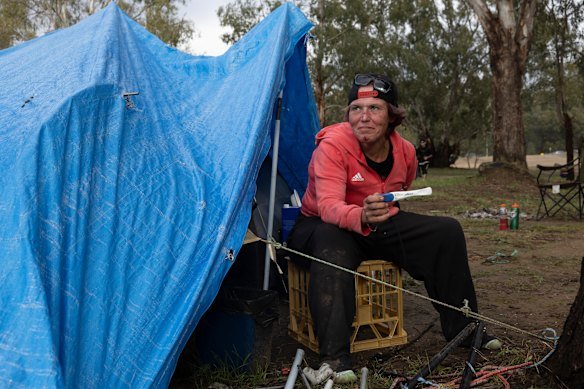
“The workers come and ask if I need a place, but when I ask them about my dogs, they go quiet,” he said.
He would like to find somewhere more permanent – his caravan sprung a leak following heavy rain over Christmas, causing mould to proliferate and forcing him to move into a smaller campervan – but he doesn’t have a car and can’t afford registration or insurance.
Some at the camps live with substance abuse and mental health issues, and others are stuck in the cycle of poverty, unable to find secure work without secure accommodation or transport. Others said they lived transitionally by choice, choosing a grey nomad lifestyle to avoid debt.
Community urge action
The riverfront camp, Wilks Park campground and a third tent city at Oura Beach have been a prominent point of discussion among residents and local politicians for months.
While the issue isn’t unique to Wagga Wagga, city councillors said the issue had surged in the past year and was set to worsen as a new prison facility, inland rail, and projects at the nearby defence base brought in more workers and their families looking for homes.
Vickie Burkinshaw is the president of Wagga Women’s Health Services, a drop-in crisis service where women can access showers, laundry facilities, counselling and physical therapy.
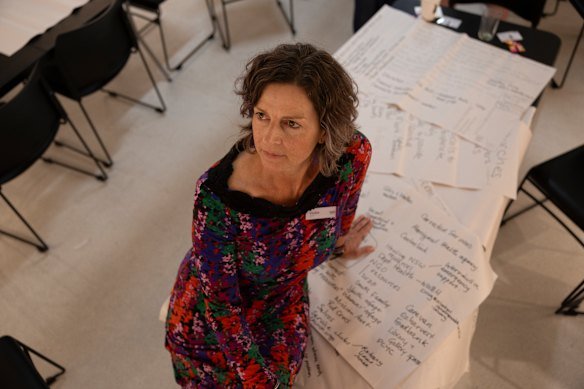
The centre had 700 new clients last year and about five new women come in each week for crisis services. It has 60 women on its waitlist to access counselling.
“It shouldn’t have come to this,” Burkinshaw said. “It shouldn’t have taken a death to get to this level of emergency because it’s been on a slow boil for years.”
Councillor Richard Foley said he had been warning for more than a year that the homeless crisis and camps were a disaster waiting to happen.
“I warned there’d be a death, but I never thought it’d be something like this,” he said.
Earlier this year, he requested a report from the council on the number of people sleeping rough in Wilks Park, which has not yet been released.
NSW Premier Chris Minns convened an emergency working group on Thursday, meeting with member for Wagga Wagga Dr Joe McGirr, mayor Dallas Tout, and Housing and Homelessness Minister Rose Jackson.
“It was a productive meeting that allowed us to come up with an immediate plan to support those people currently camping at Wilks Park and along the Murrumbidgee,” Minns said.
Jackson said her thoughts were with the parents and their newborn.
“This tragic death is a timely reminder that we must all double our efforts to look after the most vulnerable among us,” she said.
“The death of any member of our homeless community is tragic, but the death of a newborn baby is beyond comprehension.”
Wagga Wagga is a priority area for “renewal and delivery of new social housing”, the NSW government said.
*Name changed for privacy.
Start the day with a summary of the day’s most important and interesting stories, analysis and insights. Sign up for our Morning Edition newsletter.
Read the full article here