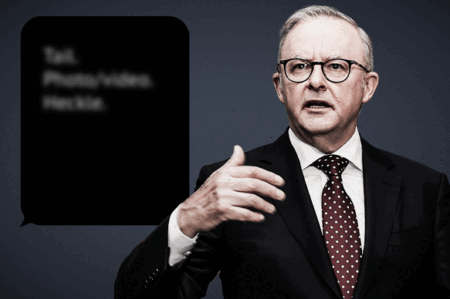






It’s 11am, bleak and eight degrees outside. A classroom packed with year 9 boys is asked what their biggest fear is.
“Women,” one student volunteers, “because they are mean.”
The answer lands in The Man Cave session, a male-focused mental health charity, with awkward laughter, but the subtext is heavy.
Australian schools are facing a “crisis due to rampant misogyny and sexism” fuelled by online influencers, with educators struggling to tackle it, experts say.
Cyber Safety expert Susan McLean said that while there are some amazing young men in schools, there is also a subculture where women and girls are sexualised and treated as possessions, and where boys see themselves as superior.
Many of these ideas are propagated via the “manosphere” – an online space of male-centred content that ranges from self-improvement and gym routines to endorsing gender stereotypes and promoting violence against women.
McLean says many schools – both public and independent – aren’t well-equipped to tackle it.
Melbourne primary school teacher Ruby*, who asked to remain anonymous, said she was subjected to months of physical abuse and sexual harassment from male students aged between just five and 13 years old.
“I was punched [in the crotch], slapped, groped, told sexual fantasies about what I did to them in their dreams; some said they could smell fish when I walked past,” she said.
Ruby, who is fighting a WorkCover claim, said she believes some of the behaviour was due to students consuming “manosphere” content, but that students’ home environments also played a role.
Misogyny in schools has become so widespread, Australian Education Union deputy federal president Matt Jarman said, it has become a key reason that some female teachers are leaving the profession.
“Education departments need to address this growing issue with clear policies, adequate resources and strong leadership to confront misogyny and ensure schools are safe and respectful places to work and learn.”
Data compiled exclusively for The Age by the Crime Statistics Agency found that in the past 10 years, at least 35 allegations of rape were reported and 198 alleged indecent assaults at school or reported by schools where the alleged offender was between 10 and 17 years old.
A Victoria Police spokesperson said the data included schools reporting sex offences whether they occurred on its grounds or elsewhere. Police proactively visit schools to provide advice on the law and safety, including consent.
While the data doesn’t show the gender breakdown of alleged offenders, Monash University lecturer Stephanie Wescott says research shows that males perpetrate the most sexual harm.
“We have a cultural issue in schools, and I think schools are the best place to do this work because that is where young people spend most of their time,” she said.
Wescott also said teachers found that anecdotally, the schools’ “crisis due to rampant misogyny and sexism” was causing a decline in girls’ attitudes to school.
“If you are a girl student sitting in a classroom, and you are seeing a [female teacher] … and see how they are degraded, that sets up an expectation for you in how you might be treated in your lifetime.”
Though the federal government’s social media ban is well-intentioned, Leeson Timms, a facilitator for The Man Cave, calls it a “band-aid over an open wound”.
Timms himself was lured into the manosphere when he was in year 11, at the height of the pandemic.
“It snuck in without me realising it,” he said.
Timms said that before his partner helped him realise how harmful the content he was watching was, it resulted in destructive behaviour towards people in his life. For children, he says the combination of manosphere content and boys observing how “dad talks about mum” can have dire results, he said.
“Boys are swimming in a pool, looking for something to hold them afloat.”
Since becoming a facilitator, Timms has run almost 250 school workshops, and says about two out of every three elicit a disclosure of suicidal ideation from a male student.
At a recent full-day relationship session, facilitators worked quickly to suss out the dynamics of the group of 27 teenage boys.
Initially, there was jostling and cackles, but by the end of the day, the year 9 boys had connected and opened up. One talked about how they were struggling since their dad had died, while another boy shared for the first time he wanted to kill himself.
Timms said boys needed direction, positive male role models, counterarguments, education about healthy masculinity, and ideally, changes to social media.
“If there’s a world where there’s a possibility to change algorithms, that should be the step,” he said.
This is something the advocacy group Teach Us Consent is calling on the Australian government to investigate, saying that algorithms – which largely dictate the content we are exposed to online – are creating a “pipeline for extreme misogynistic content”. They want laws that will “fix our feeds” by introducing an opt-in feature for algorithms.
“This has real consequences offline, both for victim-survivors of sexual violence and for the boys being fed this material,” a Teach Us Consent spokesperson said.
If you think your son is engaging with manosphere content
Youth advocate and educator Daniel Principe recommends:
- Stay curious, not confrontational: Ask about what he’s watching and ask him to show you. Ask him what he finds interesting about it rather than criticising it straight away.
- Don’t shame or ridicule him: If he feels judged, he’s more likely to retreat further into the online communities reinforcing the beliefs you may be hoping to counter.
- Listen for the underlying need: Most boys aren’t chasing misogynistic ideas. They’re chasing confidence, belonging, success or advice on relationships they might not be getting.
- Talk about healthy masculinity and being a good human: Help him see that strength, decency and respect for others aren’t opposites, but that they can all coexist.
- Make critical thinking a conversation, not a lecture: Ask what a mate would actually say about the content, or how we can know if someone online is helping or manipulating us.
- Make sure he’s got other people to look up to: Coaches, mentors, older siblings. People who model respect and accountability in real life, not just online.
- Keep the conversation going: One calm chat beats one big argument every time. Most of this is curiosity, but if you’re seeing escalating anger, isolation, content for women or rigid “us vs them” thinking, don’t ignore it.
- Get support early from someone your son already trusts: Curiosity and connection are key.
Cyber safety expert Susan McLean says Respectful Relationships, a whole-of-school program aimed at preventing gender-based violence, needs to be updated at least yearly due to the rapidly changing nature of online culture.
“People can argue it’s [just] a parent’s job,” McLean said. “Everyone has to work together.”
In Victoria, the state government has invested $129 million to deliver the whole-of-school Respectful Relationships program in schools, while a further $10.4 million allocated in the most recent budget will expand the program to over 400 schools.
More independent and Catholic schools have been signing up, but Wescott says there were very few “who have been willing” to implement the whole-of-school approach, which is what evidence says is the most transformative.
For change to happen, she said, schools needed to admit there was a problem with misogyny. “We are afraid of saying that because it implicates boys.”
Tintern Grammar head of junior school principal Adam Kenny uses a whole-of-school approach and says gender equality isn’t a box to tick at the Ringwood East school, but rather something that is embedded in every element.
“It’s living and breathing it, and guiding and supporting and mentoring and rectifying immediately when mistakes are made,” he said.
UNSW lecturer Alex Fleck says Australia could learn from Brazil, where an anti-misogyny bill that could send people to jail is being considered.
Modelled on existing anti-racism legislation, the proposed bill would make engaging in violence, inciting violence, or restricting a woman’s rights or dignity could result in a two- to five-year prison sentence, and rise to a sentence of three to 10 years if posted online for profit or by someone with a large following.
“I don’t think that it is a stretch to say that the latter circumstance of the offence is aimed at combating manosphere online influencers,” Fleck said.
But he believes reform works best when built with communities it’s meant to protect, rather than just copying the same law.
For primary school teacher Ruby, the schoolyard misogyny will stay with her.
“Imagine trying to teach someone how to read and write while being physically assaulted,” she said. “I’m never going to be able to work full-time again as a teacher.”
If you or someone you know is experiencing violence or abuse you can call 1800RESPECT or visit 1800 Respect. Help is also available via the Kids Helpline on 1800 55 1800 and Lifeline on 13 11 14.
Start the day with a summary of the day’s most important and interesting stories, analysis and insights. Sign up for our Morning Edition newsletter.


From our partners
Read the full article here