





Sanjeev Gupta is a puzzle. He is certainly a world-class salesman. On that let’s all agree. It is how he managed to borrow so much money, how he came to be a billionaire and how he persuaded so many decent people to share his vision.
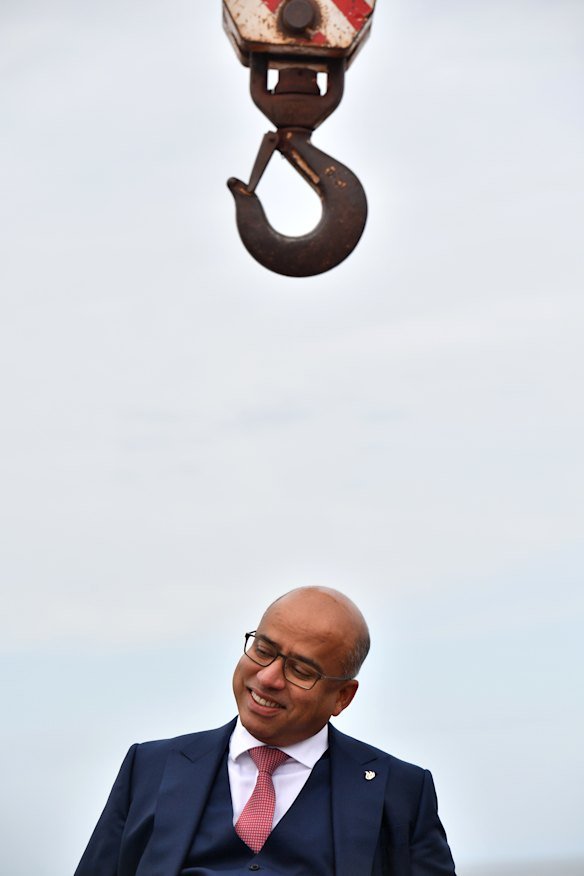
But surprisingly, the silver-tongued steel tycoon is no brash fairground spruiker. He is a shy man, an introvert: quiet and softly spoken. Picture a besuited Dr Evil in the Austin Powers comedy movies and you’ll get a fair idea of what he looks like. Although Gupta, of course, was promising to save the world and not destroy it.
Naturally, he loved money and expensive toys. But those who observed him from up close believed he was driven by a craving for attention and the thrill of the deal. He was an outsider who wanted to be on the inside and be accepted into the Establishment.
The people who liked him said he was smart, generous, likeable, loyal and sincere. Some even called him a visionary. But many saw a less attractive side. One former executive described him to me as “the most selfish man I’ve ever met”. A second who knew him well branded him a narcissist. A third said he wouldn’t believe anything that came out of his mouth. Yet all agreed he had world-class charm, if he chose to turn it on.
So what do we know of his formative years? Before the luxury homes in London, Sydney and Dubai? Before the private plane and helicopter, a yacht in every port and a slew of offshore companies and trusts to keep his baubles safe? Before he was hailed as the “Saviour of Steel” for rescuing South Australia’s famous Whyalla steelworks. Before all of it – the worldwide business empire built on billions of dollars of Other People’s Money, and the disaster waiting to happen north of Adelaide?
Sanjeev Gupta was born in India in 1971 and spent his childhood in the Punjab, in the industrial city of Ludhiana, often known as the Manchester of India. His father, Parduman (“PK”) Gupta, was a self-made man who left school at 11 and started out selling nuts and bolts before making his fortune manufacturing Victor bicycles in India and trading commodities in Nigeria.
Gupta was the third of four children, who, according to his big sister Anjali, was always trying to prove himself. “You know, he sometimes needed more attention,” she told the BBC in 2016, “but he was very driven, very ambitious … He was a very quiet child, and he wouldn’t want to talk to people.”
On Anjali’s account, Gupta was wilful and determined. At the age of 11, he convinced his seven-year-old brother to run away from their exclusive boarding school at Shimla in the Himalayas, which they hated, and catch a bus back home, six hours away. “They gave us a shock of our life because they had to check into a hotel overnight,” his sister recalled.
Four years later, as Sanjeev was turning 15, he persuaded his father to send him to one of England’s most expensive boarding schools, St Edmund’s Canterbury, where his elder brother Raj was already a student. Coming into fifth form when most of his classmates had already chosen their friends, he was younger than most and was small, chubby, quiet and shy.
“He wasn’t bullied but he was certainly teased,” says one old schoolmate, who is now a successful businessman. “He had a bit of an accent. One boy called him De Gupita Singh and would chant the name at him, laughing.”
At the start, Gupta was homesick and missed his mum and dad. He slept in a big, cold, chapel-like dorm with 50 other boys, one of whom recalls the 15-year-old crying in his sleep. And while life at St Edmund’s wasn’t quite as brutal as Rugby School in that famous Victorian novel, Tom Brown’s Schooldays, it was certainly a tougher environment than would be tolerated today. Sixth formers would come into the dorm during the night and “lamppost” the beds, tipping them up on their ends with the occupant inside. Another random punishment was the Boko, a painful knuckle to the head. And a third was the “yellow card”, which obliged a boy to report 10 times a day to prefects, so they could check that the victim’s shirt, tie and uniform were in perfect order.
Gupta survived this thoroughly British institution but didn’t leave much of a mark. He never scored a mention in the school magazine, was not in any teams, had no interest in sports and was certainly not in the cool group or in-crowd.
But he was smart enough for his classmates to plagiarise his homework. And his tuck box remains famous to this day. It was full of goodies like cold tandoori chicken that Gupta could sometimes be persuaded – or perhaps pressured – to give away.
What does that tell you? Was he being kind and generous by doling out these treats? Was he trying to buy friends? Or was he just being stood over by the bigger, stronger boys? Perhaps this was young Gupta’s Rosebud moment: the key to understanding what drives him on.
For 20 years after his stint in school, Gupta made a fortune trading commodities in London and Dubai. Then in 2013, he started four years of frenzied buying, acquiring almost two dozen ailing steelworks and aluminium smelters in Britain, Europe, the United States and Australia that had been pushed to the brink of bankruptcy by cheap Chinese steel flooding the world market.
Everywhere he went he was hailed as the “Saviour of Steel”. Politicians loved him, as did the workers whose jobs he was saving. In 2017, he set his sights on the steelworks at Whyalla. It was in the hands of administrators and in danger of closing for good. There, in the industrial town on the Spencer Gulf, he received a hero’s welcome.
Dressed in a dark blue three-piece suit in 30-degree heat, Sanjeev Gupta was piped up Whyalla’s main street by a bagpiper in a kilt, at the head of a parade of politicians and steelworkers waving flags. It was no wonder they loved him. He was saving not only thousands of jobs, but the very town that he said had “adopted” him. He even called the place his “spiritual home”.
That September 2017 night there was a party for the steelworkers and staff down on the foreshore, with Indian dancing and a huge fireworks display – the biggest Whyalla could remember. Gupta and his kids were right in the thick of it all, as was his wife, Nicola, who was happily bumming cigarettes off the locals.
Natalie Hyde, whose partner Shane Karger was then an Australian Workers’ Union delegate at the steelworks, was impressed. “They seemed down-to-earth and real,” she told me. “We were hearing he had saved the Scottish steel plants, and everyone was encouraged to see him as a white knight.”
He threw generous parties for politicians, stockbrokers and B-list celebrities, with pink champagne on tap … but [they] were by no means his only extravagance.
Gupta was so impressed by the warm reception that he said he would buy a house in the town: one of many promises he would ultimately fail to keep. Yet he did go some way to keeping his word, because he also announced he would now abandon his mansions in Wales and Dubai and move his family to Sydney to set up a home. He had brought Nicola and the children with him to Australia to enjoy a four-week holiday and had broken the news on the plane that they would not be going back.
“She looked at me like I was joking,” he later told The Australian, “but she knew I wasn’t. She rallied everyone to persuade me otherwise, but of course I won, as I always do.”
His arrival in Australia’s harbour city caused a stir in the business community and in Sydney’s status-conscious eastern suburbs, where many were keen to befriend the British business guru. As his profile rose, he threw generous parties for politicians, stockbrokers and B-list celebrities, with pink champagne on tap and invitations to “Meet the Guptas”. A garden party under white marquees, arranged at a moment’s notice to celebrate Harry and Meghan’s royal wedding, had then-prime minister Malcolm Turnbull among the guests. Another, reportedly, had a sit-down dinner for 200 revellers.
But the parties were by no means his only extravagance. A few days before Christmas 2017, Sanjeev bought Maya, a 30-metre motor yacht, in time to host a New Year’s Eve party on the water. With teak decks, wenge flooring, a mirrored stateroom and aft cockpit bar, it was a stunning boat with a $5 million price tag.
Only later would it emerge that his big boat was owned through an Isle of Man company called GFG Marine and registered in Jersey, effectively paid for by the good folk of Whyalla, with the bill picked up by the company that owned the steelworks, OneSteel Manufacturing.
Gupta spent the next seven years building this house of cards while promising to transform Whyalla – to make it a world leader in low-emission “green steel”. He would build a “mega” steelworks, 10 times the size of the existing plant, powered by Australia’s largest solar farm. He would scrap the ancient coal-fired blast furnace and install an electric arc furnace, plus a direct reduction iron plant using “green” hydrogen.
Instead, he siphoned hundreds of millions of dollars out of his Australian businesses and pushed suppliers to the brink of bankruptcy. It finally caught up with him in 2025, as his worldwide steelmaking empire imploded under the weight of billions of dollars of debts. Gupta was left desperately shuffling money between his private companies in an attempt to keep his creditors at bay, all the while declaring that -everything would turn out fine. But everyone had stopped believing.
With his dreams in ruins and his promises unfulfilled, the good folk of Whyalla were left wishing they had never set eyes on him. With hundreds of millions of dollars owed to creditors and local businesses pushed into bankruptcy, Gupta’s employees, suppliers and political backers told him, bluntly: “Pay up or piss off.”
He was kicked out of Whyalla by the South Australian government, and almost all his companies around the world went bust, leaving debts of around $8 billion. And it was not just Australia giving him the bum’s rush; the Whyalla story was playing out in a dozen different theatres in a dozen different countries, with the plot always the same: angry creditors, broken promises, shattered dreams and employees fearing for their future.
The fast-talking entrepreneur, however, is still rich, and free, and has based his family in Sydney. But his world-class charm, infectious optimism and remarkable ability to inspire his followers – if they even still exist – are no longer enough.
Investigators are pursuing him worldwide. Gupta is being investigated by the corporate cops in at least four countries – the United Kingdom, France, Romania and Australia – for possible crimes that include, as Britain’s Serious Fraud Office put it, “Suspected fraud, fraudulent trading and money-laundering in relation to the financing and conduct of the business of companies within the Gupta Family Group …”
Perhaps the biggest question left to answer now is, “How did he lead the world on such a merry dance for so long?”
This is an edited extract from The Big Steal: How Steel Tycoon Sanjeev Gupta Fooled Australia and the World, by Paul Barry (Allen & Unwin, $37), out August 25.
Get the best of Good Weekend delivered to your inbox every Saturday morning. Sign up for our newsletter.
Read more from Good Weekend magazine:
Get the best of Good Weekend delivered to your inbox every Saturday morning. Sign up for our newsletter.
Read the full article here