




Published on •Updated
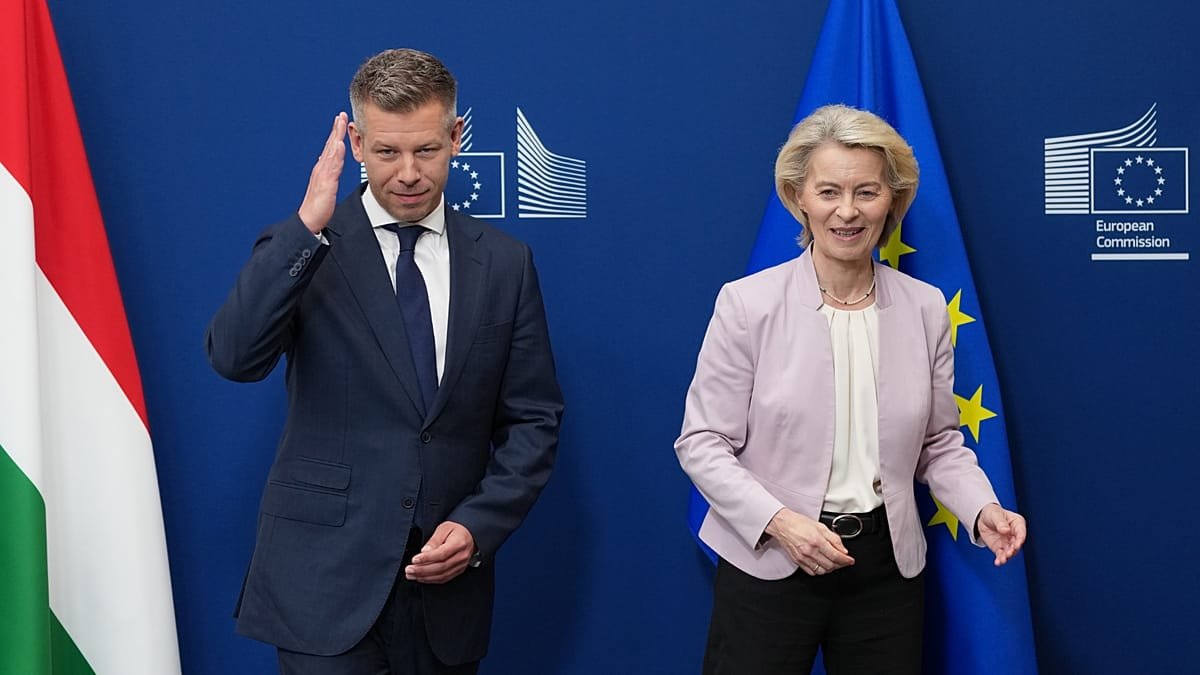
Hungarian Prime Minister Péter Magyar sealed an agreement on Friday with European Commission President Ursula von der Leyen to unblock nearly all recovery and cohesion funds earmarked for Hungary, allowing the government to access the full €16.4bn that had been frozen under the previous administration.
Praising Magyar for forming a government “in record time” and advancing what she described as “long-overdue reforms” within just a few weeks, von der Leyen said €10bn would be released from the bloc’s post-pandemic Recovery and Resilience Facility.
“I think the hard work has really paid off now,” she added.
She also announced the release of €4.2bn in cohesion funds, along with a further €2.2bn from a separate tranche within the same cohesion funding envelope.
Magyar won April’s general election, bringing an end to Orbán’s 16-year rule. The funds had been suspended by Brussels during Orbán’s tenure over concerns related to corruption and the rule of law.
“Three weeks was enough to do what Viktor Orbán could not achieve in three years,” Magyar told reporters, adding that “we fought for the full amount.”
Hungary must still meet conditions, known as super-milestones, to complete the payment.
A complex set of criteria to disburse the money
Magyar outlined several plans for the money—equivalent to 13% of Hungary’s GDP—including modernising the country’s energy grid, railways, and rental housing. The government plans to allocate €4.2bn to transport infrastructure, healthcare, and small and medium-sized enterprises; €2.2bn to education; and €1.5bn to upgrading the electricity grid.
Budapest and Brussels also agreed on a timeline for the legislative steps required.
If Hungary fails to meet the 27 super-milestones linked to the recovery funds, parts of the funding could be lost. Measures include joining the European Public Prosecutor’s Office, strengthening the Integrity Authority, revising public procurement rules, and phasing out public-interest foundations.
“This is a very strong political signal. We also know that we have a great deal of work ahead of us — we need to pass a lot of legislation,” Magyar said.
Hungarian students will also be able to participate in the EU’s Erasmus+ exchange programme from the next academic year.
Hungary is waiting for “guarantees” on Ukraine minority rights
Magyar also addressed Ukraine’s EU accession process, which Hungary had blocked under Orbán. He rejected suggestions that the release of EU funds was conditional on lifting that veto.
“There was absolutely no link between the unfreezing of the funds and the opening of the first chapter of the Ukraine talks,” Magyar said.
He reiterated that Hungary’s condition for lifting the veto on opening the first negotiating chapter is the resolution of educational and language rights for the Hungarian minority in Ukraine, set out in an 11-point list. Technical talks between the two countries are ongoing.
“I really hope that we will be able to conclude these 11 points soon and that the Ukrainian side can give a guarantee that they will implement them into their legislation within a few months” he added.
Magyar’s remarks suggested Budapest would not wait for Ukraine to amend its minority legislation and would instead accept formal guarantees.
Magyar softened his tone on the Migration Pact
Magyar struck a notably softer tone on the EU’s migration pact than he had during the election campaign, when his Tisza Party opposed the new legislation.
The prime minister did not rule out compliance and noted that Orbán himself had approved the pact, which is binding on all member states.
“There are many tough measures in this migration pact. At the time, Orbán was right about its weaknesses and shortcomings. In many areas it had to be changed, and the protection of external borders was strengthened” Magyar said.
Magyar also noted that under Orbán, Hungary had released 2,200 people-smugglers owing to prison overcrowding, and said his government was prepared to build new facilities to house both smugglers and corrupt politicians.
Read the full article here