






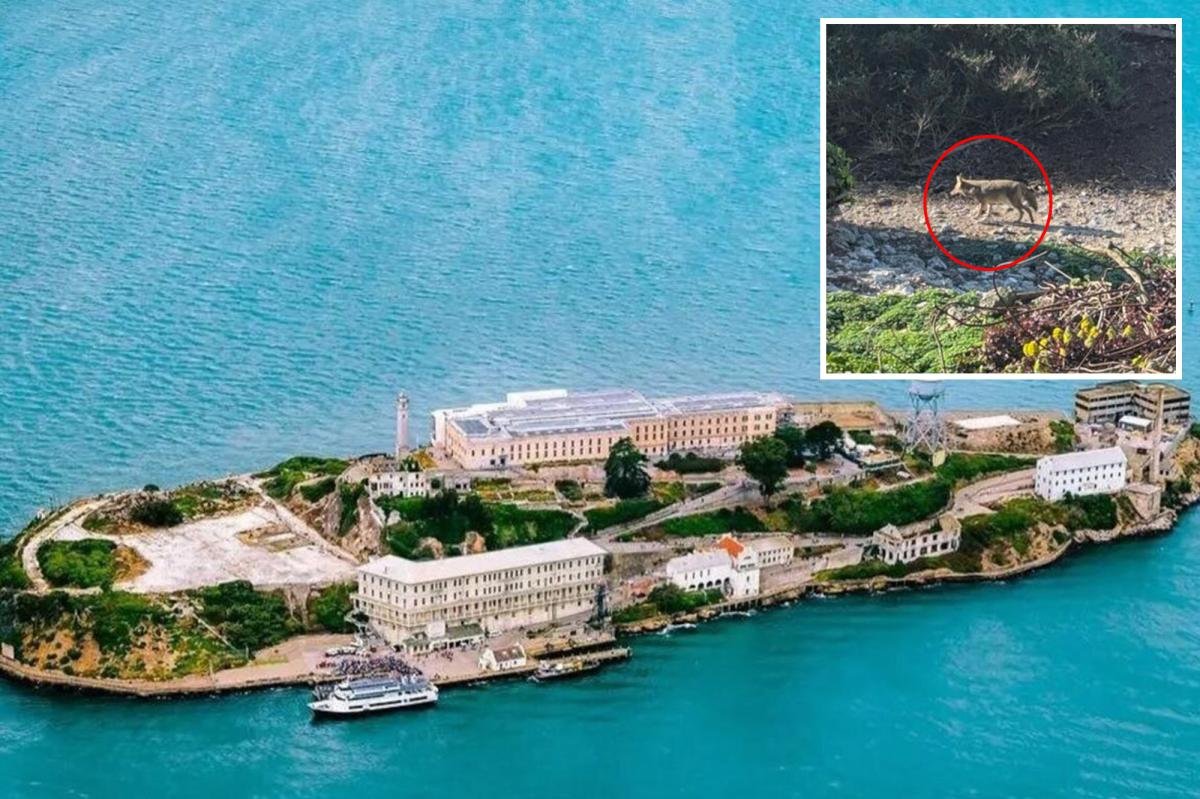
A lone coyote that stunned visitors by appearing on Alcatraz Island earlier this year didn’t just take a daring dip, it likely pulled off an even longer, more grueling swim than anyone first believed.
The canine was first spotted Jan. 24 on the notorious former prison island, after a visitor captured video of the unexpected guest and alerted National Park Service staff.
Biologists quickly moved in, finding fresh tracks and scat, and setting up cameras and audio equipment to monitor the intruder.
But despite days of evidence and months of follow-up surveillance, the elusive coyote was never seen again.
What happened next only deepened the mystery.
Scientists analyzed DNA from the scat at the UC Davis Mammalian Ecology and Conservation Unit (MECU) to trace the animal’s origin.
Initially, experts thought the coyote had crossed the bay from San Francisco, a challenging swim on its own.
The lab results told a different story.
“Three distinct coyote populations could have been the source of the Alcatraz coyote: San Francisco, Southern Marin, and Angel Island,” Dr. Ben Sacks of MECU told KRON.
“Our lab was able to take the DNA sample and match it to a coyote previously sampled from the Angel Island population.”
That finding means the animal likely swam from Angel Island, roughly two miles north of Alcatraz, doubling the originally assumed distance across the cold, choppy waters of San Francisco Bay.
Wildlife ecologist Bill Merkle said the feat points to the species’ toughness.
“Coyotes are known to be resilient and adaptable, and he certainly demonstrated those qualities,” he told KRON.
Yet for all its grit, the coyote’s fate remains completely unknown.
There have been no further sightings, no camera captures and no remains discovered anywhere on the island.
“We don’t know what happened to the coyote,” Merkle said. “But he proved himself an expert swimmer to get to Alcatraz, and I hope he made a successful swim back home to Angel Island.”
Alcatraz, once a high-security federal prison that operated from the 1930s until its closure in the 1960s due to high costs, has long been known for failed escape attempts, with most inmates unable to survive the bay’s icy, fast-moving currents.
The island reopened as a public park in 1973.
Download The California Post App, follow us on social, and subscribe to our newsletters
California Post News: Facebook, Instagram, TikTok, X, YouTube, WhatsApp, LinkedIn
California Post Sports Facebook, Instagram, TikTok, YouTube, X
California Post Opinion
California Post Newsletters: Sign up here!
California Post App: Download here!
Home delivery: Sign up here!
Page Six Hollywood: Sign up here!
Read the full article here