





I was 11 years old when I watched television for the first time, though “watched” is an exaggeration.
The screen, when our wealthy grazier neighbour ostentatiously switched on his new set, emitted a swirling ghostliness with mysterious shapes floating through it.
“Oh, wow,” I breathed. “An underwater film!”
My parents tried to hush me, but it was too late.
Our host tried jiggling a knob on the machine, a faux mahogany arrangement, but the electronic snow I had mistaken for a scene from the deep persisted.
The nearest TV station’s transmission tower was in Ballarat, almost 200 kilometres away.
The tallest aerial’s chance of picking a worthwhile picture from our district’s ether was a vain hankering in 1962, the year the station, BTV6, was launched (though TV had been around in the big cities since 1956).
Even when reception improved, my family still didn’t get a TV, much to my discontent.
We got a multi-volume Encyclopaedia Britannica on time payment instead. It sat aloof for years on its shelf, largely undisturbed, while TV-deprived, I contented myself riding bikes and horses with mates, building billycarts and treehouses, surfing and gallivanting about.
I was off to boarding school before my parents installed a TV.
The first television moment I can recall was on July 21, 1969, when the school’s student body filed into the hall to get a glimpse of Neil Armstrong walking on the moon.
A few years ago, after my mother died, I found she had kept a journal. And there, over several pages written in the mid-1960s, she agonised with herself about the benefits or drawbacks of installing a TV.
She concluded it would be detrimental to family life.
Conversations in the evenings would surely dry up. Dinner – her favourite ritual, known as tea and always a leisurely affair at the table set for three courses, the day’s and the world’s events discussed at length – would become an undignified race before some meaningless show.
Why, she’d heard of people balancing their meals on their laps while watching the screen in the corner! Furthermore, television might endanger our pleasure in reading, my mother wrote. Books and words were her passion.
Television, of course, captured the nation’s lounge rooms with astonishing swiftness, just as the wireless had done in previous generations, and changed the culture.
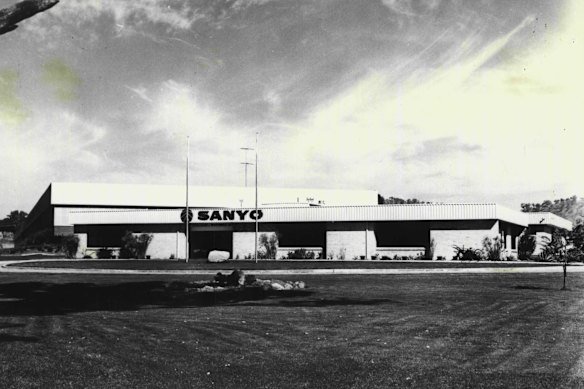
Australians are champion early adopters: when colour TV arrived in 1975, the Japanese company Sanyo established a brand-new television-manufacturing factory in the declared national growth city of Albury-Wodonga.
Half of Sanyo’s workers were retrenched by early 1978, the beginning of the end, partly because just about everyone who was going to buy a colour TV had done so.
Indeed, by 1978 about 70 per cent of all Australian households in the big cities had each shelled out between $1000 and $1500 (about $8000 to more than $10,000 in today’s money) for the pleasure of being glued to a new colour set.
All of which is a long way around to today’s frantic love affair with screens that offer a great deal more than the evening news, a quiz show, a lame comedy, an old movie and a test pattern from midnight, which was the program in the early days.
We have, as television company executives mourn, moved away from traditional TV shows and even news on TV screens, reserving them for sports and so-called “reality” programs, which bear out Andy Warhol’s prediction in 1967 that “in the future, everyone will be famous for 15 minutes”.
As screens have become smaller and smaller, they have become smarter and smarter – in a technological sense, at least – and fuelled by artificial intelligence are now almost like George Orwell’s telescreens from 1984, omnipresent in our lives and never turned off.
About 24 million Australians – in a population of 28 million – currently use so-called smartphones, according to various studies. It’s probably an underestimate. There are more than 34 million smartphone connections in the nation.
Social media, YouTube videos, texting with friends, e-shopping, re-runs of TV shows never watched on big screens, music, games, TikTok and Instagram doom-scrolling … all of it so mesmeric a stage hypnotist would weep with envy.
It may be tempting for those of us ancient enough to get wistful about screen-free old times and to lament today’s over-use of smartphones. It would be as useful as trying to turn back the ocean with a trowel; as successful as my mother standing against the coming of television.
Anyway, smartphones and their associated apps make life easier for many of us, from getting news on the go, undertaking instant banking and e-health and keeping in touch with family and friends anywhere.
The Australian government, mercifully, has at least tried to limit the damage to children by banning those under 16 from using social media. Best of luck with that.
Now we have the rise of a species previously unknown to nature: influencers.
And, of course, the would-be prophet – or false prophet, take your pick – of One Nation, Pauline Hanson, who uses numerous screen tools to spruik for the need to return to a past so nebulous it never existed.
We must, she preaches, return to a “monoculture”, while damning multiculturalism, immigration, attempts to ameliorate climate change and much else.
And how does she supercharge her proselytising?
Why, by the relentless use of multiple social media platforms, from Facebook – where she has 1 million followers – to Instagram, TikTok, X and YouTube.
She and her chief strategist, James Ashby, have obviously taken note of Donald Trump’s approach. Trump famously spends his nights madly posting to his own Truth Social, a platform that is neither invested in much truth nor is particularly social, though it seems not to matter to his millions of followers.
Hanson, like Trump, uses social media to bypass mainstream media, instead invading little screens everywhere to raise money and to spread and quarantine her message from pesky journalists intent on testing the truth.
After Hanson spoke at the National Press Club for the first time, her team rapidly cut the old-fashioned TV feed into short grabs they judged likely to best excite their followers and rapidly posted them on YouTube, well before traditional media fact-checkers could complete putting a responsible ruler over her claims.
Her series of animated Please Explain videos – a sort of radical right-wing South Park – haven’t been above a spot of flat-out disinformation masquerading as satire. The Australian Electoral Commission prevailed upon TikTok and Instagram to ditch a Please Explain skit in 2022 depicting Penny Wong and Anthony Albanese characters indulging in voter fraud, while chortling that requiring IDs to vote “would be racist”.
Very Trumpian.
In recent times, mysterious AI posts emanating from overseas, their creators all but impossible to track and not authorised by One Nation, have been circulating. Many of them fraudulently depict Hanson destroying Albanese in some argument on such shows as the ABC’s 7.30. They get passed around, screen to screen, by delighted Facebook users as if these events actually happened.
Whether large numbers of One Nation supporters who register their approval of Hanson on screens are real or AI-powered “bot-farms” – in the manner used by Russia, for instance, to influence the US election of Donald Trump in 2016 – is much debated, and flat out denied by One Nation.
A recent article in the Australian Financial Review suggested something uncomfortable for established political parties: “Many of the serial commenters in Australia’s Facebook info wars look and post like bots. In reality, though, they are – by and large – human.”
In other words, Hanson’s apparently massive army of supporters posting identical messages on Facebook are probably real voters.
If so, they should be prepared to be disappointed by Hanson’s dream of an Australian monoculture. Since the First Fleet arrived, Australia has never had such a thing.
Hanson ought to know: her first husband, Walter Zagorski, whom she met when she was 15 and married a year later, arrived in Australia in the early 1950s as a Polish refugee. He was, in short, part of the post-war wave that turned Australia multicultural.
Hanson’s essential idea of a monocultural Australia appears to be to rid the country of Muslims. She made that clear years ago when she put up for sale her rural retreat at Coleyville, on Queensland’s bucolic Scenic Rim. She stated that no Muslim would be allowed to buy. It didn’t sell.
In fact, by 1962, the year I thought I saw an underwater adventure on a TV screen, Australia’s dominant culture – fashion, music, movies in cinemas and drive-ins – was heavily American, just as it had been British before World War II.
With the spread of TV, a wider world invaded our lounge rooms, and as the screens turned smaller, every culture imaginable, and now, every influencer and half-cocked political theory, swam into view.
My mother, who loved words and distrusted screens, could have advised that the primary meaning of monoculture is merely an agricultural practice that involves growing only one crop.
Just add bulldust, perhaps.
Read the full article here