



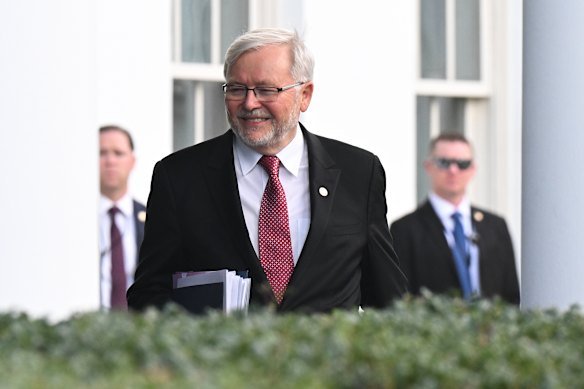
The AUKUS submarine project has passed the point of no return and will be delivered successfully, says Australia’s recently departed ambassador to the US, Kevin Rudd.
“There is zero possibility of this coming unstuck,” Rudd said in his first Australian interview since leaving government service last month. It is the most emphatic expression of confidence yet by any of the high-level architects of AUKUS.
He confessed that he had harboured doubts about the joint Australian-UK-US undertaking, announced nearly five years ago, until the moment in October when US President Donald Trump declared publicly that AUKUS was “full steam ahead”.
The former Australian prime minister said: “I have a high degree of confidence – beyond the normal political chutzpah and the normal defence-of-record stuff – that, by the time we hit 2032, you’re going to have the first Virginia-class boat delivered” by the US to Australia on time.
At the same time, Rudd – who is an expert on China, a Mandarin speaker, and the author of a book on Chinese President Xi Jinping – said that China had not surpassed the US as the dominant world power “yet”. But, he said, it continued to move towards forcibly seizing control of Taiwan.
“Irrespective of President Trump’s posture and policy, I think you’d have to say that the risks of Chinese military action against Taiwan continue to increase,” he said.
“It would be foolhardy publicly to speculate on any timetable around that, but it’s not going in reverse.”
Rudd resigned from the ambassador’s post after three years – a year before his full term – at the end of March to resume his former job as head of the New York-based Asia Society, a 70-year-old cultural institute with an affiliated think tank, the Asia Society Policy Institute.
His “galvanising interest”, he said, was that “I don’t want us to end up in crisis, conflict and war over Taiwan”. He said he didn’t want to overestimate his influence but that “I’ve worked on this for decades” and would do what he could to avert war. A clash between the US and China would be “unbelievably catastrophic”.
Asked about Trump’s recent visit to Beijing, Rudd said he was not bothered by the US president discussing arms sales to Taiwan with Xi, as Trump had made no changes to US policy.
Beijing, he argued, would be deeply uncertain about how Trump would respond to any unilateral military action against Taiwan, because of the priority he places on showing strength.
Explaining his confidence in the success of AUKUS, Rudd noted that it was legislated by the US Congress, where it enjoys bipartisan support, and had now been endorsed by presidents from both sides of politics. Rudd helped steer the enabling legislation through Congress.
Significant work had already taken place on readying Australian shipyards for AUKUS, he noted.
“Operationally, on the ground, both in terms of the massive investments in preparatory work being undertaken at Fleet Base West for the submarine home-porting facility for our future fleet, together with supporting visiting American and British vessels, plus the massive investment unfolding in Osborne in South Australia, I see negligible risk of this coming unstuck,” he said.
“Had you asked me before last October when the PM was in town with the president, I would have said there was perhaps some risk.”
Rudd described the US-Australia relationship as being well placed for the future. He said it was now supported by three pillars, with a fourth under construction. First was AUKUS; second, rare earths and critical minerals co-operation; third, finance based on Australian superannuation investment; and fourth, co-operation on critical tech, including AI.
The “most complex challenge”, he said, was navigating the respective China relationships of the US and Australia, implying that the two allies have diverging priorities.
Rudd has been replaced as ambassador by Greg Moriarty, a long-time diplomat and public servant who was most recently the secretary of Australia’s Defence Department.
He served as ambassador to Iran from 2005 to 2008, and in that capacity briefed then US president George W. Bush on Iranian politics – a rare event for an Australian diplomat. He was later posted to Jakarta, and was also chief of staff to then prime minister Malcolm Turnbull.
Moriarty presented his credentials to Trump at a White House ceremony on Thursday (US time), along with 11 other new ambassadors to the US.
He was greeted at the West Wing by Monica Crowley, the US chief of protocol. Press were not invited to the credentialing ceremony.
Start the day with a summary of the day’s most important and interesting stories, analysis and insights. Sign up for our Morning Edition newsletter.


From our partners
Read the full article here