

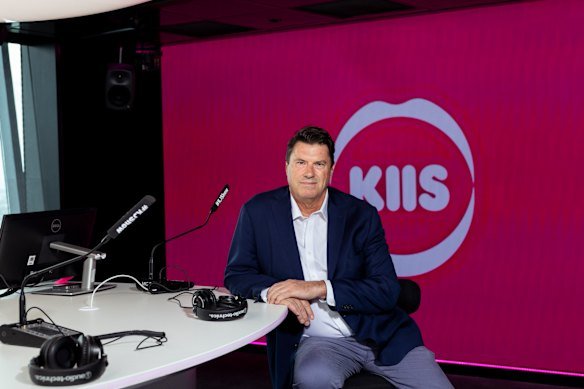
Riddle us this. Hamish “The Hammer” McLennan, the chairman of Kyle Sandilands and Jackie O Henderson’s former employer, suffered a 90 per cent protest vote against the pay deal he proposed for his executive team.
But somehow, only 20 per cent of shareholders issued a proxy vote against McLennan’s own position on the board.
Regular readers of this column will no doubt recall that CBD first brought word of the prospect of a vote against KIIS network owner ARN’s plans for executive pay last month. Back then, we revealed that the influential proxy advisor CGI Glass Lewis had taken aim at the pay packet of ARN’s chief executive and former Nine sales guy Michael Stephenson, which clocks in at a cool $1.1 million. The company, by contrast, is only worth $81 million.
But even we couldn’t have predicted a protest vote so big. The last time we recall seeing such a massive number was back in 2018, when NAB recorded a monster 88 per cent protest vote against its executive pay. That was branded “unprecedented” by The Australian Financial Review at the time. So how close did The Hammer get to setting a new record?
The ASX said it doesn’t track these votes, so there’s no official word on whether it tops the investor fury charts. But Stanley Soosur, who oversees Glass Lewis’ operation in the APAC region, said the figure is “right up there with the highest votes-against” his firm has seen. The highest protest vote since 2016, according to data provided by Soosur, was Jupiter Mines, which faced a 93.4 per cent vote against in 2020.
“Perpetual’s 88 per cent in 2024 is the only recent comparable that comes to mind, and that was considered extraordinary,” Soosur told CBD.
“Outside of remuneration, the Kyle and Jackie O controversy and associated litigation have created real reputational and commercial risk for the business. With that level of dissent, it’s hard to argue that the vote was purely about pay – shareholder frustration with the company’s broader direction spilled over into the remuneration vote.”
So how did the big man secure a few more years in the chairman’s seat, despite spending Thursday morning getting towelled up by shareholders? (Well, by the veteran investor David Kingston more than most, while former Seven boss Jeff Howard sat quietly, watching on.)
He promised to get more skin in the game by shelling out for $500,000 worth of shares in the company (no better time than when the stock is in the toilet!) and had the support of at least two big proxy advisory firms heading into the meeting. All told, he secured re-election with roughly 79 per cent of the proxy votes.
Before the AGM, McLennan had just 73,000 shares, according to the company’s 2025 annual report, fewer even than Sandilands and Henderson before their lawsuits against the company.
But a tick over 20 per cent of shareholders remained unconvinced. Facing questions, McLennan was asked by shareholder activist Stephen Mayne whether he’d made any commitments to the company’s biggest shareholders in order to get their support heading into the meeting. “Is that why he committed to buy $500,000 worth of shares?” Mayne asked.
“No, I didn’t make any specific commitments,” McLennan told investors in response. “I have consulted shareholders, and they all want executives and board directors to have more shares in the company.”
McLennan, according to the 2025 annual report, receives total compensation of $324,674 a year from the company. So, in other words, he’s committed to buying the $500,000 in shares to stave off the public humiliation of being dumped from the board of one of the market’s least valuable companies. It pays for itself in the second year, after all. Not a bad investment.
Heading into Thursday, we were preparing, as readers may recall, for the circus to come to town, with The Hammer cast as ringmaster. And boy did he deliver.


From our partners
Read the full article here