




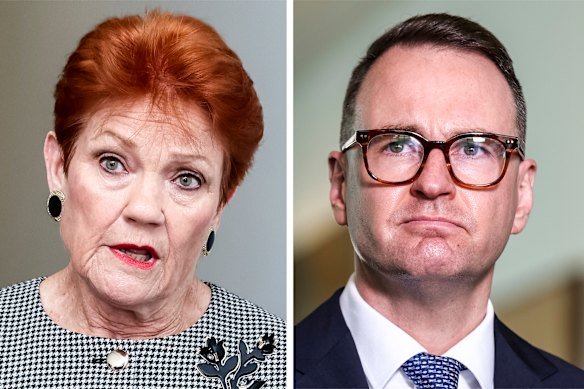
Pauline Hanson is high as a kite. Her polling remains at historic levels. Her antics, which used to trigger a few bemused bylines, now lead the news. Her thought bubbles are put to major party politicians as policy positions demanding an answer. Where her wind blows, media follow.
This is causing the Coalition no end of angst. The amazing shrinking establishment party – which until just a few years back held the highly coveted mantle of Natural Party of Government in Australia – now finds itself in a race to put out policy before the headline-grabbing upstart. Competition between the two parties on the right has led to childish accusations of copying.
The Coalition cannot win by indulging this rivalry. And, frankly, it should stop trying. But that’s not an argument to stop worrying and learn to love the orange bomb.
The opportunity Hanson represents for the Coalition is best illustrated by a recent failure to appreciate it. Senator Andrew Bragg’s wide-ranging speech at the National Press Club earlier this month was a reminder that sending new policy ideas above the parapet can be a useful tactic. But you’d rather the shrapnel not land on your side if they get shot down.
The practice is known as political kite-flying. A party sends out a junior backbencher to make a statement, or drops an idea to the media, which they are “said to be considering”. Then it watches how the public and other parties respond. If it’s pilloried, the party disowns the kite, claiming it was falsely reported gossip or the freelancing of someone with little influence on the party position. And if the coverage is favourable, and the public reaction seems manageable, the party can move forward with a formal announcement.
Following Bragg’s speech, shrapnel rained down on the Coalition. The government gleefully seized upon his unfortunate answer to a question from the ABC as to whether low-income Australians should accept substandard housing. “Definitely,” he told the presenter, later claiming he’d misheard the question.
As a backbencher, Bragg’s colleagues received his penchant for deviating from party policy as somewhere on a scale from refreshing to malaria mosquito. But he’s not a backbencher any more. In a party room embarrassed for talent after a traumatic election, members who may not have been deemed ready in the past have found themselves dramatically promoted. Opposition Leader Angus Taylor was forced to issue a public rebuke to his frontbencher, warning him to stick to party policy and not express personal views.
It was a poorly planned and executed contribution – not only because of the fallout. While Bragg used the speech to apologise for not doing more to “stop the madness” in the Morrison government, he fell into a very Morrisonian mistake. He tried to play a tactical hand, blind to the strategic landscape around him.
Her rapid rise in the polls has made Pauline Hanson a strategic risk, as well as an opportunity. One Nation’s dramatic statements grab headlines. It will slash the tobacco excise by 75 per cent, stop foreign students from abusing the asylum system, and allow you early access to your super because “it’s your money”. And that’s just this month. Hanson also declared that businesses shouldn’t be on the hook for paid parental leave, and the industrial relations system is stopping businesses from firing “lazy” workers.
The Labor Party is in heaven. It reckons it can conflate the Coalition with One Nation and drape them both with the fallout from unpopular policy ideas raised by Hanson. The Coalition is miffed. One Nation cuts through with voters and grabs all the attention. The major parties are both right and both wrong in their respective response.
Pauline Hanson is either a curse or a kite for the major parties, depending on what they choose to make of her. Labor seized on the superannuation comments to claim that the Coalition and One Nation want Australians to have less money in retirement. Senator Bragg claims the superannuation system has failed. Left on the table was the chance to engage seriously with the proposition that Hanson articulated, that “superannuation is your own money”.
Polls have found that Gen Z in particular are keen on the idea of using super to get into the housing market. A clever Coalition would have spoken to them past the other parties on the issue, positioning itself as the reasonable voice in a shrill and polarised debate. Hanson seemed not to know compassionate grounds for access already exist.
While rejecting that workers are generally lazy, Hanson’s kite on industrial relations could have given the Coalition a moment to side with small businesses, which can struggle with complex legal processes when an employee really doesn’t work out. Perhaps there’s even a sensible solution to help small to medium enterprises keep a spot vacant for an employee on maternity leave.
The tobacco excise cut is still waiting to land. The Coalition is upset because it was planning to announce it. Instead of sulking, it should be taking notes, watching which way the kite blows and tightening its policy.
Kite-flying has become so popular in Canberra that it’s looking more and more like the whole last federal budget was itself a kite. Since it was handed down in May, Labor has been forced to claim its costed measures were just “consultations”. The tech and start-up sector carve-outs from the capital gains tax, followed by an exemption for foreign interests investing in renewable energy, and the “widow’s tax” amendment to grandfathered negative gearing, are just a few of the changes that the government has been forced into.
The uncontested ground right now is competence. The Coalition’s vote will never “come home” while voters are disappointed with the establishment system or unconvinced it’s capable of doing a better job than the alternative. It will only be lured back by two feet on the ground, hard work and intense scrutiny of the wind direction while other parties’ kites whip wildly overhead.
Parnell Palme McGuinness is an insights and advocacy strategist. She has done work for the Liberal Party and the German Greens and is a senior fellow at the Centre for Independent Studies. She is also an advisory board member of Australians For Prosperity, which is part-funded by the coal industry.
Get a weekly wrap of views that will challenge, champion and inform your own. Sign up for our Opinion newsletter.


From our partners
Read the full article here