



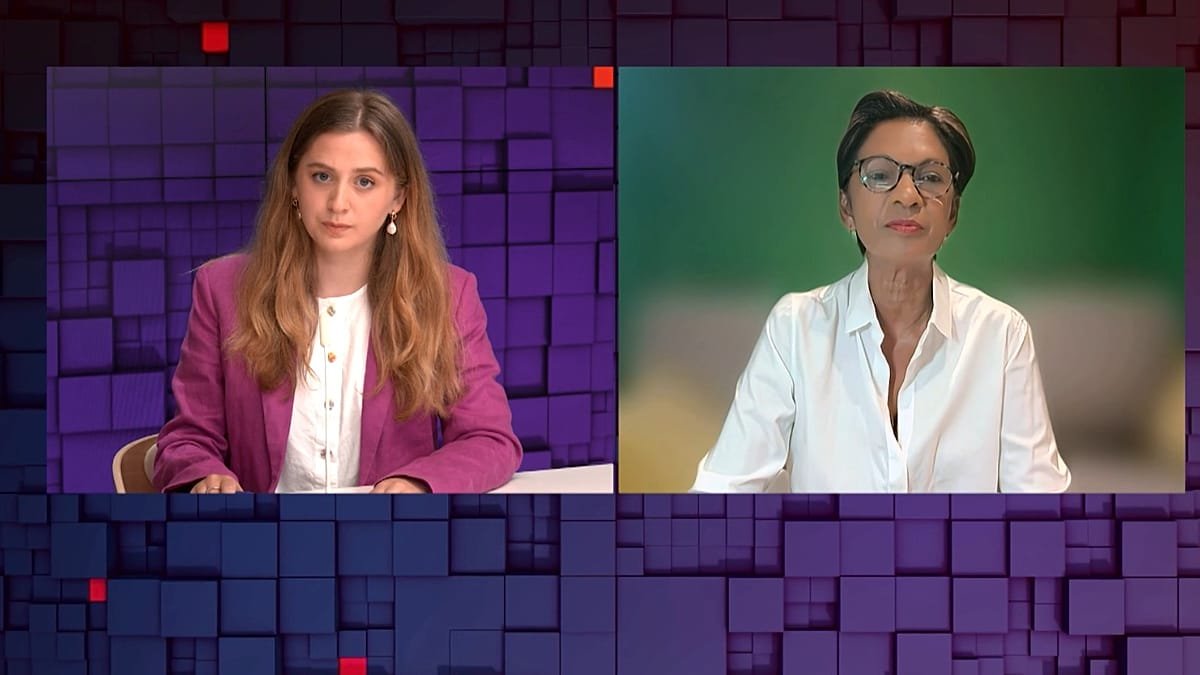
Businesswoman and campaigner Gina Miller, known for leading two successful landmark legal challenges related to the Brexit process, said she hopes that Britain’s next leader will have “a plan” for the UK’s future relationship with Brussels, hours after Prime Minister Keir Starmer announced he would resign.
The British-Guyanese 61-year-old became one of Britain’s most divisive political figures after she took the successive Conservative governments of Theresa May and Boris Johnson to court, contesting their handling of the UK’s exit from the European Union in 2016-17 and 2019.
“I’m hoping that the new leader of the Labour Party will have a plan and a strategy, some clarity on the direction of travel on our relationship with Europe,” Miller told Euronews on Monday — the eve of the 10th anniversary of Brexit.
“I have been very disappointed that Prime Minister Starmer was not much clearer on what he called ‘realigning’.”
Although Starmer was arguably Britain’s most pro-European leader since the Brexit vote, he cautiously balanced calls from within his party to strengthen the UK’s ties with the EU and longstanding public opposition to challenging the referendum’s outcome.
His resignation also raises questions around the United Kingdom’s upcoming post-Brexit ‘reset’ talks, which are set to take place on 22 July.
Here, Brussels and London hoped to sign a ‘triple deal’ to slash barriers to agri-food trade by aligning sanitary and phytosanitary rules, bringing the UK back into the EU’s internal electricity market and granting special visas to young Europeans and Brits under a youth experience scheme.
“In my mind, the door is open on a Swiss-type agreement, and I think that’s something we should be very clear about, rather than cherry-picking here, there and everywhere in tiny little steps. I’m hoping the opportunity is there for a new leader to be much bolder and talk about alignment.”
The “Swiss model” has been touted as an alternative to the current UK-EU Trade and Cooperation Agreement (TCA), granting London deep access to the EU’s single market for certain sectors, as is given to non-EU member Switzerland.
“We’ve got [far-right party] Reform lurking over our British politics and possibly a Reform-type government after the next General Election. To me, a Swiss-style agreement, we have to do something like that, to make sure that the door is kept open to one day, perhaps rejoining.”
However, this type of agreement has been rejected in the past by the EU. Miller also noted that she doesn’t think the UK or the EU have the political bandwidth “to be talking about that right now.”
Ensuring PMs don’t put themselves above law
In 2016, Miller challenged Theresa May’s government in court after it enacted Article 50 of the Treaty on the EU — the legal mechanism used by member states to formally withdraw from the union — through executive prerogative powers without a vote in Parliament.
In September 2017, the Supreme Court ruled in favour of giving MPs a say over triggering Article 50. Two years on, Miller enacted a second successful legal challenge, leading the UK Supreme Court to unanimously rule that former Prime Minister Boris Johnson’s suspension of Parliament was unlawful.
“Irrespective of my personal support for remaining in the EU, this was much more about the process and ensuring prime ministers could not put themselves above the law. Ironically, if you remember, everyone was talking about parliamentary sovereignty,” Miller said.
She noted that the same checks and balances must be put in place for discussions on rejoining the bloc.
“Whatever happens next cannot be sneaked through the back door. Any realignment and changes that come in the future need to be transparent, in the open and debated by Parliament.”
As Brexit is being propelled back to the top of the political agenda in the UK, and there is talk among top Labour figures of rejoining the EU, Miller said the threats she faced for bringing her legal challenges are also returning.
Miller and her family were placed under protection by an anti-terrorism brigade due to the sheer level of death threats and abuse she faced, for which people were imprisoned.
“For a long time, the B word (Brexit) was not mentioned by politicians; they were too frightened to mention it. Now, with the anniversary this week, the abuse that I’ve been receiving has increased,” she explained.
“I’m getting it from both sides this time. I’m getting it from the ‘Leavers’ because their hatred hasn’t gone away, and the Reform and the Restore parties in the UK are whipping up all the anti-migrant and anti-EU sentiment, which means that I get a backlash.”
Meanwhile, she said, she is being criticised by the ‘Remainers’ for her taking a pragmatic stance, while they “think we can just rejoin tomorrow.”
Damaged economy and divided politics
A decade on from the Brexit vote, the overwhelming consensus among researchers and government institutions is that the decision to leave the EU has damaged the economy, although gradually rather than in a sharp drop or sudden blow.
“I suspected that the Brexiteers, the Leavers, had no plan for what would happen if they had won,” Miller said.
“And that has unfortunately played out in the fact that there is a confirmation that our economy has been damaged by around 5% of GDP, according to most economists.”
The 2016 Brexit referendum polarised the UK, dividing communities and families with the entrenched categories of “Leavers” and “Remainers.”
According to a poll published by the European Council on Foreign Relations (ECFR) on 21 June, up to two-thirds of British voters, across all party lines, believe Brexit has hurt the country.
For Miller, Brexit has left wounds across the nation but also pushed Britons to further engage with politics.
“If there is one positive to take from Brexit, it is that […] people are now much more engaged, and that’s why we are seeing so many of the new parties that are coming up,” she argued.
“The Green party is doing very well, as is the new extreme-right party, Restore. People are more engaged, and that is positive because a healthy democracy requires people to be more engaged.”
However, Miller did note that the country has become very politically divisive. “I think the problem is that we don’t have politicians with courage,” she said.
“We do not have politicians who are spelling out the difficulties, […] they’re not telling people the truth about where we are and the hard choices we need to make to get to a better place.”
Read the full article here