




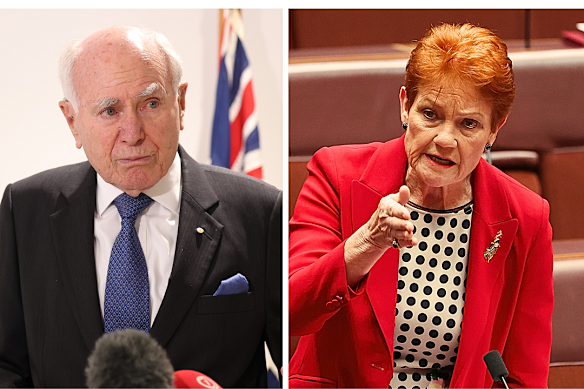
It’s all very well for John Howard to tell his present Liberal cohort that they should “be the best demonstration of themselves” (“Howard’s advice to Liberals to win back voters flocking to Pauline Hanson”, August 12). It’s probably sound advice, but the problem is they don’t have any idea of who they are or what they represent. Howard knew how difficult it was to wrangle this group of self-interested, patriarchal old men when he used the term “broad church” to describe his fractious party room. His broad church has been reduced to an irrelevant rump and I would argue that rather than being the doyen of the Liberal Party, he was the beginning of the end of it when he declared himself the most conservative leader the party had ever had. It was when it abandoned any semblance of liberalism and embraced conservatism that its eventual demise was assured. Chris McKimm, Karangi
Like reader Craig Jory, I applaud John Howard’s views on gambling reform (Letters, August 12). And also his advice to Angus Taylor on how to combat Pauline Hanson. But when he dismisses the current government as “this miserable, rotten mob” and offers support to those in his party who claim Anthony Albanese is the worst-ever PM, he loses the last shred of his credibility. He can criticise Albo all he wants, like the rest of us, but when he indulges in such personal and absurd abuse he abandons all hope of positioning himself as the elder statesman he aspires to be. Richard Walsh, Woollahra
Decrease a collective gain
If there was any doubt regarding Angus Taylor’s loyalties, his remarks in parliament this week about house prices clarify everything. After years of most people wanting house prices to stop rising, we finally get a small decrease. Yet Taylor asserts this is destroying the market. Destroying it for whom? For investors. As RBA head Michele Bullock suggested, if the market dropped 20 per cent we might see 5 per cent of the population in negative equity, which would only be a problem for someone who wanted to sell in a hurry. Clearly, Taylor is no friend of the aspiring young homeowner. Bruce Johnson, Lakewood
US’s cautionary tale
Sussan Ley told Sarah Ferguson on ABC’s 7.30 that she travelled by Greyhound bus through the US, listening to punk music and observing the disconnected, the lost, the lonely and the poor. Hopefully she also noticed the political failure of right-wing ideology, the widening income gap through trickle-down economics and the lack of government support through underfunded Medicaid and pension payments. Denise Young, Thirroul
Losing faith
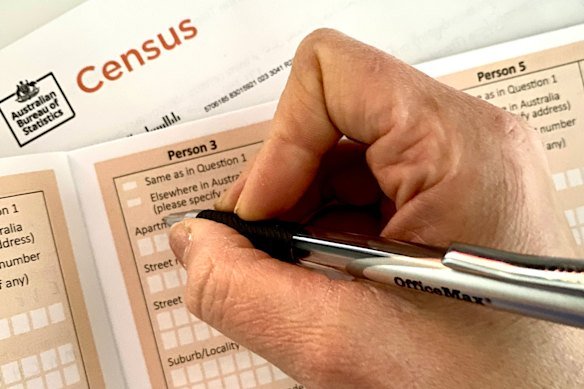
The question of “religion” on the census form was vexing for many of us who for years were fully immersed in Christian communities but are now deconstructing a faith that was ultimately coercive. Self-surveillance, control of sexuality and rigid gender prescriptions were masqueraded as freedom. Like your correspondent Andrew Cohen (Letters, August 12), I wonder if “no religion” can ever describe the search for the numinous and mysterious that ended in my disillusionment and disengagement from evangelical churches. I settled on “ex-evangelical” which, while inadequate, summarises the journey of searching then rejecting the straitjacket on offer. Josie McSkimming, Coogee

Perhaps it is not surprising your correspondent was unable to find a religion in mainstream Christian churches. In his book What’s Wrong with the World, G.K. Chesterton has a chapter called “The Unfinished Temple”. In this chapter he wrote: “The Christian ideal has not been tried and found wanting. It has been found difficult and left untried.” Mark Porter, New Lambton
Despite being a “person of faith”, Andrew Cohen wound up being classified as an atheist in the census because he declared he had no religion. The word atheist has become problematic and needs reinterpreting because it comes from an era when “theism” was the only option. “Atheism” was therefore “wicked” and “of the devil” – pejorative attitudes which persist to this day. Even though I have the equivalent of a theology degree, I find “mainstream” Christians hostile to me, not because I am “without belief” but they are “without knowledge” and know not what they do. Time for a new definition. Suggestions? John MacKay, Asquith
Hot topic
Brussels’ newly unveiled city square is being pilloried as “Europe’s largest frying pan”. Is Sydney hoping to snare the world title (“First look at the divisive plans for Sydney’s $150m Town Hall square”, August 11)? Yes, the Town Hall square will have some trees and a fountain, but who in their right mind would sit on those concrete steps on a hot summer day in Sydney? Global heating is real, it’s happening now, and it will only get worse. Is it too much to ask for designers to take it seriously? Tom McGinness, Randwick
What is this obsession with destroying Sydney and spending millions on an unnecessary “town square”? Sydney already has enough public spaces. What we desperately need is affordable social housing. The buildings that council has acquired should be repurposed into safe, affordable housing for people who actually need it – right in the heart of Sydney, close to jobs, transport, schools and essential services. And before council dreams up another grand public space, perhaps it should focus on maintaining the one it already has. Wentworth Park on Wattle Street would be a far better meeting place for the people of Sydney, looking toward the new fish market and Sydney skyline, especially once the dog track is finally demolished. That is real, usable space that could serve the community far better than another expensive civic experiment. Christopher Vidler, Willoughby
As a former arborist, trust me when I say that lilly-pillies and blueberry ash are inappropriate species for a large square in the CBD (Letters, August 12). Not only do they drop copious amounts of potentially slippery fruit and seeds, their high domes aren’t very shadeworthy, and they’re a small tree at maturity. What is needed are trees complimentary to the scale of surrounding buildings that are a mix of deciduous and evergreen, that can thrive in heavily engineered growing medium and will tolerate heat reflection from hard surfaces while coping with city wind tunnels, and are reliant on rainwater through mostly impermeable pavement surfaces. Not too much to ask of trees. Clare Raffan, Campsie
Bernie Bourke, after you’ve taken Pauline Hanson for a walk through Gosford Hospital (Letters, August 12), please take her through an aged care facility. From my observations these places are largely staffed by highly competent and compassionate people from South Asia and South-East Asia who diligently care for our most vulnerable citizens. I can think of no better place for Ms Hanson to start her Australia-wide listening tour. Rhonda Seymour, Castle Hill
Bulk-billing dilemma
Bulk-billing gives easier access to medical care but sadly may not reflect quality care (Letters, August 12). I dare any bulk-billing doctor to prove they spend sufficient time to truly hear complex patients. Like all of my obese and anorexic patients who insist they are on a perfect diet, bulk-billing doctors will no doubt rebel at my implication. But there are enough anecdotes to corroborate my claim, which of course, can never be proven given the confidentiality of consultations. There is no doubt that with current Medicare rebates, bulk-billing centres need a high throughput. Dr Ashley Berry, Wollongong
Storm in a teacup
Columnist Kate Halfpenny believes the coverage of Anthony Albanese’s schoolboy responses about the Japan’s PM Sanae Takaichi and singer Kylie Minogue has been overblown (“I’m hyper-alert to misogyny and sexism, but even this from the PM had me cackling”, August 12). The fact is, if Albanese had not been so eager to appeal to the people who might find this titillating it would have received no coverage at all. Harmless or not, what irritates many people is the campaign led by numerous female Labor MPs (whom I suspect are privately fuming) and others, to downplay the issue. These same supporters would be howling from the rooftops if a member of the right had made the same comments. I suppose the one benefit arising out of it all is that Albanese will be better prepared for the inevitable appearance on Kyle Sandilands’ podcast. Mike Kenneally, Manly
I wonder if other readers, like me, are fed up with the Coalition’s obsession with what the prime minister might or might have not meant on a popular podcast months ago. To try and confect a diplomatic gaffe out of it is pathetic (“Coalition wants probe into leaked Japan note”, August 12). Australians are interested in what politicians can do to improve their lives and this behaviour will only confirm the Coalition’s irrelevance. At present, their policies seem to comprise the reinstatement of financial arrangements that clearly helped the better off, and a race to the bottom with One Nation on immigration. The Japanese are not bothered. Prime Minister Sanae Takaichi strikes me as a very knowledgeable and focused politician. She has her own issues to deal with, both domestically and globally. I’m sure she will rightly dismiss the Coalition’s behaviour as mere fluff. John Jones, Armidale
Albanese deserves a rap over the knuckles for his recent faux pas. Intentional or not, he would have known that his comment contained a double entendre. It wasn’t a cardinal sin but showed poor judgment. Language is a powerful tool in politics and should always be above reproach. The PM’s comment may have been disrespectful, but it pales in comparison to the misogynistic language of some Liberal Party members at times. Angus Taylor’s belated attempt to use Albo’s error for political gain is typical and hypocritical. Graham Lum, North Rocks
No wonder the Liberal Party is in such a mess. They are presently concentrating on attacking our PM for his light-hearted comments in a podcast about Japanese melons. Really, of all the important issues facing the country they focus on this. This behaviour reeks of desperation from a party not fit to govern. David Boyd, Bondi Beach
Dear Mr Albanese, please stay away from social media and podcasts. It is not your forte. Stick to what you do best – which is the art of negotiations and running the country. Ruth Pojer, Double Bay
ABC crisis control
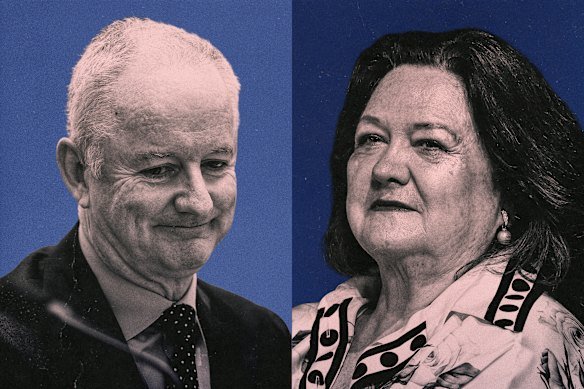
Jenna Price asks us to “give this kid a break” (“What apology over Rinehart skit tells us about Hugh Marks’ ABC. It’s not good,” August 12). This would have to be the first time I have heard a 29-year-old postgraduate described as a kid. Has adulthood reached a new starting point of 30? Or has Price engaged in a bit of overreach in her attempt to defend the video by Kate McGuinness on Race around the World? She admits that the comments made by McGuinness about Gina Rinehart were not funny, but defends them as attempt at humour. I would argue that the comments were out of context with the rest of the video, which makes no reference to Rinehart, and were nothing more than an unnecessary, nasty dig that had no place in the show. ABC boss Hugh Marks did the only thing he could do – apologise to Rinehart and edit the piece out. It speaks more to the producers for allowing the video into the show and thus throwing Kate McGuiness to the wolves of social media. Brendon Flynn, Tasmania
Fair play
In another life as an English head teacher, I dealt with the problem of compromised take-home tasks by introducing three changes (“AI can be taking the escalator when you need to use the stairs”, August 10). First, the task was prepared at home but written at school; second, students were given two possible questions for which to prepare, with only one being the question on the day; third, we supplied the paper on which the response was written. In this way, the objective of take-home tasks – private research, deeper thinking and reasoning – was preserved and the writing of the response within a set time period enabled students to practise an important HSC skill. Wayne Duncombe, Lilyfield
Migrants’ vital contribution
We should never lose sight of the great contribution migrants have made to this country, as indicated by your correspondent Tony Simons (Letters, August 11). Without that contribution, the workforce, particularly in the areas of healthcare, agriculture and construction, would have been found seriously wanting. Those who have come from overseas countries to care for our sick and aged, harvest our primary produce and build our infrastructure have played a big role in adding to our prosperity and simply making our lives easier. Migration has taken up the slack of our ageing population and helped pay the taxes to keep health and welfare commitments afloat. The narrow-minded scaremongering of people like Pauline Hanson should never lead us to forget the debt we owe to migrants, who are now unfairly being blamed for the current housing shortage. Hanson’s incoherent babbling should not blind us to the part migrants have played in our country’s progress. Derrick Mason, Boorowa
As an ordinary Boomer outdoorsy kid growing up in suburbia, life was suffused with a sense of egalitarianism. We didn’t know the word “multiculturalism” then. Our street was a mix of private and government housing whose occupants were neighbourly. Some didn’t look like us. Modest in size, the houses represented security and comfort to their occupants. We were content with what we had, with hand-me-down clothing and no car. The aspiration driving our parents was for a good education. Acquisition of wealth was not the goal. Competition for education was unheard of. Teachers were respected and their decisions never questioned. Kids rode bikes and played together after school, once homework was out of the way. All the while we were interacting face to face, dealing with rivalries, developing communication skills and learning that we needed to compromise at times if we wanted to fit in. Now the streets are silent after school and also at weekends, with kids locked in to tutoring, extra homework and relentless study pressures. Egalitarian interaction in childhood is a necessity for raising our young people to value a multicultural society as adults. Sue Ellyard, Epping
- To submit a letter to the Sydney Morning Herald, email letters@smh.com.au. Click here for tips on how to submit letters.
- The Opinion newsletter is a weekly wrap of views that will challenge, champion and inform. Sign up here.
Read the full article here