



One night, as I stood on my nature strip and looked up to the heavens at an eclipse of the moon, an elderly couple approached me to ask for directions to the local synagogue. Although not of that persuasion, I happily pointed them in the right direction towards Inkerman Road.
Noting their advanced age and mobility I offered to drive them to their destination. Having not lived in the area long, I hadn’t realised it was Passover and that any mechanical assistance would be taboo to them. They politely declined my offer, but the gentleman then took both my hands in his and blessed me for my offer and assistance.
A week later at regional Metung, I picked up a mystery trifecta at the local hotel on the Menangle trots and was able to afford a premium ticket to the upcoming Rolling Stones concert at Rod Laver Arena. Ever since, I have felt truly blessed to live in Caulfield North.
Tantalisingly close to St Kilda, Armadale and Caulfield South, Caulfield Junction, Caulfield East and Caulfield, wherever that actually is, lies postcode 3161, Caulfield North. Dominating the landscape is the nearby Caulfield Racecourse, which is central to all the Caulfields, including the newish Caulfield Village, a large complex of apartments and towers in what was once a racecourse car park. At the ground level of this development is one of the largest Coles you’re ever likely to find.
It took about 150 years, but locals have finally in the past decade regained access to some of the Crown land on which the racecourse was established. The middle of the track – mostly used as a car park – has been converted into Caulfield Commons, a public recreation reserve, wetlands and walking trail. I discovered this peaceful open space during COVID, and it now hosts a craft and food market every Sunday.
We arrived in Caulfield North by accident, really. After downsizing from Elsternwick to an apartment in Armadale, it was with the arrival of grandchildren that we looked to re-upsize and found ourselves moving into a small Edwardian house midway between our previous homes.
Here, we are nestled among old and new apartments and historic and modern stately homes, the most famous being Labassa, an ornate Victorian mansion just a few streets away. Built in 1862 and now looked after by the National Trust, it is a popular backdrop for photographers and filmmakers, including for Miss Fisher’s Murder Mysteries. The biggest and most prestigious homes of the suburb can be found along Alma, Balaclava and Inkerman roads, where the luxury Teslas and Audis drive in and out.
Caulfield North is a reserved place. It has a quiet, residential feel and lacks the high-profile shopping strips of our former neighbourhoods. But as more apartments have gone in and the population density has gone up, there has been a growth in diversity and vibrancy.
For non-residents, Caulfield North is known as a Jewish enclave, with its many synagogues and shules, and rightly so given that more than 40 per cent of our residents are Jewish. According to census data, this makes my suburb the most populous Jewish neighbourhood in Australia. And this no doubt plays a large part in how quiet it is here between Friday and Saturday nights, along with the large number of retirees who live here.
But there is nothing lacking in this vibrant, multicultural suburb. Our local hub is the Alma Village shops, which include five coffee outlets encompassing three cafes, a bakery and a Woolies Metro. Caulfield North and its surrounds must surely be among the most caffeine-saturated places in Melbourne.
Animals are welcomed everywhere, and outside those cafes there is usually quite a line-up of tethered pets. French bulldogs seem the most popular, but you’ll also find plenty of greyhounds and cavoodles, along with every dog species you can think of. We’re so international that Caulfield North primary school offers an integrated French curriculum.
A good pub wouldn’t go astray here, but there are plenty of options in Elsternwick, East St Kilda and both Malvern East and proper to fall back on, as well as the gaggle close to Caulfield station.
The jewel in our crown is Caulfield Park, the 28-hectare dog walking/work-from-home capital of south-east Melbourne. It features a new rose garden and a lake that in recent years was carefully cleared of introduced ducks and geese to make way for native species. The many sports facilities at the park include a bowls club, bocce rink, pickleball court, tennis club, football pitches, touch football, grid iron, cricket and lacrosse fields. What more could an active suburb want?
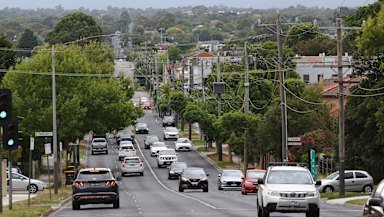
Our other main retail and dining hub is the Hawthorn Road/Balaclava Road junction. Tram routes 16, 64, 3 and, at weekends, 3a, traverse what is the only junction of its kind in the southern hemisphere. Known as the Balaclava Junction grand union, this feat of engineering allowing trams to head in any direction is so intricate and unusual that it’s listed on the heritage register.
Another recent shift has been the expansion of the Caulfield station interchange since the Metro Tunnel opened. Pakenham and Cranbourne line passengers must now transfer here to access the City Loop. A plea: let the Pakenham and Cranbourne lines go through Richmond on MCG match days.
If I had to offer a criticism of my suburb it would be the trend toward demolishing heritage houses, sometimes for big boxy modern residences. Of course, this view about protecting those homes wouldn’t be shared by those living in the many impressive and high-standard apartment complexes that replaced some of the homes and now dominate the suburb. And more than anything, it’s the people who live here that make it what it is today – a delightful place to live.
Rob O’Brien is a North Caulfield resident.
From our partners
Read the full article here