






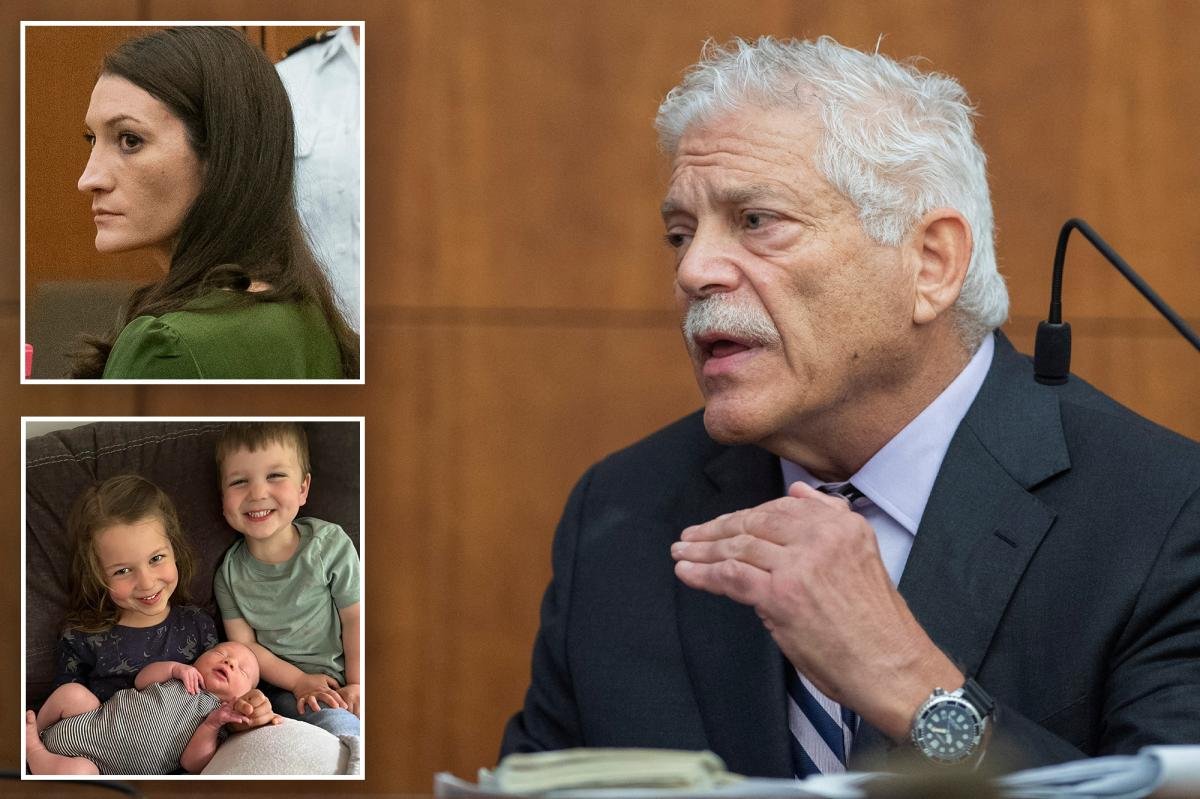
Lindsay Clancy has “bad days and worse days” at the hospital where she is monitored round-the-clock to ensure she doesn’t kill herself, a psychologist testified Wednesday.
The 36-year-old Boston-area mother is never left alone at Tewksbury Hospital, where she is being held during her murder case after she strangled her three kids and paralyzed herself in a suicide attempt on Jan. 24, 2023, Dr. Paul Zeizel told a jury.
“She is on a constant one-to-one [monitoring] to ensure Ms. Clancy doesn’t take her own life,” said Zeizel, who has met with Clancy dozens of times and was testifying in her defense.
He said she is in good hands, but the concern she could try again to kill herself again is always under the surface.
Clancy, who is now wheelchair-bound, has been accompanied to court each day by two nurses, her lawyer, Kevin Reddington revealed Wednesday.
During cross-examination of Zeizel, prosecutor Shanan Buckingham read from Tewksbury Hospital records, noting Clancy’s behaviors on the anniversaries of her children’s birthdays and the anniversary of the day she killed them — suggesting she was unaffected and acting normally at the hospital on those days.
The records said she didn’t try to harm herself on any of those days, took the medications she was given, interacted cordially with hospital staff and generally carried on as normal.
Clancy — a former labor and delivery nurse — shook her head slightly from side to side and blinked slowly during the portion of Buckingham’s questioning.
But Clancy’s lawyer, Kevin Reddington, attempted to counter the suggestion she was unaffected on those days when he said to Zeizel: “I didn’t hear that she is laughing and partying and having a good time while in the Tewksbury Hospital, did you see anything like that?”
“No, Lindsay Clancy has bad days and worse days,” the doctor responded.
At another point, Zeizel told jurors Clancy, “really loves [her kids] and misses them and thinks of them every single day, almost every moment of the day.”
When asked by Buckingham, Zeizel confirmed that Clancy refers to the deaths of Cora, 5, Dawson, 3, and 8-month-old Callan as “my tragedy.”
He also confirmed she hasn’t made a suicide attempt since the day of the slayings.
Reddington wants a jury to find Clancy not criminally responsible for the murders on the grounds she was suffering from severe postpartum psychosis worsened by powerful psychiatric medications prescribed to her by doctors.
Zeizel on Tuesday told the jury he heard Clancy tell her then-husband, Patrick Clancy, during a call days after the murders that a man’s voice commanded her to “kill her children and kill herself.”
The doctor said in the months before the killings, when Clancy was struggling with intrusive thoughts, insomnia, anxiety and depression, she worried that people could hear her dark inner thoughts and would take her children away from her forever.
He suggested this may have been the reason why Clancy allegedly minimized her symptoms and never told her doctors about her auditory hallucinations.
Zeizel also said he believed Clancy had bipolar disorder and postpartum psychosis and that, “She was unable to conform her behavior to the rule of law and she had no appreciation for the wrongfulness of her act.”
Clancy hasn’t heard any voices since committing the horrific acts, Zeizel admitted during Buckingham’s grilling.
Judge William Sullivan at one point Wednesday blocked a witness who Reddington was hoping to have testify in front of the jury, therapist Emily Thorndike.
Thorndike was called to the witness stand when the jury was out of the room to tell the judge about her time working at mental institution McLean Hospital — where Clancy did a five-day stint for suicidal thoughts weeks before the murders.
Thorndike had been following Clancy’s trial and made a 10-minute TikTok video explaining why she felt the testimony about McLean was “misleading,” and painted it in too positive of a light.
Reddington had wanted Thorndike to testify about the lack of staffing at McLean on holidays and weekends, but Sullivan said her testimony wasn’t relevant since she stopped working at the facility a year before Clancy’s stay.
Clancy checked herself into McLean on New Year’s Day 2023 and checked herself out on Jan. 5 — just 19 days before the murders.
Patrick — who remarried earlier this year — was spotted last week with his new wife, reproductive endocrinologist Dr. Rachel Danis, appearing stressed out and making phone calls on the patio area of a Manhattan apartment building.
He was the first witness to testify at trial over three weeks ago, and told jurors about returning home to find the three kids motionless with elastic workout bands tied around their necks. He also discovered Clancy laying on her back in their backyard, unable to move and with gashes on her wrists and neck.
Patrick and Clancy separately filed lawsuits against the doctors and providers who treated her the months before the murders, claiming they misdiagnosed and overmedicated her.
Prosecutors have sought throughout trial so show that Clancy carefully planned the murders and was not experiencing a psychotic break at the time.
If you or someone you know is affected by any of the issues raised in this story, call the National Suicide Prevention Lifeline at 800-273-TALK (8255) or text Crisis Text Line at 741741.
If you are struggling with suicidal thoughts, you can dial the 24/7 National Suicide Prevention hotline at 988 or go to SuicidePreventionLifeline.org.
Read the full article here