




An alarming number of children from Melbourne’s inner-west are landing in emergency departments to be treated for asthma attacks, fuelling warnings about the health impacts of truck pollution.
A new report led by Deakin University has found asthma-related hospital visits are 26-53 per cent higher in the local government areas of Maribyrnong, Hobsons Bay and Brimbank, compared to the rest of Victoria.
Report co-author and paediatrician Dr Katherine Chen treats a steady stream of children from Melbourne’s north-west who arrive at the Royal Children’s Hospital with breathing difficulties.
“They are presenting with asthma and then coming back a second and third time,” said Chen, who is a research fellow at the Murdoch Children’s Research Institute. “They’re finding it hard to breathe.”
While the state average is 92 asthma-related emergency department visits per 10,000 children, rates in the inner-west climb well beyond that. In Brimbank, the figure is 125, in Hobsons Bay it sits at 137, and in Maribyrnong it is 144.
The study, which was published in the Australian Journal of General Practice, analysed 12 years’ worth of Victorian hospital data (2007-2019), and surveyed more than 500 parents of children in Melbourne’s inner-west.
The findings highlight an “urgent need” to reduce environmental triggers such as air pollution and increase support for asthma care, according to the researchers.
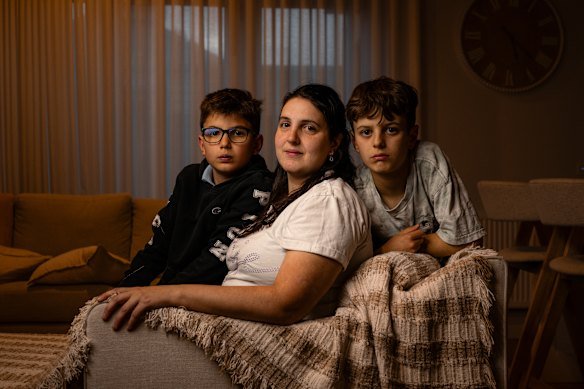
When Sylvia moved to Yarraville from Berwick in the city’s south-east in 2023 with her five children, she was struck by the thick, brown film of dust, which seemed to blanket the cars, concrete and fences outside.
“You can even see it when you go for walks to the park,” Sylvia, who asked for her surname to be withheld for privacy reasons, said. “There is dust everywhere.”
After moving, her two sons, 9-year-old Nicholas and 11-year-old Michael, began having trouble breathing. Michael, who had only had one episode of asthma as a toddler, began to get regular chest pains and was left gasping for air.
“Nicholas was also getting a very, very tight chest and wheezing,” she said. “It has only been since we moved here.”
Nicholas, who manages his condition with Ventolin, was diagnosed with asthma soon after the family moved to Yarraville and he began school.
The mother-of-five has taken her younger son to the hospital several times in the last two years, while Michael was recently diagnosed with asthma by a general practitioner.
“It’s been really tough,” she said. “It is such a beautiful area to live in, but we sometimes talk about moving out a bit further out, where the air is a bit cleaner.”
The lawyer and her husband moved to Yarraville to be closer to the city for work and have invested in measures such as air purifiers at home to try and help.
“When we take the [air purifier] filter off to vacuum … it’s disgusting,” she said. “You can see how much of that dust is captured in the filters.”
While previous studies have linked high asthma rates with lower socio-economic areas, the researchers noted the inner-west bucks that trend.
Dr Kate Lycett, a report co-author from Deakin Lifespan Institute, said it was concerning that children in the west were over-represented in the emergency department figures.
“We need to start looking at this more seriously and investing in mitigation strategies,” she said, adding that air quality was often considered too hard to tackle because it cannot be seen.
The researchers found that while families rely on GPs and pharmacists to manage asthma, many are driven to emergency departments by the terror of seeing a child struggle to breathe.
“Asthma is a scary disease,” Lycett noted. “For these parents, it’s frightening when you have a child with breathing difficulties, and many are uncertain about what exactly is triggering these flare-ups.”
Treatment usually involves administering high doses of steroids to reduce inflammation in their lungs, as well as Ventolin and oxygen.
Maribyrnong Truck Action Group president Martin Wurt described the research findings as alarming.
“It’s an absolute crisis,” Wurt said.
Wurt, who has lived in the inner-west for more than three decades, said while 24-hour truck bans on several local roads following the West Gate Tunnel project were welcome, all the measures had done was push air pollution elsewhere, not reduce it.
As part of the project, the government has enforced a 24-hour ban on six roads, including Francis Street and Somerville Road in Yarraville, and Buckley Street and Moore Street in Footscray. The Victorian government was contacted for comment.
Wurt said areas such as Williamstown Road, which is expected to get a doubling of trucks in the next five years, had been left behind when the bans were enforced.
“We’ve got one of the dirtiest, oldest truck fleets here … and these trucks are going to be going right past Yarra West Primary School, a tennis court, a skate park where kids play every day,” he said.
He is also concerned about the West Gate tunnel’s unfiltered twin ventilation stacks, which he warned will not prevent noxious fumes from reaching nearby homes.
Mounting research shows truck exhaust pipes spew out fine particulate matter and nitrogen oxide, which cause asthma, and contribute to coronary heart disease, strokes, bladder cancer and other chronic illnesses.
Australia has one of the highest rates of asthma in the world, with about 11 per cent of the population, or 2.8 million people, living with the health condition.
It is a complex inflammatory lung disease, caused by a combination of genetic and environmental factors, such as air pollution and viruses.
Children are particularly vulnerable to air pollution. A study published in the Lancet Medical Journal last year found children breathe faster and intake more air than adults, resulting in greater inhalation of pollutants. It also found their developing organs are more vulnerable to inflammation and damage.
Get fascinating insights and explanations on the world’s most perplexing topics. Sign up for our weekly Explainer newsletter.


From our partners
Read the full article here