





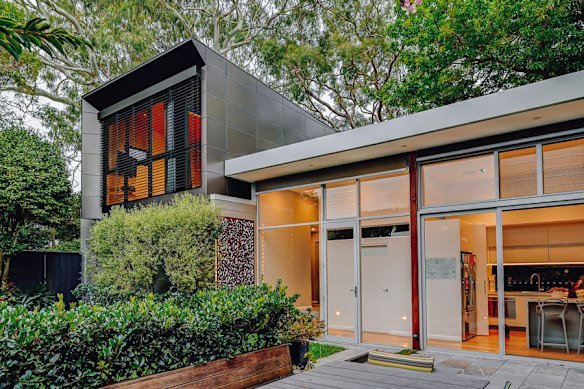
Thank you for the editorial on modular and prefab housing (“Modular homes may a magic bullet for Minns”, June 22). We have been living in our modular home for 10 years and I would never build a conventional home again. We live in a bushfire zone, and our house needed to have a steel frame and double glazing. This was standard for the company that built it. It took only 14 weeks to build and the price was fixed. Another positive was that there was minimal damage to our block, unlike what happens on conventional building sites, where trucks and tradies spend months clogging the street and flattening the ground. Two weeks after it arrived, following a 300-kilometre trip, the house was all connected and ready to go. This really is a no-brainer. We can only guess why people seem locked into brick-veneer homes, single-glazed with timber frames that are not fit for purpose in Australia’s bush environments. Robert Antill, Lake Conjola
After World War II there was great enthusiasm for the idea of prefabrication as a means of speeding up housing production and lowering costs. Designing a prototype house was a favourite exercise in architectural schools of the time, and I know Harry Seidler once produced and exhibited one that was promoted as a solution for the local market. Yet none of this has come to anything in the following 80 years. I have had some experience of prefabricated housing and have yet to see an example where it led to a significant reduction in the total cost of a house that met all the requirements of a BASIX certificate in NSW. When you include the design inflexibility of prefabrication, it becomes highly doubtful that factory-built houses can contribute meaningfully to achieving our housing targets. Perhaps our premier knows something about prefabrication that the rest of us don’t, but there seems to be more gimmickry than substance in the idea of a housing-production hub that will rely entirely on private initiative. I see public subsidies being channelled into this kind of enterprise with little public benefit to show for it. Bruce Hyland, Woy Woy
My late friend lived in the kit home shown in the video accompanying your article on the same subject (“Government goes big on pre-made homes to solve housing crisis”, June 22). It was well built and comfortable and admired by many who visited. It’s a no-brainer that these kit homes represent a viable future for the housing crisis. Dermot Perry, Mount Keira
Boost tradie ranks
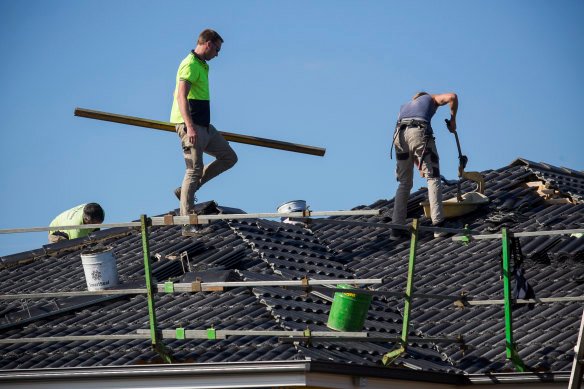
I often hear mention of the ageing workforce of tradespeople on building sites (“Australia is crying out for more tradies. Why aren’t young people answering?” June 20). Surely the problem goes back years, when career advisers, intellectuals and decision-makers pushed the agenda that tertiary education would provide students with a well-paid and satisfying career. The idea of students going on to because tradespeople by doing apprenticeships was downplayed, to the detriment of communities. Far more emphasis should have been placed on the benefits of such careers, along with the real possibilities that the future tradesperson could one day become a successful business owner. So many opportunities exist for school-leavers. With better encouragement, many more would choose to become tradespeople and business operators. Geoff Lindsay, Thurgoona
Why are there not enough tradies? Because we build a fork in the road after school – university or vocational training, degree or trade certificate. Why not have a single training institution issuing degrees to all – a carpentry or building degree alongside a law degree? Just as university students change degrees during their study, a builder might decide to switch to architecture or vice versa. Part of the reason there are not enough tradies is the elitism of universities. Remove the fork in the road and you reduce the perception of status. Neville Turbit, Russell Lea

Coalition counting
There is no doubt the housing crisis is complex, but I am struggling to understand the Coalition’s position of matching housing construction to migration levels. Last year, we built 172,000 new homes, with net migration reported at 301,000 – a big gap. But more than one person lives in each new house; indeed, the standard modelling figure assumes 2.4 persons per house. So to meet the Coalition’s target, we needed to have built only 125,000 new homes last year. That being the case, how is migration causing the housing crisis? Please explain. Ray Thompson, Randwick
Redeem dignity
I attended Redeemer Baptist School from 1994 to 2003. During that time, I had close friendships with both students and teachers from the Redeemer church “community”. Communal living has a real beauty, but in practice it often downplays our inherent individual human agency and dignity (“Inside the Sydney private school that dictates students’ choices right down to their underwear”, June 21). This system too often weaponises “sin” and “shame”. It breaks my heart that when members of Redeemer decide to leave (at great personal expense), they are shunned and shamed by everyone they know, leaving such a bad taste in their mouths that they also give up their faith. To those who do leave close-knit religious communities like Redeemer, please remember there is a loving, safe and freeing Christian community out there in forms that do not deny your independence and dignity. Rev. Steve Cimarosti, Parkes
Your report about Redeemer Baptist School was shocking but not that surprising. I can walk from my house to the school’s historic Castle Hill property, used for vocational education and for their uniform shop. Word on the street about the repressive nature of the school has been widespread for decades. I wince as I drive past, never having seen a soul in the grounds behind the high wrought iron fencing. But this is what we must come to expect when our taxes are used to support any religion that decides to set up a school. Personally, I resent every dollar I’ve paid towards private schooling. Maureen Partridge, Baulkham Hills
Your article about the Redeemer Baptist School is simply more evidence that modern, organised religion is largely concerned with control and coercion. Like many of its kind, the school exerts an Orwellian oversight on students and staff to ensure they conform to the school’s “ethics”. Of course, fear is one of many tools used to make sure everyone falls into line. Sadly, it is all too common for those who complain to face a wall of silence from those who should be taking action, yet such groups claim charity status and receive taxpayer money while the loving message of the Christian gospels is distorted by acts of cruelty and suspicion. Derrick Mason, Boorowa
Lightning rod
Sean Kelly lists many reasons why Pauline Hanson is so dangerous, but in my view missed the most important (“Hanson is extreme but she can do something rival politicians can’t”, June 22). Twenty years ago, Hanson was dismissed as a crank. That is not the case today, the reason being that Australians have become angrier. In my view as a retired psychiatrist, there are two main causes. First, the internet introduced us to the phenomenon of pile-ons, disagreeing with someone but with a level of abuse that would never be tolerated face-to-face. Australians joined in and that behaviour became normalised. Second, social media algorithms, particularly Meta, were trained to feed people outrage to keep them clicking, which turbocharged anger in the community. They would not stop it when asked. We have made a start to reduce the damage social media is doing to our children, but we haven’t been able to stop it from making us fertile ground for Trumpism. That is why Hanson can’t be ignored now. Gary Barnes, Mosman
Sean Kelly’s analysis of Hanson articulates the worrying reality of One Nation’s rise in opinion polls. Hanson’s absurd and cruel ideas are there to be seen. But in one way the details or absence of policy detail doesn’t matter. Because at the core of One Nation’s “philosophy” is one word: bigotry. I learnt from a young age from my parents, my school, my church, and from my lifelong reading that bigotry and prejudice are simply wrong and hateful. I remain hopeful that the vast majority of Australians are decent people who will reject extremist intolerance and divisive politics and banish Pauline Hanson to the fringes, where she and her views belong. Steve Ellis, Hackett (ACT)

Pauline Hanson doesn’t have a grasp of international relations, she simply wants to act on Donald Trump’s instructions to raise our defence spending to 5 per cent of GDP (“Hanson’s defence boost will cost extra $225b”, June 22). Comparing Australia to NATO is like comparing apples and oranges. Unlike the NATO countries Australia is an island country with no enemies, however, by following the US blindly, we may create them. AUKUS is a white elephant and should be replaced with more balanced defence approach that suits our needs. We shouldn’t just become an outpost of the US.
Bipin Johri, Epping
It is disturbing to learn Hanson’s defence boost will cost an extra $225b. However, has she worked out how much it will cost to abolish SBS? The staff will need to receive redundancy payments and with almost 2000 employees the cost will be enormous. Robyn Lewis, Raglan
Sean Kelly analyses Hanson’s far-right policies and practices, which echo her American mentor. The blistering paint and algae that float on the Lincoln Memorial Reflecting Pool symbolise the corruption and incompetence of the MAGA leader. The grievance agenda and tactics of One Nation are tellingly similar. It’s doubtful there are enough tarpaulins left in Washington (after the debacle at the John F Kennedy Center for the Performing Arts) to assist with the cover-up of what is happening at one of America’s sacred places. Millions around the world suffer because of Trump’s vanity. The poor, the vulnerable and minorities are just the front-line casualties in a bigger war. This is what a far-right administration looks and acts like when they get into power. Australians beware. Deb McPherson, Gerringong
Pauline Hanson, and One Nation in general, vehemently deny they are racist. I’ve met a lot of racists in my time and have noticed that pretty well all of them say they are not racist. Funny that. Alan Phillips, Mosman
It is worth noting that Hanson’s critics understand more about her policies than her supporters do (Letters, June 22). Lindsay Foyle, Stanmore
No excuses
KPMG’s excuses for failing to protect a whistleblower and instead allegedly pursuing him with acts of retaliation and revenge are ingenuous (“KPMG whistleblower reveals toll of going public”, June 22). If KPMG’s operational structure as a partnership prohibits the application of legal protections for its own staff, then perhaps the operational structures should be aligned or the laws should be changed. This situation sounds too similar to PwC’s secret use of tax documents, to which PwC had privileged access, to promote and generate profits, in conflict with its contractual commitments to the tax department. How many more of these conflicts of interest are yet to be discovered? Nell Knight, Avoca Beach
Blunt Brandis
George Brandis may have inadvertently revealed why the Liberal Party never endorsed him to become prime minister. In his opinion piece (“UK set to get a very different PM”, June 22), when discussing the likelihood that Andy Burnham will replace current PM Keir Starmer, Brandis states that “for one thing, he (Burnham) has a personality.” Warren Marks, Long Beach
Teacher knows best
I have been teaching secondary school mathematics for many years. One topic in year 10 is variation. If you have two variables, such that an increase in one causes an increase in the other – this is direct variation. However, if one variable decreases while the other one increases, then we have inverse variation. For example, in Australia, the more affluent a person is, the less likely he or she is to want to deal with the climate catastrophe. I won’t mention any names. Rod Watson, East Brighton (Vic)
Murky water
I write just in case the shark-hugging community tries to run the suggestion that sharks are just doing a “taste test” when they bite humans. This is not the same as plucking a grape to taste at the green grocers. Shark bites are potentially fatal and frighten the wits out of millions of Australians wanting to enjoy saltwater. I’d like AI-assisted water surveillance to eliminate identifiable risks. Maybe I’m dreaming, but I’d like to see the government focus less on the interests of sharks and more on us humans. Chris Commens, Rosebery
Dirty work
One of your household cleaning tips points out that equipment such as a mop, vacuum cleaner and toilet brush also need to be cleaned (“Too much product and bad technique: The 11 cleaning mistakes making your home dirtier”, June 22). It follows then that the things I use to clean those cleaning tools will also then need to be cleaned. There’s no end to it. Ross Duncan, Potts Point
- To submit a letter to the Sydney Morning Herald, email letters@smh.com.au. Click here for tips on how to submit letters.
- The Opinion newsletter is a weekly wrap of views that will challenge, champion and inform. Sign up here.
Read the full article here