






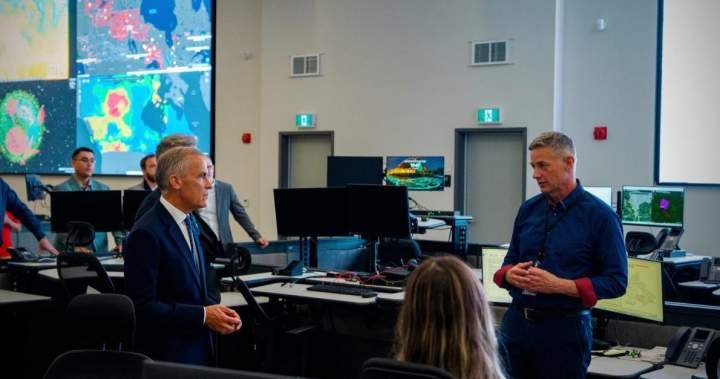
The number of workers at the federal nerve centre for emergency response was slashed by about 50 per cent earlier this year, according to the union, which says the cuts have affected the government’s response to an already brutal wildfire season in Canada.
The Public Service Alliance of Canada said in a statement Thursday that about 60 employees at the Government Operations Centre in Ottawa received workforce adjustment letters in January that eliminated their positions, representing approximately half the workforce.
The union added it has heard from its members on the ground that most of those affected workers have since left, though PSAC did not say if those workers had gone to other public service jobs or been terminated.
“The government operations centre (GOC) is responsible for coordinating our national emergency response,” Sharon DeSousa, PSAC’s national president, said in the statement.
“Gutting it by almost half puts people across the country at risk, including frontline workers who are battling wildfires, supporting evacuations, and risking their lives.”
The staff cuts were first reported by the Ottawa Citizen.
Global News has reached out to the federal government for comment.
The operations centre, which operates under Public Safety Canada, identifies high-risk events and provides round-the-clock coordination and support to key national players for national emergencies such as wildfires, floods and earthquakes. The government opened a new “state-of-the-art facility” for the operations centre in November.


Get breaking National news
Get breaking Canada news delivered to your inbox as it happens so you won’t miss a trending story.
Prime Minister Mark Carney visited the centre on Sunday to meet with workers and discuss the federal wildfire response in northern Ontario, which he said in a post on X required mobilizing “more than 5,000 firefighters and nearly 300 waterbombers, helicopters, and evacuation aircraft to contain, control, and mitigate the fires.”
“It’s an enormous, complex effort that ultimately depends on dedicated and brave individuals who work relentlessly to keep everyone safe,” Carney posted.
That visit came before Carney attended the FIFA World Cup final in New Jersey alongside U.S. President Donald Trump, who said he discussed the wildfire situation with Carney at the match.
Trump has threatened tariffs on Canada over smoke that has poured across the border and blanketed U.S. cities including New York and Detroit. The president has accused the Carney government of not doing enough to battle the fires.
Carney has led an effort to sharply reduce the size of the public service in order to find government cost savings. Departmental plans released this spring for the 2026-27 fiscal year showed federal departments and agencies are looking to cut more than 12,000 full-time equivalent jobs over the next three years.
Public Safety Canada’s departmental plan allocated $1.18 billion toward improving its emergency management strategies, which includes using artificial intelligence to increase efficiency and reduce costs.
Yet the plan also warned that the push to reduce spending was “juxtaposed against pressures to respond to new threats and priorities, attract specialized expertise and retain talent.”
“This poses capacity, operational and service delivery challenges,” it adds.
Conservatives on Thursday blasted the workforce cuts amid another dangerous wildfire season, which has also impacted provinces like British Columbia.
“The first thing a government should do is keep citizens safe,” emergency preparedness critic Blake Richards said in a statement.
“Canadians expect their government to strengthen emergency preparedness, not weaken the teams responsible for coordinating the federal response when their lives, homes, and communities are at risk.”
NDP Leader Avi Lewis also criticized the cuts in a post on X, which he said brought the workforce in the operations centre “from 100 to just 50 workers.”
“In other words, to advance major projects ‘in the national interest’ (like pipelines and military hardware), the PM has slashed the number of public sector workers who coordinate the response to emergencies ‘of a national interest,’” he said.
—with files from Global’s Jillian Piper and the Canadian Press
Read the full article here