





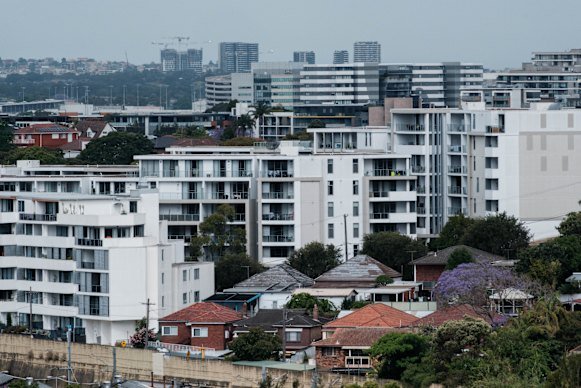
The state government has framed Sydney’s housing supply problems as a top priority, so the news that one of its signature policies is failing is deeply disappointing.
The pledge to bring an additional 112,000 homes to fill the city’s “missing middle” by 2029 is shaping up as a distant dream, writes state political reporter Max Maddison.
An analysis of the government’s low-and-mid-rise, or LMR, policy shows that four-fifths of the development applications received so far apply to single detached homes rather than the terraces and apartments required.
Most people are using the streamlined planning system to renovate existing homes rather than build more of them.
There were 13,308 dwellings in the LMR pipeline, of which residential apartment buildings accounted for about half. Just 3333 homes have been approved under the policy, Maddison reports.
The government’s commitment required 22,400 homes to be delivered each year until mid-2029.
The focus of the LMR policy is on delivering more housing choice, particularly in well-located areas of the city where more people can be accommodated but large-scale, high-density construction is not feasible.
In theory this is an intelligent approach.
Population density in urban Sydney is already significantly higher than that in other Australian cities, but it still falls well short of that in most other top-tier global cities.
This means its use of space and infrastructure is less efficient than it could be.
Adding residents in well-located areas also generally leads to more customers for local shops and services and fewer people relying solely on cars to get around.
The Sun-Herald supports the broad objectives of the government’s reforms.
It also believes that achieving high density is not as straightforward as simply stacking high-rise buildings over all available sites – no one wants to live in an unrelieved concrete jungle.
All else aside, Sydney’s character and appeal relies on its diversity of housing styles – from high-density apartment living to detached homes with backyards.
Our city is hilly and split by major waterways and there are large protected areas.
With this in mind, solving the housing crisis will require a holistic approach, and a clear-eyed examination of why current policies are falling short.
One example worth exploring is so-called “bluefield” housing, in which the character of suburbs is retained, with infill housing added around established buildings.
For example, rather than a single house with a large backyard being demolished for a duplex, this concept retains the house and adds two smaller dwellings behind it, with a smaller, shared garden.
South Australia enacted laws to smooth the way for such developments last year, but NSW’s planning barriers prevent bluefield housing from becoming more widespread.
The state government deserved and received credit when it publicly set its ambitious targets, so it cannot complain when people point out they are unlikely to be met.
It should take criticism on board and continue to refine its approach.
Creative thinking and broad public discussion is needed to sharpen the focus of the state’s housing policy.
Jordan Baker sends a newsletter to subscribers each week. Sign up to receive her Note from the Editor.


From our partners
Read the full article here