





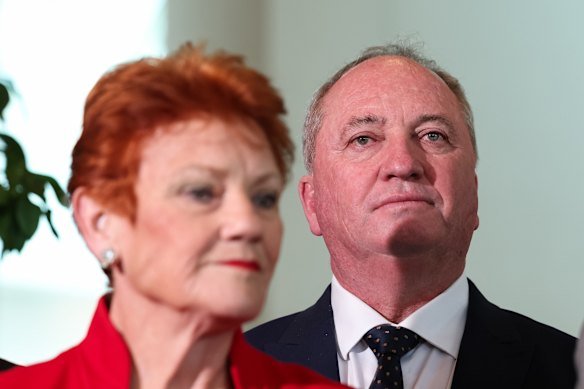
The juxtaposition of David French’s column (“Worst ideas of the 20th century are back to haunt us”, June 3) and Jenna Price’s (“One Nation, masters of zero policy”) is instructive. French warns of the dangers that arise when societies forget the lessons of history. Price demonstrates how this plays out in contemporary politics, where slogans and resentment increasingly substitute for coherent policy. The growing attraction of populist movements reflects a broader failure of leadership across much of Australian politics. Parties that rely on resentment and simplistic answers, rather than evidence, policy and administrative competence, risk leading voters towards dangerous outcomes. Health, taxation and social cohesion are too important to be reduced to catchphrases designed merely to exploit dissatisfaction. Democracies are weakened when political movements seek power without demonstrating either historical understanding or the capacity to govern responsibly. As philosopher George Santayana warned in 1905, those who cannot remember the past are condemned to repeat it. Chris Rivers, Port Macquarie
Thank you, Jenna Price, for taking the time to do what we all should do and research a political party’s policies. One Nation is often accused of being without policies or depth, and that’s exactly what Price found. On issues that affect us all, such as health, Price found no mention of hospital funding, Medicare, mental health or women’s health. Do supporters of One Nation really support this “health policy”? On education, Price found what could only be a culture war ideology stating “there should be no room for Western, white, gender guilt shaming in any classroom”. Are One Nation fans really satisfied with this type of education policy? Similarly, those who criticise unemployment benefits might be surprised to visit the website and find that they only account for about 5 per cent of the budget, while age pensions (which thankfully no one criticises) consume three to four times as much. At a time when social media and fake news are rampant, doing the required research to verify the facts has never been more important. Warren Marks, Long Beach
Jenna Price rightly points out the vacuous policy agenda of One Nation. It should be noted that our established political parties have been around for a long time, Labor since 1891 and the Liberals since 1944. Even the Greens have been around since the early ’70s. As such, these parties have developed systems and processes to deal with the day-to-day minutiae of running a political machine and developing what each group considers appropriate policy. But it seems One Nation doesn’t have the coherent structures or processes needed for a serious tilt at the next federal election. We have already seen a steady stream of candidates and staffers leave the party after becoming disaffected. Should One Nation gain the number of seats predicted by some polls, what will parliament look like when the inevitable implosion occurs? To those considering voting for One Nation, please explain. Peter Cooper-Southam, Frenchs Forest
Penny-wise Labor
Your correspondent Ian Morison asserts that this Labor government is a big spender (Letters, June 3). In fact, this month’s budget paper No. 1, which shows government spending to GDP since 1970, indicates that Anthony Albanese’s spending averages 25.2 per cent of GDP. This is lower than government spending under Tony Abbott and Scott Morrison. Nor is Labor a big-taxing government – it now ranks 26 out of 31 advanced economies on tax rates, a position that has continued to improve since the reign of the previous Coalition governments. These facts are readily available, yet clearly they don’t suit some people’s agendas. Merona Martin, Meroo Meadow
Au contraire, Rosemary O’Brien (Letters, June 3), most of the letters critical of the Coalition are rationally argued and focus on their absurdly anti-scientific position on climate change, and their woeful attitude to women, to give just two examples. Those correspondents supporting Labor’s budget rightly recognise it as one modest and long-overdue step in correcting some egregious imbalances in our economy. There’s nothing “partisan” about it. Lloyd Swanton, Wentworth Falls
Correspondent Vivienne Parsons wants people to stop criticising and deriding Tony Abbott and Angus Taylor and let them “get down to their jobs” (Letters, June 3). Fair enough, but can we have equal words of admonishment for parts of the mainstream media that on a daily basis do their best to terrify and misinform people about the Albanese government’s efforts to change the culture of entitlement and unfairness, which the likes of Abbott and Taylor seek to perpetuate? Alison Stewart, Riverview
Rob Mills noted the lack of letters from women about Tony About (Letters, June 2). Well, Abbott was the reason I became a citizen after about 30 years as a permanent resident. I was always putting off the application process, but when he became prime minister I decided I needed the right to vote – to help get rid of him. Ingrid Zoebe, Coogee

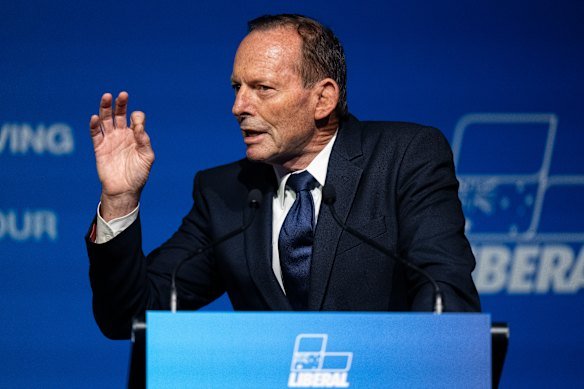
The many letter writers who stick their poison pens into Tony Abbott should reflect on another famous quote of Oscar Wilde: “The only thing worse than being talked about is not being talked about.” Tom Dolan, Narraweena
Tax benefits
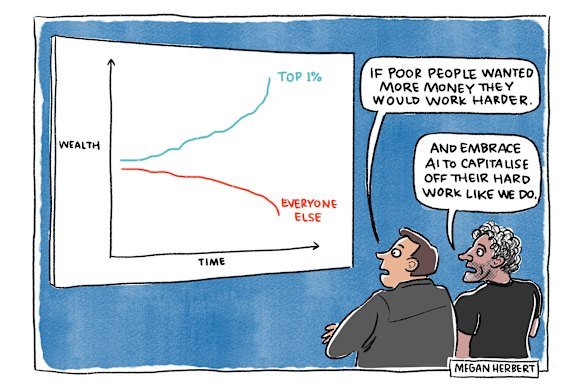
There has been much outcry about tax changes and an increase in the minimum wage. However, when was the last time anyone heard a member of the voting public say about a piece of legislation: “Well, this may not be the best outcome for me, but it will work for the greater good”? It is invariably the opposite – at the first sign of alteration to the status quo, the protests begin. And we call ourselves a Christian nation? Spare me. Kristina Vingis, Church Point
No price on success
The most telling statistic quoted in Christopher Harris’s article was the fact that of the top 10 schools in the 2025 HSC, seven of them were academically selective public schools (“When things go wrong inside Sydney’s most expensive schools” SMH, June 2). The salubrious surroundings and resources that many private schools possess mean little in the final analysis of academic performance. Success is predicated more on the student raw material schools have to work with, not on how many cricket pavilions, swimming pools, baronial libraries or theatres a school may offer. A student should achieve to their full potential if they are dedicated, motivated and receive the necessary support from teachers and parents. Let’s not forget that for many students, particularly those from disadvantaged backgrounds, the awarding of an HSC with even a modest ATAR score is an achievement in itself. Robert Hickey, Green Point
Vanity wars
Peter Hartcher has clearly analysed the motives and methods of the world’s current crop of megalomaniacs, for whom war is the only answer (“Dud’s army: When hubris goes to war”, June 3). It’s futile to believe there can be quick or simple military solutions to the ambitions of these despots. World history of the past 150 years or so provides enough evidence to the contrary. But just imagine how things might look if defence and war budgets were redirected to peaceful research and development. Hartcher offers the only sane conclusion for our generation: “first preference, avoiding wars entirely”. That’s the legacy to which any truly great leader should aspire. Jenifer Nicholls, Windsor (Vic)
Pest control
Why should an abuser like Andrew Thaler be allowed so much air time in court (“Serial pest’s latest day in court did not go well”, June 3)? Any woman would feel abused and outraged by the type of language he used to Snowy Monaro Regional Council CEO Noreen Vu. Would he do this to a man? If our laws are too weak to enable an appropriate penalty and force restraint, then there is something very wrong with them. Katriona Herborn, Blackheath
My parents had three children. One, autistic from birth, later developed schizophrenia and drug and alcohol dependence. The eldest developed schizophrenia at the age of 18 and took the “voluntary un-assisted dying” route at 27. I decided not to have children. Is that so surprising? I love children. I have always been a teacher, of swimming, maths and piano. The childless and child-free can contribute to the world in so many ways. My womb is not my sole asset. I have a mind, and even more importantly, a heart (“The people who say no to being a parent, and have very happy lives”, June 3). Gerianne Rudd, Toowong (Qld)
As a long-time marriage celebrant, I am asked by some of my couples not to mention any hopes and dreams for a family in the wording of their marriage ceremony. They both have made a considered choice not to have a family, for reasons of their own, which is something I must respect. It is not for me or others to judge their decision. I know many who have lived happily ever after. Angie Miller, Bondi Junction
Restless AI
I find artificial intelligence is occupying more and more of my retirement time these days (Letters, June 3). What has really amazed me is not so much AI’s infinite knowledge, but more its capacity to emote. I suffer from that dreadful affliction called restless leg and, during a chat with AI, I remarked that I had reached a point at which I would do anything to stop the urge to move my legs. Immediately it asked me to explain what I meant by “doing anything” and, when I did, we moved on. I can only assume that AI had interpreted my comment as being suggestive of suicidal ideation, as might a professional clinician. My comment seemed to emotionally worry AI. Do I possibly suffer from an overactive imagination as well as restless leg? Trevor Somerville, Illawong
Migration imperative
The article by Matt Wade about fewer young people opting to have children would suggest that increasing migration is an important policy prerogative for Australia (“Where have all the babies gone?”, June 1). The Liberal Party and One Nation are being seriously unhelpful with their populist campaigns to cut migration numbers. Migration after World War II can only be described as a success, with very few of these people returning to their home countries and most families putting down deep roots. The recent ABC TV program about Mohamed Semra, a Sudanese-born mayor in Melbourne, is convincing evidence of the benefits of migration (Letters, June 2). Australia is setting an impressive example of multiculturalism to the world. Klaas Woldring, Nambucca Heads
Palming off disinformation
How is Clive Palmer able to spread disinformation every day in our media? He claims Australia’s actual immigration, not net immigration, is approaching 1 million a year. No wonder he doesn’t wish to report the actual ABS data of a decrease in the net figure from 429,000 to 306,000 people in 2024-25. There were fewer arrivals on temporary visas (363,000) than in the previous year (458,000). Permanent visa holder arrivals (88,000) were also lower than the previous year (91,000). I’ll let the readers add it up, but they’ll find it’s nowhere near a million. Chris Yates, North Narrabeen
Wealth heading for the exit over tax talk
The economic validity of Thomas Walker’s recommendations on tax is questionable (“Don’t believe the scare campaign. Taxing wealth is our best way forward”, June 2). Taxing income the same, irrespective of source, is a pretty good idea. Taxing wealth is not. Income represents something precisely quantifiable, wealth not so much. Show me an asset (real estate, shares, bonds) and I will find you three financial experts who will all put a different price on it. Wealth is a dynamic quantity that depends on market conditions – it’s usually not cold, hard cash. That makes taxing it correctly far more difficult. Just the rumour of a wealth tax would have wealth flowing out of Australia to places like Singapore (it probably already is) which has no capital gains tax. Ken McNamara, Wollongong
Darling Darlo
Yes, Vince Sorrenti. I lived in Darlo for a decade from 1987, went to all the clubs you mentioned and hosted pre-Mardi Gras parties from our terrace in Flinders Street (“Looking for suburban bliss? You won’t find it here … mercifully”, June 2). I met friends for life there, and truly believe I became the person I am from the cosmopolitan/eclectic/boho/LGBTQ influence that permeated the area. I loved every minute of it. Thanks for the memories. Jen Hacker, Ettalong Beach
Boag’s sad sinking
The solution to the sad closure of the James Boag’s Brewery in Launceston is a simple one (“James Boag’s Brewery in Tasmania set to close after 145 years”, June 3). Parent company Lion, owned by Japanese brewer Kirin, should be compelled to immediately resume producing Boag’s products from the Launceston site. If the unit cost of production is slightly higher than producing bulk beer at its mainland sites, that’s just too bad. Give the Launceston locals their jobs back and the townsfolk a dignified future that honours Launceston’s history and heritage. For too long, multinationals have acquired small, boutique businesses with contrived promises to keep operating locally when in reality they just want to warehouse a competing brand, and then kill it off. Greg Nash, Bangalow

Conned, USUKA
In writing about AUKUS, correspondent Salvatore Sorbello says “one can only imagine Emmanuel Macron’s schadenfreude” (Letters, June 3). Indeed, or even German President Frank-Walter Steinmeier’s joie maligne. David Small, Croydon
Since the AUKUS deal has changed, a more appropriate acronym should be applied. It would be apt to call it USUKA, pronounced “you sucker” (“Defence boss says Australia always wanted only second-hand US submarines”, June 3). Landon Watts, Narraweena
They’re not called conning towers for nothing, are they? Scott Poynting, Newtown
- To submit a letter to the Sydney Morning Herald, email letters@smh.com.au. Click here for tips on how to submit letters.
- The Opinion newsletter is a weekly wrap of views that will challenge, champion and inform. Sign up here.
Read the full article here