





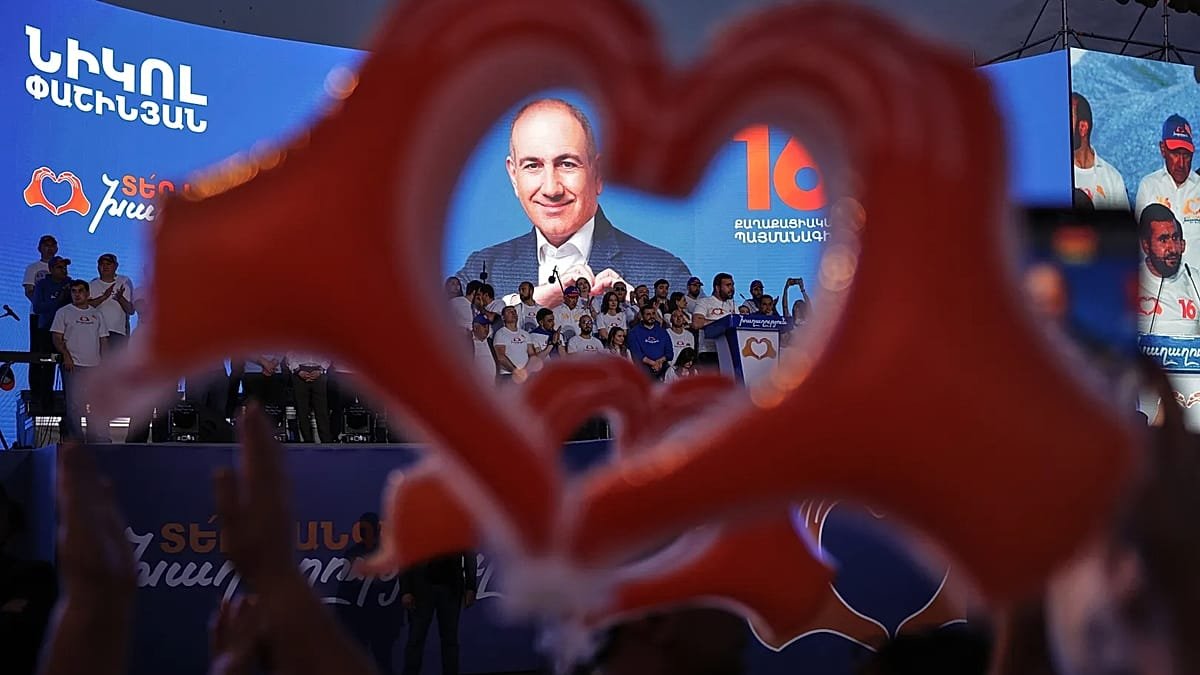
Armenians decided to turn the page on their tumultuous political past and give incumbent Prime Minister Nikol Pashinyan a strong mandate for a balanced, pro-West future, in what Pashinyan said was a “historic victory that will ensure Armenia’s eternity and development” in his address following the vote.
Pashinyan pledged to “continue the course of rapprochement with the West” while also developing Armenia’s relations with Russia, reaffirmed Yerevan’s commitment to peace and regional cooperation and said that strengthening the peace process with Azerbaijan and normalising relations with Turkey will continue to be key priorities for his government.
He said that the Armenians gave him significant backing in a show of support for peace, regional prosperity and cooperation.
“The Armenian people voted for regional prosperity and cooperation and I hope this will draw a positive response from Turkey and Azerbaijan,” he told a news conference. “We need to institutionalise peace between Armenia and Azerbaijan.”
After the final results were announced, European Commission President Ursula von der Leyen said, “Armenia can count on us,” as she congratulated Pashinyan on his victory.
“We deeply value our partnership with a democratic Armenia that is drawing ever closer to Europe,” von der Leyen added.
The EU has fully endorsed Pashinyan in the elections and built an economic support package to help alleviate the Russian economic restrictions slammed on Yerevan during the election campaign.
The result of the vote on Sunday also signalled diminishing influence in a region once dominated by Russia, despite Moscow’s threats and claims of interference.
While Armenia and Russia are technically allies, Moscow has compared the former Soviet republic’s ambitions to join the European Union to one of the reasons it triggered its 2022 full-scale invasion of Ukraine.
The key question now is what is next for Yerevan and Moscow after Russia warned that Armenia’s pro-West course could expose it to a “Ukraine scenario,” as Russian President Vladimir Putin said recently.
Stephen Nix, the regional director of the International Republican Institute’s Eurasia Program told Euronews in Yerevan that “much is at stake as this election will determine Armenia’s future trajectory.”
“The real question is not what direction Armenia is going to go, we know that. What will be the reaction of Russia and the other neighbours,” Nix asked.
“We assess that Russia may continue to try to embargo goods from Armenia and we have to remember that almost all of Armenia’s oil and gas is imported from Russia.”
Nix, who led a team of election observers across the country, said the voting was calm and peaceful, and he hailed the voting turnout.
Richard Giragosian, director of the Regional Studies Centre in Armenia, told Euronews in Yerevan that “the re-election of Pashinyan’s government is really not a surprise.”
“What I would much more focus on is the day after the election,” he said.
Giragosian said he expected “a continuation of prudent policies” regarding Russia and that “this isn’t about the EU versus Russia, this is the Armenian government’s delicate balancing act.”
“I see the tension with Russia which was pre-existing as quickly dissipating. In other words, what Is expect is the re-elected prime minister of Armenia going first to Moscow to reassure Russia that Armenian remains committed to the Eurasian Economic Union,” he said.
“Russia in turn will ease restrictions on Armenia’s imports and exports, yet Russia over the longer term does rely on economics and trade as structural leverage over Armenia,” the Armenian political analyst told Euronews in Yerevan.
“Despite the geopolitical context the real issue here is sustaining the momentum of the government’s policies in terms of normalising relations with neighbours and diplomatic engagement with Azerbaijan and Turkey,” Giragosian said.
“The second real importance of this election is Armenia’s third back-to-back genuinely free and fair election.
“However this is the very same government that has been too often tempted to cut corners and take shortcuts in democratic governance, so we do see a number of challenges facing the incoming government, including, beyond foreign policy, economics, anti-corruption, and a return to the rule of law,” Giragosian concluded.
Georgian Prime Minister Irakli Kobakhidze was the first to congratulate the Armenian premier, just as the vote count was starting on Sunday evening.
Kazakhstan’s President Kassym-Jomart Tokayev also congratulated the Armenian premier, wishing him success in advancing Armenia’s long-term national interests and reaffirmed Kazakhstan’s readiness to continue active cooperation across various fields, according to a statement by Korda news agency.
With more than 60% of the votes counted, the Civil Contract party is leading against Russian-Armenian billionaire Samvel Karapetyan’s Strong Armenia alliance by 51.2% to 23%, the Central Election Commission said.
Two other opposition forces, ex-president Robert Kocharyan’s “Armenia” alliance and the Prosperous Armenia party, also cleared the electoral threshold, winning 9.9% and 4.1% of the vote respectively.
Turnout was 59%, the commission said.
Russia pushes pressure points
The election comes after years of upheaval since Pashinyan was propelled to power in a 2018 street revolution.
Pashinyan conducted a fiery election campaign, telling Armenians that their future is at stake and openly confronting critics and the opposition who accused him of giving up on Karabakh and betraying the country, in a key message that he closed the chapter with Azerbaijan to forge a peaceful and prosperous future for the South Caucasus region.
While US President Donald Trump offered his “total endorsement for re-election” to “great friend and leader” Pashinyan, Moscow has bristled at the prospect of losing yet another ally in its backyard.
“We will accept any choice made by the people,” Pashinyan told journalists at a polling station in Yerevan after casting his ballot.
He pledged Armenia would pursue a balanced foreign policy after the vote, insisting “there is no question of choosing” between Russia and the West.
The Kremlin has been accused of seeking to sway the vote.
Analysts have noted misinformation on the web, hacker activity and Kremlin-friendly narratives portraying Western cooperation as dangerous.
In the weeks before the vote, Russia banned the import of several key agricultural products as well as its renowned brandy and wine, seen as a move to heap economic pressure on the country.
Armenian officials have warned that “enemies of freedom” are funding propaganda efforts.
‘Voted for peace’
Pashinyan has insisted he does not want a rupture with Moscow, but the campaign played out as a battle over Armenia’s geopolitical future.
Pashinyan and his chief opponents all accused each other of risking a fresh conflict.
Pashinyan told voters Armenia could face a “catastrophic war” with Azerbaijan within months if his party failed to secure a strong majority.
His opponents called that rhetoric fear-mongering.
Opposition parties accused authorities of electoral violations and repression, particularly against their campaign staff.
Armenia’s Investigative Committee said it had opened 59 criminal cases over alleged electoral violations, including multiple voting, and detained nine people.
Strong Armenia’s leader Karapetyan has rejected claims that he would drag Armenia back into Russia’s orbit, but warned against Pashinyan’s “reckless rush” to the West.
He has been under house arrest since last year on charges of plotting a coup, allegations he rejects as politically motivated.
Still, for many Armenians, the opposition remains associated with Russian influence and oligarchs.
“I voted for peace. Only Pashinyan can bring peace,” one voter, 63-year-old craftsman Hakob Hakobyan, told the AFP news agency.
Another voter, Khachatur Movsisyan, a 59-year-old mechanical engineer, said he had backed an opposition party “because the country, and all of us, need change, in foreign policy, domestic policy and in negotiations with Azerbaijan.”
Read the full article here