





For most Melburnians, my suburb is interchangeable – in name or direction – with a shopping centre. Their entire view of the place where I have lived for seven decades is based on their experience of Eastland, our retail adventure playground. I get it – there’s a lot to see there. The shopping centre is coming up for its diamond anniversary next year and has grown into the third-largest centre in Australia in terms of the number of shops.
Costco is a stone’s throw across the road from Eastland, which adds another opportunity to spend. Once you’ve visited the shops, had a haircut and a massage, seen a movie or eaten from the array of food outlets you might well ask if this suburb is nothing more than Chadstone, Fountain Gate or the Highpoint of the east.
Yet, Ringwood is more than the shopping experience.
For a start, it has since the 1960s been an unlikely centre of Melbourne’s music culture. Many of the local schools have actively promoted the arts – music, acting, painting and writing. Most of the families are middle class and the pressure on students to get out into the workforce hasn’t been as strong as elsewhere. So there has been an opportunity to follow your passions. Half the Skyhooks (bassist Greg Macainsh and drummer Freddie Strauks) attended the local high school and were prominent in local bands before the Skyhooks came together. Roger Hart-Wells, of Little Heroes, artist Herman Pekel, and a string of actors in Home and Away, Neighbours and The Sullivans came from Ringwood.
Ringwood was full of great, yet small, music venues. Church halls, Scout halls and the Ringwood Town Hall were THE places to go on a Saturday night. The Piccadilly nightclub at the Town Hall drew the likes of John Farnham, The Masters Apprentices and Johnny O’Keefe. The former skating rink Iceland on Maroondah Highway was the unlikely, but popular, venue where many Melburnians first saw AC/DC, Billy Thorpe and Cold Chisel. A generation later, in the ’90s and 2000s, Ringwood was home to Jooce nightclub – the largest single-level club in this hemisphere. These days, music still reverberates but in smaller bars, clubs and pubs.
Ringwood has always loved a big event. While the Highland Games and Ringwood Festival have been renamed and moved to neighbouring Croydon, due to lack of a sizeable green space in central Ringwood, we have retained the Ringwood Eisteddfod, still going after 71 years, showcasing a vast range of musical talent. I find the local theatre venue Karralyka a wonderful place to enjoy live entertainment. Not only because my wedding reception was held there, but it sits atop what I call the spiritual home of Ringwood, the former location of gold and antimony mines. There is also evidence in recent archaeological surveys along Mullum Mullum Creek that the local Indigenous inhabitants frequented the area.
Ringwood has long been multicultural. From the 1870s onwards, Germans, English and Irish tended the local orchards side by side. As a proof of strong multinational unity during the wars, no one suggested internment of our German resident aliens, unlike in Langwarrin and Tatura. After the Second World War more migrants came from Europe, particularly Italians, Dutch and Hungarians. Italian families set up businesses in Ringwood such as Pronto Concrete and fruit shops that are still operating today. The Dutch ran various manufacturing or marketing companies and brought soccer here, initially as the Wilhelmina club, now rebadged as Ringwood City Soccer Club. Many of our stars, such as footballer Paul Vander Haar and Pekel, the artist, had Dutch parentage. Ringwood remains a place to enjoy each other’s culture, music, art, food and, of course, company.
My family arrived in Ringwood along with the wave of Baby Boomers who settled here after the war. Using government compensation money upon his return from service overseas, my father built a small weatherboard house with no mod cons. That meant no shower or indoor toilet. We made do and there could be something peaceful about taking a night visit to the outside dunny and chatting to the resident possums, bats or owls, or taking in the constellations above.
It was a semi-rural atmosphere in Ringwood then. There was abundant wildlife such as snakes and lizards and kangaroos, bats at night, birds of all species, and plenty of trees to climb and butterflies to chase. More than anything, Ringwood was always green with pockets of serenity. It still is, once you venture a few hundred metres from the high-density zones.
Being the president of Ringwood & District Historical Society, you may think I yearn for the past. Not so. History is interesting and fun to study but that’s all it is. Do I want to return to when my mum washed clothes and sheets in a concrete trough, me lighting the Everhot wood stove every morning to get some hot water, food cooked or the kitchen heated up, or Dad burying our toilet waste in the vegie garden before the pan service came along? I don’t think so!
Many elements survive from the bush setting I grew up in. The Ringwood Lake, formed by damming a creek that once inconveniently crossed Maroondah Highway, is today the home of ducks and other birdlife and a place for weekday kids’ playdates, or for families who want to cook a snag and run around on weekends. It is well worth walking up to the east end of the lake to see the historical mining display.
Mullum Mullum Creek still flows through Ringwood, though there are far fewer of the snakes that were once abundant. The Memorial Clocktower built in 1928 stands in the centre of the city and its hourly chimes remind people of the sacrifices made by local families, not only in war but rebuilding their lives during the intervening peace.
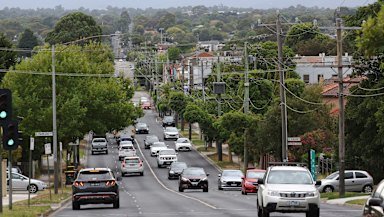
Bike and walking trails are well used, all within spitting distance of central Ringwood. While Ringwood hasn’t reached the building heights of our neighbouring suburbs, the quarter-acre blocks are quickly being replaced with dual-occupancy houses or blocks of apartments. Ringwood has been targeted as an activity centre by the state government, with a view to squeezing more people around the railway station and Eastland shopping precinct.
While it seems logical that more people will gravitate to the area, parking and road congestion are growing problems. Cars are still an essential household item for residents and the theory of cycling or using public transport doesn’t hold water. Children don’t walk to school as they once did. With the proliferation of private schools spread around the Ringwood area, dropping off students is commonplace. Then rushing to after-school sport creates the second traffic jam of the day. Most sporting complexes and ovals are at least a kilometre out of central Ringwood.
During the day the elderly and retired can head for the local men’s shed or U3A. Some walk along tracks or get some lawn-bowling in at Ringwood Bowls then settle at a local cafe or dine at Ringwood RSL or the Ringwood Club.
Four generations of my family have lived in Ringwood. I look out the window today and the kids are still playing, people are still walking dogs or cycling. Ringwood has always been a pleasant place. I can’t see any reason not to live here.
Russ Haines is president of Ringwood & District Historical Society and a grandfather.
The Opinion newsletter is a weekly wrap of views that will challenge, champion and inform your own. Sign up here.


From our partners
Read the full article here