





An executive with Enbridge Inc. says the company is unfazed by rival oil pipeline expansions likely to jockey for oilsands producers’ business.
If anything, the stepped-up competition is a good sign, said Colin Gruending, who leads Enbridge’s liquids pipelines business.
“We’ve seen other competitors respond to the quite favourable outlook in the Canadian basin, which is not surprising,” Gruending told analysts on a conference call to discuss first-quarter results Friday.
If customers do sign long-term contracts on competing proposals, Gruending said he would “view it as a positive sign and a vote of confidence in the basin and in the outlook.”
Chief executive Greg Ebel said the macroeconomic landscape is the strongest he’s seen in more than a decade, as the global oil and gas supply crunch, triggered by the war in the Middle East, drives up demand for the services Enbridge provides.
“It’s actually lining up to be a super favourable environment for oil infrastructure in North America, both domestically and export-wise.”
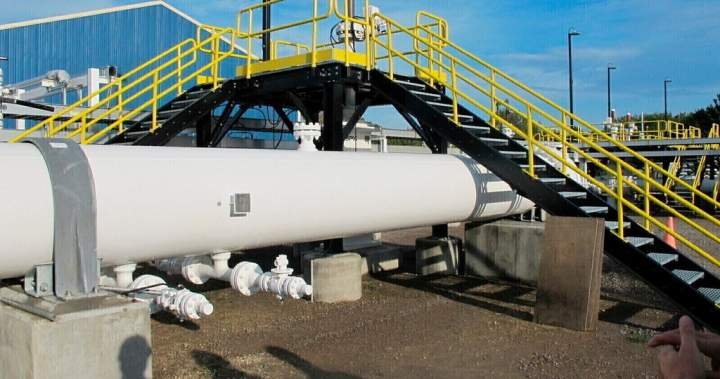
Calgary-based Enbridge is in the midst of expanding its vast network in Canada and the United States including the Canadian Mainline which is the backbone of Canada’s oil transportation infrastructure and also feeds crude to many markets south of the border.
Work on an initial 150,000-barrel-a-day phase of its Mainline Optimization Program is underway.


Get weekly money news
Get expert insights, Q&A on markets, housing, inflation, and personal finance information delivered to you every Saturday.
Enbridge expects to make a decision on whether to proceed with a second 250,000-barrel-a-day phase later this year. To support the second phase, Enbridge has launched formal processes to gauge customer interest in two U.S. pipeline expansions serving the U.S. Gulf Coast.
Gruending said an advantage of a Mainline expansion is the relative speed at which it could get up and running, as it would boost output from existing infrastructure and not require new pipe at a large scale.
Enbridge competitor South Bow has its own cross-border pipeline plans in the works with a project called Prairie Connector.
It is now going over bids it received for a project that would carry Alberta crude to the Canada-U.S. border and various points south, using dormant infrastructure that had been meant for the defunct Keystone XL expansion project. It could link up with a separate project being pursued by Bridger Pipeline LLC from Wyoming to the Canada-U.S. border, that recently received a permit from U.S. President Donald Trump.
Meanwhile, plans are afoot to send more Alberta crude to the West Coast for export to Asia. Crown corporation Trans Mountain Corp. is looking at a series of expansion projects to boost the amount of crude it can ship to the Vancouver area.
Earlier Friday, Enbridge reported a first-quarter profit attributable to common shareholders of $1.67 billion, down from $2.26 billion a year earlier.
That amounted to 77 cents per share for the quarter ended March 31, down from $1.04 per share in the same quarter last year.
The company said the drop was primarily due to non-cash, unrealized changes in derivatives used to manage foreign exchange, interest rate and commodity price risks.
On an adjusted basis, Enbridge says it earned 98 cents per share in its latest quarter, down from an adjusted profit of $1.03 per share in the first quarter of 2025.
The company says its secured capital backlog stood at $40 billion as it sanctioned several projects including the Cone project, an onshore wind facility in Texas that will support a data centre for Meta Platforms Inc.
Enbridge is also going ahead with growth at its Tres Palacios natural gas storage facility and an expansion of its 60 per cent owned Vector Pipeline.
Read the full article here