




When Caroline Rivest broke her ankle a few years ago, a doctor prescribed her a powerful opioid for three months to help with the pain. She was hooked in no time.
After her prescription ran out, she turned to the black market to keep the withdrawal at bay.
“What struck me was that nobody had told me just how dangerous it was. Just how much it could change my life,” Rivest said Thursday afternoon at an opioid-support centre in Montreal called Méta d’Âme.
She was there filling out paperwork with Olivia Wawin, a lawyer involved in a class-action lawsuit against eight manufacturers and distributors of opioids that was given the green light to proceed by Quebec’s Superior Court in 2024. When the lawsuit was authorized, it targeted 16 companies, several of which settled, paying a total of about $22 million. Eight defendants remain.
But while the lawsuit is making its way through the courts, Wawin and other lawyers in the case are having trouble reaching potential members of the class action. Some are experiencing homelessness; some are in jail; others are in long-term hospital care.
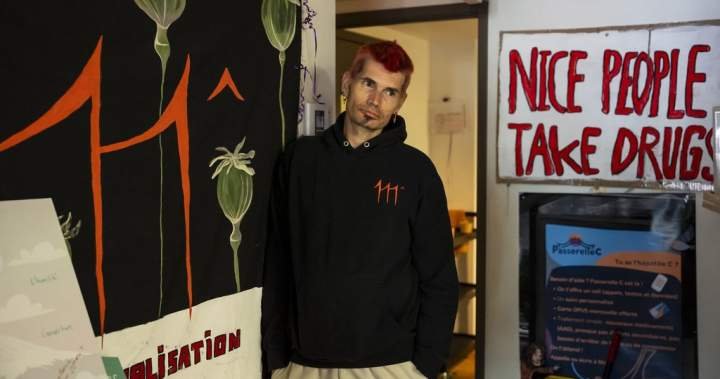
In response, the lawyers are visiting or sending information to pharmacies, jails, hospitals, and community organizations to try to meet eligible members where they are — hence Thursday’s event at Méta d’Âme, a day centre where current and former opioid users can get services including adaptive housing. It’s one of the only organizations in Quebec geared specifically toward opioid users.


Get daily National news
Get daily Canada news delivered to your inbox so you’ll never miss the day’s top stories.
Méta d’Âme is where Rivest heard of the lawsuit and the potential for compensation. To be eligible as a member of the class action, one must have been prescribed opioids and diagnosed with opioid use disorder, also known as opioid addiction.
Margo Siminovitch, with law firm Fishman Flanz Meland Paquin LLP, says some 13,000 people in Quebec have been treated for opioid addiction. “And those are the ones that are actually getting treatment,” Siminovitch said. “So, the problem is big.”
To date, about 1,400 people have registered as members, though they may not all be eligible.
Barbara Rivard and Christopher Kucyk are community workers at Méta d’Âme and said Thursday that Siminovitch, Wawin and other lawyers in the case have the right approach. Rivard helped co-ordinate the meetings between Méta d’Âme clients and lawyers.
Kucyk said he’s not surprised to hear that fewer than 1,500 people have signed onto the lawsuit because those in the throes of addiction “are just thinking about their next fix.” Others, Rivard said, might be overwhelmed by the process or don’t know they could be eligible.
The class-action lawsuit alleges the eight companies knew how addictive the drugs were but deliberately misrepresented those risks, leading users to become dependent. Siminovitch says an appeal to the authorization of the class action, filed by the defendants, was rejected.
During the proceedings ahead of the class action’s authorization, defendants had argued that the lawsuit treats all opioids as if they were the same, and that it provided no evidence that all opioid medications are addictive. The companies denied misrepresenting the effects of their drugs and said the class action included firms whose drugs the representative plaintiff had never consumed.
While Siminovitch’s firm has about $22 million to distribute from the settlements, she says it’s been difficult to reach those who would be eligible for the money.
The class action’s lead plaintiff is former construction worker Jean-François Bourassa, who had been addicted to an opioid for more than a decade. He fell off a roof in 2005 and was prescribed an opioid for years until he chose to stop in 2018 after it wreaked havoc on his venous system.
“It was really trivialized back then,” says Bourassa. “They weren’t even calling them opioids yet, they were just painkillers.”
He says he will have to use methadone — a synthetic opioid that helps reduce withdrawal symptoms — for the rest of his life. His addition, he said, has made his life a “living hell” and he filed the lawsuit to help others like him.
Opioids excluded from the lawsuit are OxyContin and OxyNEO, which were the subject of a separate, national class action that was settled in 2023, as well as opioids that were exclusively used in hospitals.
The deadline to sign up as a potential member of the class action is July 31, but Siminovitch is considering asking the court to extend the deadline by six months to allow more members to come forward.
Siminovitch says lawyers will support all potential members with the necessary paperwork, which includes accessing medical and pharmaceutical records.
The Quebec lawsuit is separate from the Canada-wide class-action against more than 40 opioid manufacturers filed by British Columbia in 2018. Those legal proceedings are ongoing, though Purdue Pharma settled for $150 million in 2022.
Read the full article here