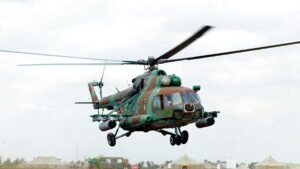






Polish fighter jets were scrambled on Wednesday morning after a Russian Mi-8 military helicopter entered Polish airspace near Braniewo in the Warmian-Masurian region.
According to the Operational Command of the Armed Forces, the aircraft approached from Russia’s Kaliningrad Oblast at 11:08 local time.
The helicopter remained in Polish airspace for around 42 seconds, entering Poland by approximately 300 metres.
The Russian aircraft’s flight was continuously tracked by Polish radar systems.
Polish fighter jets scrambled
The armed forces reacted immediately to the violation of Polish airspace. Fighter jets were scrambled and ground units remained on standby.
The Operational Command of the Armed Forces assessed that the nature of the incident may indicate an attempt to test the readiness level of Poland’s air defence.
“The nature of the incident indicates that Russia is once again testing the readiness of our air defence” – the Operational Command of the Armed Forces said.
The military underlined that the system protecting Polish airspace operates around the clock.
“The crews of Poland’s air defence systems maintain round-the-clock surveillance and remain in constant readiness to ensure the security of Polish airspace” a statement by the Operational Command of the Armed Forces added.
Polish skies under constant surveillance
Wednesday’s incident took place on the same day that NATO fighter jets were also scrambled in the morning, in response to Russian strikes on Ukrainian territory.
Because of the threat, residents of the Lublin region received an RCB alert. Operations at the airports in Lublin and Rzeszów were also temporarily suspended.
Later, the Operational Command announced that military aviation activity in Polish airspace had been brought to an end.
The military explained at the same time that the boom heard in the central part of the country was linked to combat aircraft breaking the sound barrier.
“Air operations were conducted in a controlled manner, in accordance with the applicable regulations and safety procedures” – it was stressed.
Russia steps up provocations
Wednesday’s incident is the latest in a series of recent events involving Russian aircraft near Polish airspace.
The day before, Deputy Prime Minister and Defence Minister Władysław Kosiniak-Kamysz announced that Polish fighter jets had intercepted a Russian Ilyushin Il-20 reconnaissance aircraft.
The aircraft was then about 40 kilometres from the Polish coast.
“Russia is regularly testing NATO’s eastern flank”, the defence minister said at the time.
Similar situations had previously occurred, among other places, in the areas of Łeba and Koszalin. The Operational Command reported that the number of interceptions of Russian aircraft along NATO’s eastern flank had increased by more than 250 percent.
On Thursday, fighter jets were scrambled twice following an attack on western Ukraine, as reported by Euronews. Sirens sounded in the Subcarpathia and Lublin regions, and operations at the airports in Rzeszów and Lublin were temporarily halted.
Prime Minister Donald Tusk said at the time that a Russian drone had hit a petrol station in Ukraine near the border crossing at Dorohusk. A similar situation was repeated on Friday morning, when the alert lasted until around 9:00.
Another incident involving a Russian drone was also recorded in September. In the middle of the month, on the beach at Rusinowo near Jarosławiec in the West Pomeranian region, a Russian Gerbera 2 unmanned aerial vehicle was found and recovered from the Baltic Sea.
On 3 September, Deputy Prime Minister and Defence Minister Władysław Kosiniak-Kamysz announced on X that he had decided to expand the protection of Polish airspace.
This is linked to the increased number of Russian provocations and acts of aggression against Poland.
“Recent weeks have shown that provocations from Russia are taking different forms and pose a threat in places that until now have been considered safe” – the deputy prime minister wrote on his X account.
He also assured that Poland is constantly monitoring the situation on its eastern border.
Read the full article here