



San Francisco‘s bruising fight over an iconic coastal roadway has already spawned a citywide ballot measure, a supervisor’s recall and millions of dollars of political warfare — now it’s headed for round four.
The city’s Department of Elections confirmed Thursday that a ballot measure seeking to rip apart Sunset Dunes Park and reopen the upper Great Highway to vehicle traffic has qualified for the November ballot, teeing up yet another bitter showdown over the former Ocean Beach roadway, which runs next to the Pacific Ocean along the western edge of San Francisco.
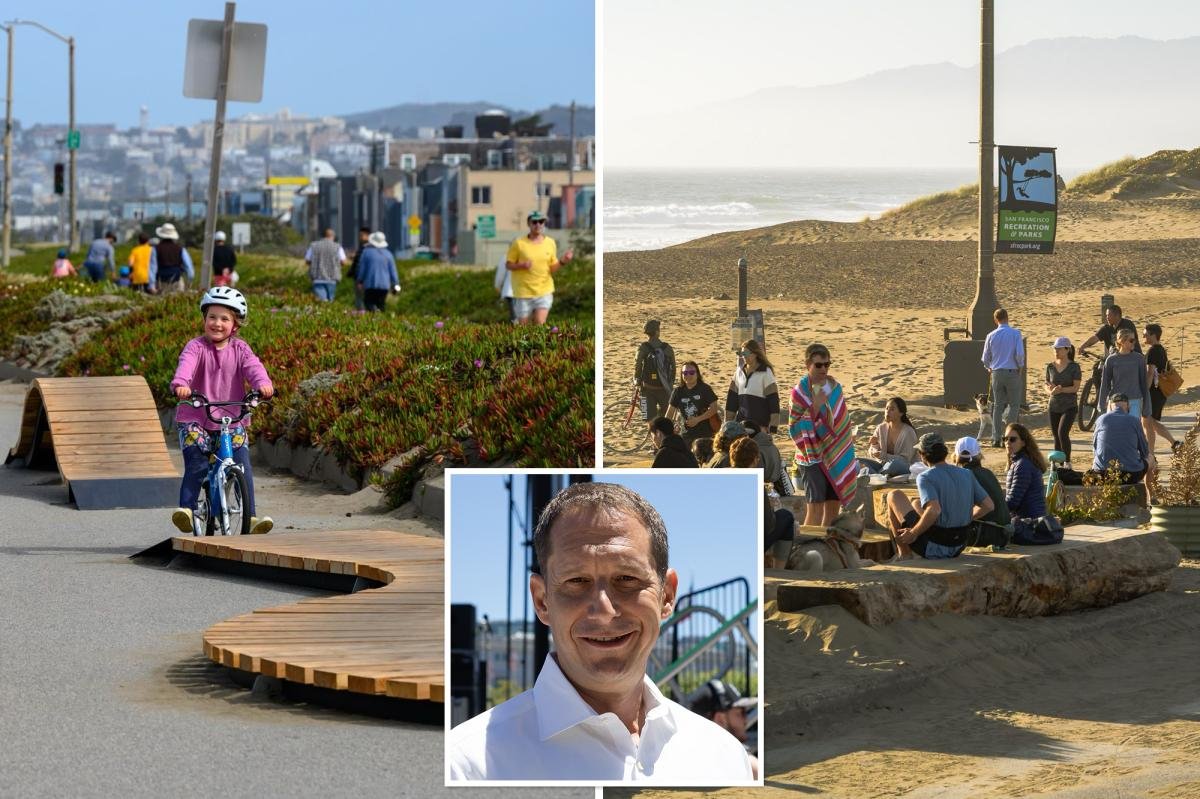
The measure would reverse Proposition K, a 2024 voter-approved transformation of the freeway into Sunset Dunes, a two-mile oceanfront park that opened in April 2025 and features picnic areas, hammocks, fitness equipment, skate and bike amenities, and seating overlooking the Pacific.
Opponents wasted no time blasting the new proposal as an expensive and unnecessary attempt to undo what voters have already decided.
“Demolishing one of the city’s most used parks isn’t just an awful idea, it’s a boondoggle that would cost taxpayers tens of millions of dollars with no upside,” Lucas Lux, president of Friends of Sunset Dunes, told The Post.
Lux said the measure would require the city to dismantle every park feature, eliminate weekday access to the park — when supporters say roughly 60% of visits occur — and erase what advocates describe as one of San Francisco’s most successful new public spaces.
“Data has debunked any remaining traffic concerns,” Lux said, “and local businesses are flourishing thanks to the park, which this measure would destroy.”
An analysis by city agencies, including the San Francisco Municipal Transportation Agency, estimates it would cost more than $14 million to dismantle Sunset Dunes and restore the roadway. Opponents have argued the ultimate price tag could approach $20 million once demolition and related work are complete.
Over the last six years, the Great Highway has become one of San Francisco’s most politically combative issues since the roadway was first closed to regular traffic during the COVID-19 pandemic. What began as a temporary emergency measure has evolved into a years-long debate over transportation, recreation, climate adaptation and neighborhood quality of life.
In 2022, voters ultimately approved Prop. I, making the closure permanent — along with John. F Kennedy Drive in Golden Gate Park — and paving the way for Sunset Dunes Park in a subsequent vote. But the controversy hardly ended there.
Last September, furious west-side residents successfully recalled Joel Engardio, a city and county supervisor who led the ballot measure to create Sunset Dunes. They argued that Engardio failed to gather community input as the Great Highway served as a key traffic corridor, leading to longer commutes and less neighborhood parking. That fight featured $1.1 million in total spending on both sides, following a $1 million battle on Prop. K.
Mayor Daniel Lurie, whose camp declined comment, quickly found himself mired in the mess after his appointed successor, Beya Alcaraz, lasted a little more than a week as a Sunset supervisor.
The San Francisco Standard and other media outlets soon found Alcaraz had paid her former pet store employees under the table while allowing scores of mice to die as the shop was littered in rodent feces.
On a second attempt, Lurie appointed Alan Wong, who is reportedly supporting the new ballot measure.
Now, after all that, voters will be asked to revisit the fight once again.
Supporters of preserving Sunset Dunes include state Sen. Scott Wiener, a majority of the Board of Supervisors and neighborhood organizations.
“The voters of San Francisco already voted to allow San Franciscans to adapt to climate change in a positive and joyful way that is to the benefit of all,” Supervisor Myrna Melgar said in a statement.
“This cynical and expensive attempt to destroy a beautiful park will fail.”
Supervisor Stephen Sherrill argued the city has more pressing priorities.
“Spending nearly $20 million we don’t have is irresponsible,” Sherrill said in a statement. “Let’s stay focused on clean and safe streets, and on addressing the massive housing crisis in our city.”
Supporters of the ballot measure counter that partially reopening the upper Great Highway to cars would restore a key transportation corridor, improving neighborhood traffic circulation and reversing a misguided experiment.
Jamie Hughes, a spokesperson for the effort to reopen the Great Highway, told the Post that he enjoys Sunset Dunes — but it’s not getting enough use beyond the weekends, and traffic impacts have not receded. He added that new measure would still ban cars from Fridays at 6 pm to Mondays at 4 am.
“Now that people have more understanding of what kind of happened [with Prop. K] and have seen the results of what Sunset Dunes has produced — which is not much — I think people are feeling differently and there has just been more sentiment to vote on this,” Hughes said.
Read the full article here