



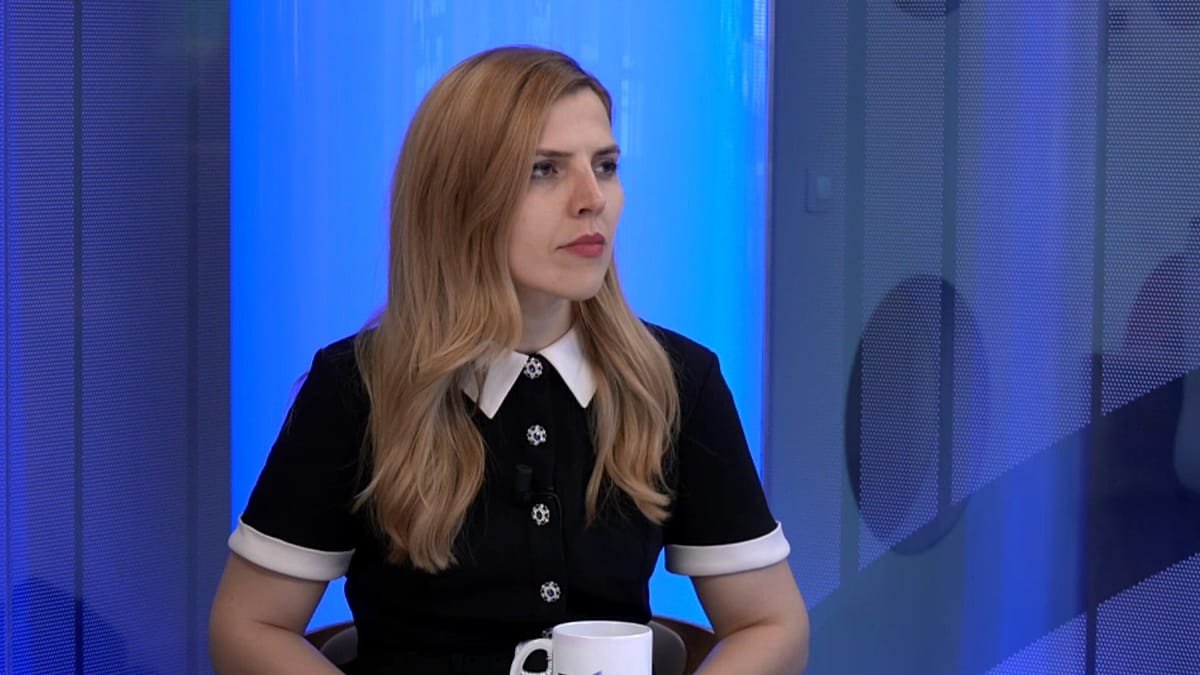
The Foreign Minister of Bulgaria, Velislava Petrova-Chamova, said in exclusive comments to Euronews that the reason her government worked vociferously to remove the head of Russia’s Orthodox Church, Patriarch Kirill, from the European Commission’s proposed 21st package of sanctions against Russia was to avoid fuelling EU scepticism.
“When you have sanctions that have purely symbolic measure but no economic consequence on Russia, what you are risking is that, in a country – an Eastern Orthodox country, such as Bulgaria – is creating the environment for brewing anti-European rhetoric,” she said.
“That’s why we’re not supporting it, and that’s why we we’re really happy that in the end the name was dropped out,” she said in comments on Euronews’ flagship morning programme, Europe Today.
The Bulgarian Orthodox Church and the Russian Orthodox Church are autonomous churches with different patriarchs. But they both belong to the Eastern Orthodox communion, share the same core beliefs and teachings, and have deep-rooted cultural and historical links.
The EU executive proposed the 21st package of sanctions against Russia for its full-scale invasion of Ukraine on 9 June.
“We focus on the sectors with the highest impact: energy, financial services and crypto, trade – including fisheries, for the first time – and we are banning the entry of former Russian combatants into the European Union,” European Commission President Ursula von der Leyen said at the time.
The proposal also included sanctioning Patriarch Kirill, who has labelled the full-scale invasion as a “holy war” and been accused of condoning the fighting. Former Bulgarian Foreign Minister Daniel Mitov claimed Kirill has used his position as a religious authority to justify Russian aggression and the killing of civilians.
At the behest of Bulgaria, his name was successfully removed from the draft proposal on Sunday at a meeting attended by European ambassadors.
Oil price cap controversy
After the sanctions package failed to be approved at a meeting attended by foreign affairs ministers in the Belgian capital on Monday, it will be renegotiated at an emergency meeting late Tuesday afternoon in hopes of finalisation.
If it is not rubber-stamped, the EU’s oil price cap mechanism – jumping from €44 to possibly €58 per barrel – could benefit the Kremlin as the war in Iran pushes the price of crude up.
The date on which the oil price mechanism will revise up or down if left unchanged, 15 July, is also the date Petrova-Chamova is travelling to the Ukrainian capital of Kyiv to discuss energy security with senior members of Ukrainian President Volodymyr Zelenskyy’s government.
The foreign minister said she is “not afraid” about showing up empty-handed, or worse, with a mechanism that is benefiting the Russian government.
“I’m more thinking about how we can work more together to help Ukraine face the challenges in front of it, which are going to be even higher as the winter approaches,” she said.
Trade with illegal Israeli settlements
The foreign affairs council meeting on Monday also focused on a two-page options paper presented by the European Commission regarding how to clamp down on trade between the EU and illegal Israeli settlements first reported by Euronews.
A 2024 International Court of Justice advisory opinion found these settlements to be unlawful, a position also taken by the European Union. The court and various international governments have called on Israel to reverse settlements while protecting the Palestinian population in the occupied territories.
The EU’s foreign policy chief Kaja Kallas said these settlements undermine the prospects for peace and the two-state solution, and that EU foreign ministers at Monday’s closed-door discussions overwhelmingly backed curbing trade.
Petrova-Chamova said she could not confidently say whether she endorsed any of the proposals as they lacked clarity.
“They’re not proposals really, they’re options, and that’s slightly different because there’s not very clear agreement between the legal service of the Commission and the Council about the ability to adopt those with unanimity,” she said.
EU ambassadors will now be tasked with putting meat on the bones of the Commission’s initial plans.
Kallas also said that an extraordinary meeting of foreign ministers could be convened to ensure further progress. The next formal ministerial gathering is scheduled for October, weeks before Israel is due to hold legislative elections, with several diplomats expressing fear that the sensitive timing could further scupper any progress.
Read the full article here