



Alex Broadfoot McBratney and his collaborators once dumped 300 tonnes of dirt into an Australian art space. It was not just any dirt: the world-leading soil scientist helped craft a rich humus of coffee grounds, cuttlebone, river sand, gravel, spent grain from a brewery and kaolinite clay.
“It was fun,” McBratney says of the art installation at Sydney’s Carriageworks. “I’m into art. Although I said, ‘Thank f— I don’t have to get rid of this at the end.’”
This Renaissance man with a penchant for art, poetry, language and lyricism was on Wednesday elevated to the highest echelons of science with his appointment as a fellow of the Royal Society.
The London-based society is the world’s oldest scientific body, and has counted Isaac Newton, Charles Darwin and Albert Einstein among its ranks.
The 2019 Carriageworks soil installation, led by artist Asad Raza, urged participants to engage with the metre-deep earth; to mix, rake and water it, and get the oft-ignored but critical substance stuck under their fingernails.
It was emblematic of McBratney’s mission to convince the public and policymakers to recast soil as something alive and diverse, a living skin of the Earth which keeps every person fed and clothed.
McBratney, a professor at the University of Sydney, was elected to the Royal Society in recognition for this work pioneering a new realm of soil science that has transformed agriculture.
Soil, he says, is not a renewable resource. It takes thousands of years to form. Soil holds more water than the world’s lakes and rivers combined, and more carbon than the atmosphere. A handful hums with a billion organisms, of 10 million different species, and contains more DNA than a human body.

McBratney’s research on soil helped pave the way for a new discipline of data-driven farming called precision agriculture. He’s one of Australia’s most-cited scientists, whose insights are credited with boosting agricultural productivity by $60 million a year in Australia alone.
But how did this eccentric Scotsman end up with his shoes on Australian soil?
“It’s a two-word answer,” he says. “Margaret Thatcher.”
McBratney grew up on a Scottish farm. His family would compete in local “plowing matches”, competitions to test which farmers could best turn lumpy soil into rows as straight and neat as corduroy.
The matches sparked McBratney’s early connection to soil, but there was a scientific aspect to the contests too. The competitors would draw lots to decide which part of the field they’d plow, so any advantage conferred by an easier patch was distributed fairly.
“They had this whole idea about randomisation, and how you do experiments, long before statisticians or even medical people figured that out,” he said.

When McBratney was completing his PhD in the UK around 1981, Thatcher was moving to defund agricultural research stations. Science jobs were scarce. He set his sights on Australia, where he expected to find a hotbed of radical ideas.
It was a more conservative research landscape than expected. There was a lot of “looking over shoulders”, he says, to see what scientists were doing in America and Europe. It was sometimes difficult to fit in.
“My approach to science is certainly very much of not looking over one’s shoulder, but just plowing on ahead,” he said. Pardon the pun.
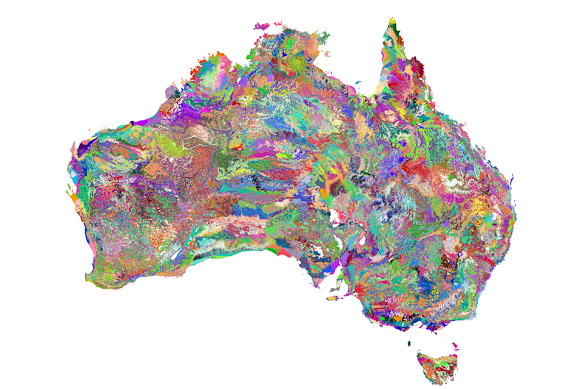
McBratney invented a new realm of science called pedometrics, which brought soil science together with statistics, and gave rise to digital soil maps. (McBratney’s cross-disciplinary mind is on display when he holds up a hunk of soil bigger than his head in the lab adjoining his office. “Ooh, it’s got lots of worm holes,” he says. “I should tell the cosmologists.”)
The merging of mathematics, soil science, remote sensing and mapping has allowed farmers to optimise water use, fertiliser and yield down to the square metre.
“The whole idea of how you do digital soil mapping, perhaps to my surprise, has been adopted all over the world. We really invented how you make soil maps in the 21st century,” he says.
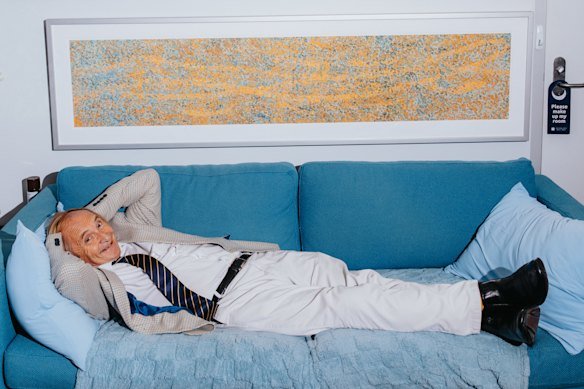
McBratney is now fostering the creativity he initially sought in Australia. He’s known for backing out-there ideas, his assistant says: one student just finished a project melding soil science with quantum physics.
Music plays in his office, which is decorated by art he’s made invoking soil strata. One of his works hangs over the couch he takes a 20-minute nap on at 1.05pm each day, guarded by a Do Not Disturb sign on his door nicked from a hotel.
It’s a song McBratney wrote, spirited by AI into a 1940s-style jazzy number about seaplanes and a Rose Bay restaurant. (He’s also made a pop song dedicated to soil.)
“New ideas in art are the same as new ideas in science,” he says. “Where we go wrong in science is that people think it’s just about knowledge. But that doesn’t create new science. New science is created by creative minds.”
McBratney’s work of late is hinged on soil security. It’s a way of thinking that focuses on the overarching preservation of soil for upholding ecosystems, mitigating climate change, and securing food, fibre and fresh water. This depends on connecting people with soil, sparking stewardship and legal protection.
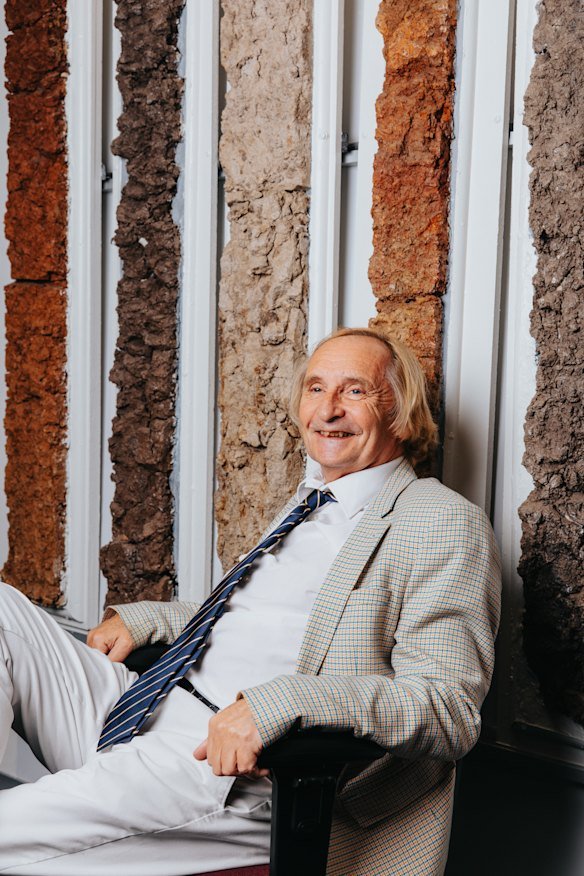
Long slabs of different soils fixed with epoxy are mounted to the walls around McBratney’s office within the Sydney Institute of Agriculture.
One showcases a ferrosol, the deep red tropical soil of coastal Queensland used to grow sugarcane. It’s rich in iron and aluminium but requires the adding of phosphorous.
Others are vertosols, the black, cracking clay soils of inland NSW. They’re fertile and derived from basalt, good for holding water and growing cotton.
The red-brown earths of the Mallee can be acidic, loamy and difficult to manage, but are an agricultural keystone used for grain. And in Western Australia you’ll find swathes of arenosols, so sandy you may be stunned anything grows from it at all.
“Australia has developed its own soil science for its own soils, and figured out what to do with it,” McBratney says. “And I think that’s a big story.”
The Examine newsletter explains and analyses science with a rigorous focus on the evidence. Sign up to get it each week.
Read the full article here