




Good morning, readers. Angela Skujins here with the final newsletter before the summer break, with Europe Today also expected to take a well-earned rest before returning 31 August.
Ahead of us sipping on a parasol-punctuated cocktail and melting into a banana lounge, it has been a mammoth 24-hours for the European Union, so let’s catch you up for this final, consequential dispatch.
What’s clear from two twin news items, from US tariffs to trade trips, is that the EU is between a rock and a hard place. The bloc is being squeezed by the world’s largest players: China and the US.
Another day, another tariff. Late Thursday night US President Donald Trump imposed new tariffs on at least 60 international partners, such as the EU, over forced labour claims. The new duties, ranging from 10 to 12.5%, replace the global 10% tariffs Trump introduced earlier this year, which expired at 12.01AM on the same day.
The EU’s top trade negotiator Bernd Lange described the measures as “crazy” on Euronews’ flagship morning programme Europe Today.
“This forced labour issue, so that we as Europeans are not respecting the fight against forced labour, is crazy. We have wonderful legislation, even stronger than the United States,” he said. Watch.
European Commission deputy chief spokesperson Olof Gill said this morning the bloc “takes note of the publication by the US” regarding the forced labour claims, and what this means is that it establishes an all-inclusive tariff rate of 10% for the EU.
It also “reintroduces the additional tariff exemptions for the EU, such as cork and diamonds, on top of those on aircrafts and parts, generic medicines, and active ingredients.”
“The EU notes positively the fact that this outcome is in line with the US tariff commitments agreed under the EU-US Joint Statement,” he said.
Back to Lange. The German MEP went on to say he expects further reaction from across the transatlantic regarding the EU’s recent fine against a Silicon Valley search engine.
Google “fine”. The European Commission slapped American-based company Google two fines totalling €890 million for breaching the bloc’s digital fairness rules on Thursday.
Undersecretary of State Jacob Helberg blasted the Digital Markets Act (DMA), stating it “penalises” industry winners, while US Trade Representative Jamieson Greer went further by arguing the DMA endangers the already wafer thin EU-US trade deal.
“The EU often claims that it is looking for stability and predictability in our trading relationship, but these actions are driving massive uncertainty for US exports of goods and services to Europe,” Greer said.
To recap: Google’s parent company, Alphabet, took home $402.8 billion (€353.08 billion) in 2025. This means the fines represent 0.22% of the company’s annual turnover.
President of Google’s Global Affairs, Kent Walker, said the DMA continues to “break” every day products. The platform has 60 days to pay the penalty and adjust its features, or incur more losses.
When the fine was handed down on Thursday, European Commission spokesperson Thomas Regnier delivered prescient remarks that almost preempted the criticism. “Our digital legislation is not up for negotiation,” he said.
As Luca Bertuzzi has reported, last year Trade Commissioner Maroš Šefčovič emerged as an outspoken voice in favour of postponing an antitrust fine against Google, fearing it could derail the trade negotiations that culminated in the Turnberry agreement. This framework was finalised one year ago this week.
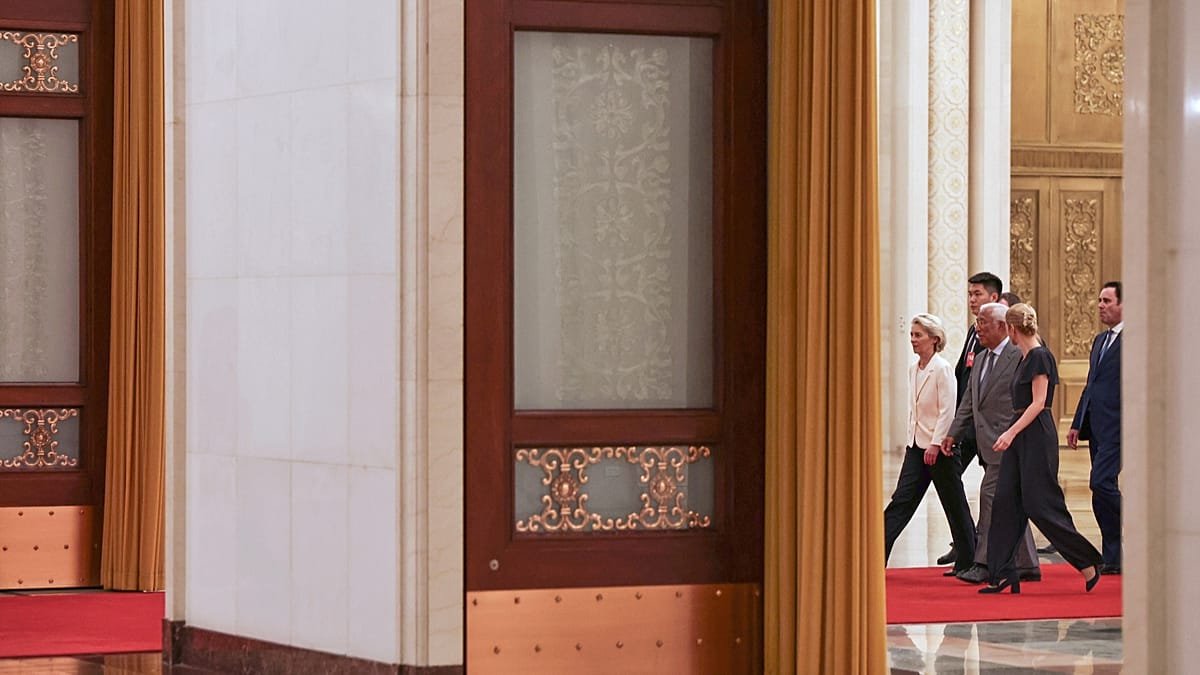
From Brussels to Beijing. Nine MEPs led by Foreign Affairs Committee boss MEP David McAllister completed a fact-finding mission in China on Thursday in a bid to boost ties and thaw an eight-year freeze between the hemicycle and Chinese lawmakers.
One element that complicated the trip is the fact that the EU has targeted several Chinese nationals in its sanctions packages against Russia. These individuals allegedly produce dual-use technologies found in Russian weapons on the battlefield in Ukraine.
Another, is an impending October deadline to solve a ballooning EU-China trade deficit, which is showing no signs of abating. In 2025, the deficit was almost €360 billion surpassing the €312 billion difference of 2024.
The last time heads of state met for a summit in Brussels, in June, they agreed that the EU should move beyond dialogue. Come October, the 27 expect results to the unsustainable discrepancy — or action
European Vice President Javier López just said on Europe Today that triggering the EU’s anti-coercion instrument (also known as the trade bazooka) may not be the answer.
“This volume of trade surplus of China — of unbalanced trade — that it’s one billion (euros) per day, that it has to be addressed, and we should find mechanisms, solutions in this regard,” he said.
“We have negotiations ongoing and what we expect is results and deliver solutions through these negotiations, through dialogue and cooperation.”
The never-ending sanctions saga. The EU’s 21st package of sanctions against Russia is continuing to turn heads. My colleague Jorge Liboreiro details with Luca in must-read analysis below the exact play-by-play of how the measures were signed, sealed, (finally) delivered, and watered-down.
One of the most crucial pieces to the deal, clinched by EU ambassadors on Thursday, grants Greece an exemption to continue shipping Russian liquified natural gas to non-EU clients for the foreseeable future.
There has also been a significant weakening of the proposed ban on entry visas for former Russian combatants, and freezing the price cap on Russian oil at $44 per barrel for one year. The latter measure, in particular, removes a source of uncertainty as the US and Iran resume hostilities and Urals crude goes up again.
As Jorge and Luca write today, the package targets, among other things, 33 banks, 14 crypto platforms, 41 shadow fleet vessels, and 218 individuals, organisations and companies accused of supporting the invasion of Ukraine, including 37 long-range drone producers. Major oil refineries in Belarus and Georgia are also listed.
Read more below.
Chaotic sanctions negotiations expose cracks in EU front versus Russia
For Brussels, this week’s agreement on a new sanctions package against Russia marks another milestone in the collective effort to undermine the economic engine sustaining Moscow’s full-scale invasion of Ukraine.
“At a time when Ukraine has built military momentum, our sanctions continue to weaken the economic foundations of Russia’s war effort,” European Commission President Ursula von der Leyen said.
“We are hitting Putin where it hurts most: cutting off the financial lifelines he relies on to sustain his war,” High Representative Kaja Kallas added.
But the agreement — and, perhaps more revealingly, the fraught negotiations behind it — has exposed growing cracks in the political unity underpinning the most ambitious sanctions regime in EU history.
Dive into Jorge and Luca’s reporting that aims to bring you inside the room where that final decision was made.
More from our newsrooms
Poland’s debt climbs above €500bn as borrowing reaches record pace
The Central European country’s debt is now among the fastest rising in the EU. According to the latest Eurostat data, only Finland and Bulgaria recorded a larger increase in the public debt-to-GDP ratio in the first quarter of 2026. Jan Bolanowski has the story.
Safeguards for new EU members need objective criteria, Montenegro’s ambassador says
Montenegro is backing new EU rule-of-law safeguards for future members while insisting they must be based on objective criteria and not create a second tier of membership. Luca Bertuzzi has the scoop.
EU temporarily extends controversial chat-scanning regime until 2028
EU countries have adopted a temporary regime allowing messaging services to voluntarily detect child sexual abuse material until 2028. End-to-end encrypted apps like WhatsApp and Signal remain exempt. Read more.
We’re also keeping an eye on
- Environment and climate ministers will meet in Dublin, Ireland for an informal environment council.
- European Commissioner for Defence and Space Andrius Kubilius continues his trip through Washington, DC.
- EU foreign policy chief Kaja Kallas continues her trip in Manila, Philippines on the sidelines of the ASEAN foreign affairs ministers meeting.
That’s it for today.
As I mentioned earlier, this newsletter and the Europe Today programme will take a break for the next few weeks over summer. Both me and newsletter co-author Mared Gwyn would like to thank you for reading, but also our colleagues for their rich contributions to this daily dispatch.
A big round of applause for Jorge Liboreiro, Vincenzo Ginovese, Luca Bertuzzi, Peggy Corlin, Shona Murray, Sándor Zsíros, Sasha Vakulina, Eleonora Vasques and Marta Pacheco for their input. Without them, this newsletter would not be as dynamic as it is.
And a bigger round of applause for Maria Tadeo, our EU news chief, who captains the ship.
Read the full article here