






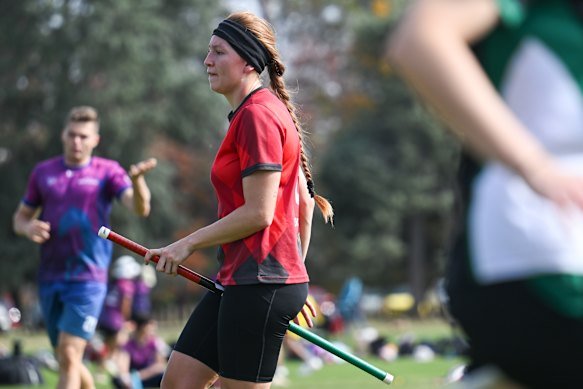
At a quiet park in the back streets of Lidcombe, an intense negotiation is taking place.
There aren’t enough players for the full four Quadball teams to compete, so Rebecca Robb and her fellow organisers are figuring out a complex solution.
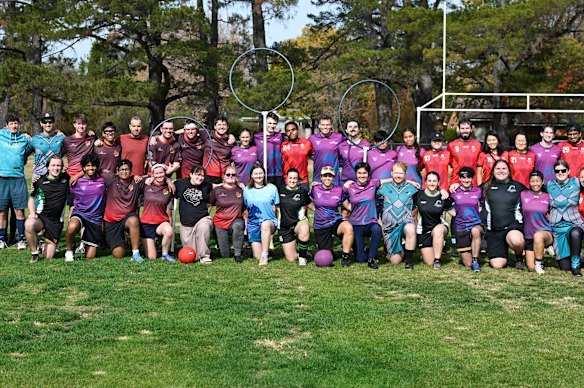
She’s in her bright red uniform, PVC pipe “broom” in one hand and the fate of the year-long Quadball tournament hangs in the balance.
Quadball, the sport that evolved out of Harry Potter’s Quidditch, is slowly dying. Despite once boasting hundreds of players around the country and thriving competitions, the sport is now in terminal decline.
The problem is that people just don’t want to play Quadball any more, due in part to Harry Potter author JK Rowling’s controversial opinions, and a generational cultural shift.
It leaves the player count so low that almost every match is under threat, and eventually there won’t be enough players to support a statewide competition.
Despite years of work promoting the game and tweaking rules and schedules, Robb is left with “crazy, twitching eyes” attempting to keep it alive.
There’s a quiet sadness lurking below every match, its slow decline a symptom of a convulsing world that is leaving behind nice hobbies and communities.
From Quidditch to Quadball
Quadball, which changed its name from Quidditch to avoid copyright issues, is a brutal and tactical sport with layers of rules and positions that feels jumbled at first.
But once the chaos clarifies into something that can be tracked, it does have a magic to it. Not the magic of flying or spells, but of narratives and sanctity.

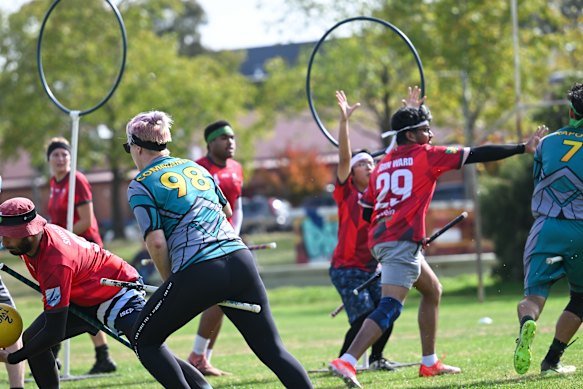
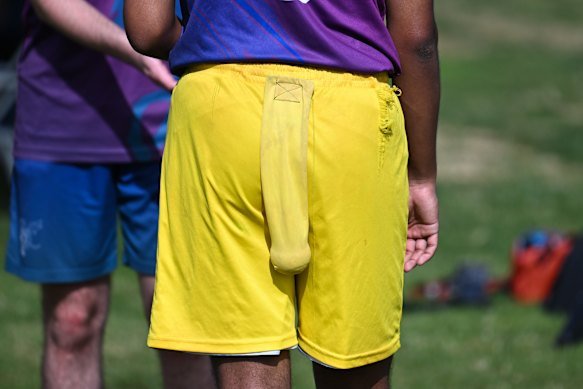
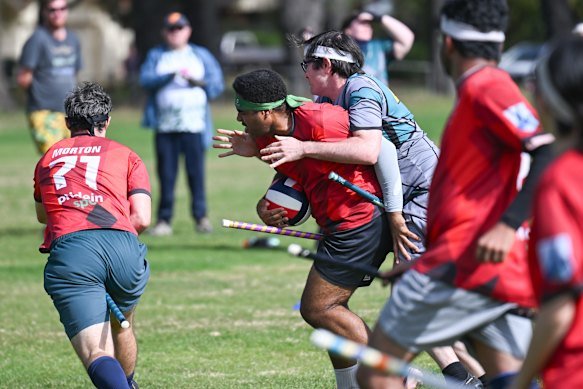
Two teams face off seeking to outscore the other. Three players can score, two use dodgeballs to knock players off their “brooms” (usually a PVC pipe they must hold at all times) and the golden snitch is a neutral player wearing a golden sock around their waist that needs to be wrestled off them.
At its peak, Quadball boasted over 600 players nationally and it was being shown on ESPN in America. Despite its niche status, the sport once attracted crowds; it had a world cup, regional competitions, and state and national bodies.
Driven by Harry Potter’s intense global popularity, Quadball rose beyond mere hobby status, aspiring at one point to be as serious a sport as soccer or rugby.
The downward spiral
From its peak of 11 clubs in NSW and Canberra, only six now remain, and some have had to combine to survive.
There are now not enough players to sustain the competition, and there aren’t enough new sign-ups. The sport’s frayed ties to Rowling offer one clue as to why.
Her anti-transgender campaigning has jarred against the determined inclusivity of Quadball, which recognises non-binary as a gender and has a limit of three players per gender on a team.
The overtly progressive values of the sport have inspired a deep connection in those who still play it, forming their sanctuary. It is a team sport made for and shaped by them.
No amount of raving from Rowling could take that away from them. But her rightward shift has clearly had an impact, forming part of the reason a new generation of players don’t want to sign up.
And that is a terminal issue because the millennials who established the sport have outgrown it. They just could not dedicate entire Saturdays to the sport any more.
“People’s lives are now filled with busy work,” Robb says. “We live in a hustle culture, where people are always looking to optimise their time and energy.
“Adding on something that requires dedication and commitment beyond yourself is scary in that context.”
After emerging from the pandemic, the sport just collapsed. Players quit, recruitment dried up and crowds disappeared.
A generational curse
“People just don’t want to commit any more,” Robb says, pointing to a broader decline in team sports participation among young people.
Data from the Committee for Sydney shows young people are moving towards individual activities such as run clubs or Pilates, over team sports.

All cultures change as a new generation comes of age, but this shift away from the communal and the earnest feels particularly harsh on Quadball.
What is left is a group of players who persist out of an abiding love for the game. They play it wherever they can, not out of nostalgia but because they love it.
Their show of hope and enthusiasm is infectious. Perhaps, despite everything it faces, Quadball will survive, enduring on the hopes of those who still play it.
“Maybe I’m delusional; maybe I’m living on a prayer; or I’m gaslighting myself, but I don’t believe we are dying,” Robb says.
“If there are enough people who are just willing to see what happens, willing to share the sport, then we’ll be just fine.”
Start the day with a summary of the day’s most important and interesting stories, analysis and insights. Sign up for our Morning Edition newsletter.
Read the full article here