





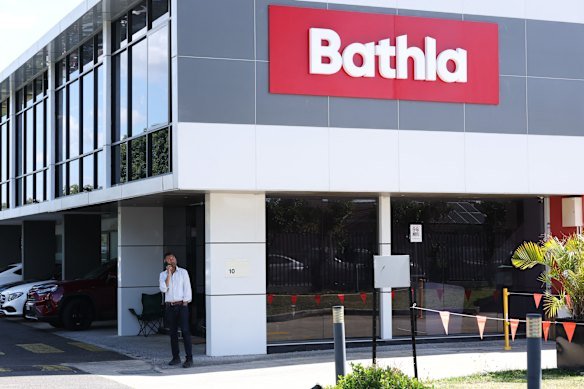
Bathla owes money and public infrastructure work to the council that approved the vast majority of its north-western Sydney developments, the first instance of ratepayers being on the hook following the collapse of the building giant.
Blacktown City Council on Friday joined a list of people and companies identifying themselves as being owed money by Bathla after the major Girraween-based greenfield housing developer entered voluntary administration a fortnight ago.
The council is believed to be owed both money and works-in-kind – that is, the creation or uplift of public infrastructure such as roads, open spaces or other things that will be affected by an increase in the number of residents living in new developments – although a spokesperson on Monday declined to say how much it was owed.
The revelation comes one day after Bathla’s administrator, Teneo, stood down 213 staff and suspended most construction projects as it struggles to come to an agreement with private lenders about funding for the completion of some developments.
As the crisis threatens to spread across the building industry, Premier Chris Minns again on Monday resisted calls for government intervention and the Greens pushed the government to compulsorily acquire Bathla’s dozens of unused plots of land across the west for housing.
A spokesperson confirmed Blacktown City Council registered as a creditor on Friday and said financial infrastructure contributions were only payable if a development had commenced. “Where Bathla has started a development, in most instances the applicable contributions have already been paid,” they said.
The council has previously struggled to deal with the developer’s works-in-kind projects, including one “drainage reserve” built by Bathla in Marsden Park. The company had committed, under its works-in-kind agreement with the council, to turn it into a play area. Despite being virtually complete, the council cannot open the park because Bathla never transferred ownership of it back to the council.
Blacktown’s residents have also been hardest hit by Bathla’s defective buildings: in August, the state’s building regulator confirmed defects had been identified and nearly fixed at sites in Marsden Park. On Friday, related entity Raj & Jai Construction was issued a building work rectification order to fix seven serious defects at an apartment building in Seven Hills.
Days before the group entered voluntary administration, Building Commission NSW also fined Raj & Jai Construction and its director a combined $54,000 over improper conduct in working on two Schofields properties without the required insurance.
The company also has a long history of causing the council to spend millions fighting development applications in the Land and Environment Court over “deemed refusals”, which occur when a council has failed to decide on an application within 40 days (high-impact plans get 60 days, and state-significant projects get 90).
Blacktown MP Stephen Bali, who was the city’s mayor from 2014 to 2019, said his council would refuse Bathla’s plans on the grounds of overdevelopment and inadequate amenity.
“We would try and reduce [the number of homes in the development]. They didn’t like it and would take it to court to try and get it overruled,” he told the Herald. “The bill was over $1 million a year in legal costs.”
Bathla was so prolific in building developments in north-west Sydney that its director, Bhart Bhushan, was crowned the “Baron of Blacktown” by the Parramatta Advertiser in 2021.
Bathla’s stood-down staff were seen shocked and making phone calls as they left a meeting with administrators on Monday afternoon, some facing the prospect of needing to leave the country if they do not find work within a month, given the requirements of some visas.
Minns said the government “didn’t have a plan to announce today” about any support for subcontractors or those who had put deposits on Bathla homes.
“I think that there’s an important process to take place before a line of credit or public money is extended to the company,” he said. “And the reason today is it’s not my money; it’s public money.
“Not all major builders in NSW are financed the same way. You know, this is a very strange corporate structure involving a hell of a lot of debt, largely collected from private capital, private credit, not through the banks and traditional finance.”


From our partners
Read the full article here