






As America approaches another big birthday bash, Maureen Dowd’s uncertainty over whether her country remains “fair” is timely (“The America of my parents was fair. Now I’m not so sure”, June 29). From where I sit, the land of opportunity has become a centre for greed. The pursuit of individual freedom drives a dog-eat-dog mindset. Religious devotion has become zealotry. Politicians regard opponents as traitors, deadly enemies and elections are tainted by partisan manipulation. The righteous anger that spawned a revolution has degenerated into a gun worship that ignores the deaths of schoolchildren. Healthcare is just a commodity. Pride in worthy achievements has become an international superiority complex. Equality depends on your looks and background. The signs of American dysfunction are so obvious that it’s fair to also ask: what’s to celebrate?
Adrian Connelly, Springwood
As America approaches another big birthday bash, Maureen Dowd’s uncertainty over whether her country remains “fair” is timely . From where I sit, the land of opportunity has become a centre for greed. The pursuit of individual freedom drives dog-eat-dog selfishness. Fervent religious devotion has become doctrinaire zealotry. Politicians regard opponents as traitorous, deadly enemies and elections are tainted by blatant partisan manipulation. The righteous anger that spawned a revolution has decayed into a gun worship that cares nothing for the deaths of schoolchildren. Health care is a mere commodity. Justifiable pride in worthy achievements has overblown into a haughty, militaristic, international superiority complex. Equality depends on your looks and background, and fissures of bigotry abound. Indeed, the stains of American ugliness so blight its image that it’s fair to also ask: what is there to celebrate? Adrian Connelly, Springwood
Maureen Dowd usually offers perceptive commentary on her US homeland, but her latest exercise in apple-pie nostalgia is unconvincing. From an Australian’s standpoint it seems to be a white, middle-class American delusion that their country was, until recently, “fair”. Just ask any person of colour, unskilled worker or poor immigrant. US politics, business and the law have been driven by bribery and intimidation for more than 200 years. Trump is just the most blatant expression of that malady. At core, when Dowd and her Not My President ilk appeal for a return to fairness, they are actually seeking “don’t blame me” absolution. For generations they were quite happy to tolerate a corrupt electoral system as long as it returned their favoured candidates. If they now genuinely believe their current leaders are an affront to democracy, they should be taking to the streets. David Salter, Hunter’s Hill
Maureen Dowd, through her own childhood lens, believed fairness in the US to be universal. Yet history reveals the US was always built on inequity and systemic disparities based on race, class and gender. The western concept of manifest destiny was used to justify the displacement and killing of native peoples, the introduction of slavery enabled economic power to a small few and disabled others for generations. The “American Dream” allowed the growth of generational fortune and an immigrant underclass. As Ms Dowd suggests, the US of today is indeed unfair, but it has always been so. Inequities in healthcare, education, imprisonment statistics, and general income inequity all feature. Belief in “the American” and the individual self as exceptional has allowed the US and its people to believe it themselves. Somehow the rest of the world believed it too. Today that belief has been shattered. Janice Creenaune, Austinmer
Maureen Dowd’s article on fairness and her father’s treatment of his colleagues, whether they were managers or cafeteria staff, reminded me of a time when I was eight and my father, who was editor of the daily newspaper, showed me around his workplace. When I asked him who was the most important person in the office, my young, puffed-up chest deflated when he informed me it was the person who emptied his waste paper basket. His reply that he couldn’t do his job properly if the cleaner didn’t fulfil his job was a valuable lesson, which I have carried throughout my life. Elizabeth Maher, Gordon
Trains late again
Our new Nancy-Bird Walton Western Sydney Airport will have passengers arriving and departing 24 hours a day, but the brand new wider metro trains will not because they have to align with the existing heavy rail network timetables (“Metro delay hits pause on airport train rollout”, June 29). What a dog’s breakfast. You would think there could be a few tweaks to our train times to get air travellers where they want to go as quickly as possible, even in the early hours. It’s beyond belief that the planners didn’t take the wider view and make co-ordination of transport facilities a top priority when designing the new airport and its transport connections. Lance Dover, Pretty Beach
China’s law a warning
China’s new ethnic unity law, which mandates a shared Chinese identity with “correct perspective” and will pursue those deemed to be undermining ethnic unity, will lead to the erasure of any minority identity and cultural practices in the country (“Fears new Chinese law will be ‘weaponised’ against Australian activists”, June 29). It is a forceful strike in China’s assimilationist agenda. While most of our multicultural society will shudder at the news, One Nation supporters will probably be jumping for joy at the positive impact they have had on President Xi Jinping. Judy Finch, Taree


Data-driven
Clancy Yeates writes with the same scepticism that communities feel regarding the so-called benefits of data centres, particularly the huge hyperscale ones that are being pushed to house big tech’s needs (“Will the $155b data centre boom pay off for us all?” June 29). The question is whether the government, both state and federal, will be fiddling while Rome burns. Assistant minister Andrew Charlton has a good grasp of the challenges of building these big tin sheds, but it is the state governments that approve them. When their greatest fear is one of missing out, good planning and regulatory practice will continue to fall by the wayside. This does not bode well for communities. Elizabeth Darton, Lane Cove West
Why are data centres being built in, or close to, major Australian cities when the Iran conflict has demonstrated that data centres become targets of war? Data centres in the UAE and Bahrain were attacked by Iran in March-April, 2026, and a data centre in Tehran was hit with a missile, apparently fired by the US or Israel on March 11. Surely these buildings need to be located well away from population centres. Barbara Chapman, South Yarra (Vic)
AI will guzzle half our electricity, much of our water, most of our jobs and could mean permanent recession and an end to the middle class. (“AI could mean recession and end to middle class,” June 29). What is there to love? Why the rush to build thousands of data centres to feed this monster? Will someone please explain why we rush blindly toward social disintegration, if not immolation? John MacKay, Asquith


When personal computers first became being popular there was a phrase doing the rounds that that said in the future a business would consist of a computer, a dog and a human – the computer to run the business, the dog to guard the computer and the human to feed the dog. We’re nearly there.
John Grinter, Katoomba
Education overhaul
Sean Kelly makes a good case for a positive Albo (“Brick by brick, Albanese is finding faith … that voters will see reason”, June 29). What is missing is the appalling state of reform in higher education, even with the reduction of local student debt. This sector is the building block for economic renewal and is a shambles. Casual academics are treated as disposable items and overseas students as cash cows. There is constant restructuring and redundancy programs, while senior management is overpaid and unaccountable. It’s time to scrape away the decaying mortar. Michael Blissenden, Dural
Waste can’t wait
Apart from the danger of nuclear accidents at the HMAS Stirling naval base regarding the disposal of nuclear waste, the vague claim that there is “further technical work under way to identify potential interim and permanent disposal pathways” is a gross understatement of what is actually required (“AUKUS inquiry warned of nuclear disaster risk”, June 29). There are 50 countries that have temporary storage facilities, and only one that is implementing a permanent one. Finland’s Onkalo project has taken 40 years, including planning and site selection, to reach its current stage of final commissioning at a cost of more than $US1 billion, with the final lifetime cost being more than $US5 billion. While our government should take credit for its attempt to address the housing shortage, a permanent solution to the problem of nuclear waste storage has been put off to the never-never. Peter Nash, Fairlight
Criminal links
The reported links between organised crime and the attack on Melbourne’s Adass Israel Synagogue highlight a growing security threat (“Underworld kingpin struck deal with Iran to attack a synagogue”, June 29). We are not alone. Authorities in the UK and Germany have warned that hostile states are increasingly using criminal gangs to carry out attacks in order to avoid direct involvement. If these allegations are proven in Australia, organised crime can no longer be seen as just a law-and-order problem. Gangs experienced in violence, extortion and intimidation can become useful tools for foreign governments. Breaking up these criminal networks is not only about reducing crime but also about protecting Australia’s national security. John Kempler, Rose Bay
Curtain call
I remember the excitement over the opening of the Community Theatre, later renamed Marian St Theatre, in 1965 (“Final curtain for beloved theatre”, June 28). In those days I used to watch my sister take part in amateur theatre productions there. She was in her teens, fulfilling a youthful dream and gaining a background for her later film studies. But there was no other cultural life in the north shore back then, so she left for the inner city as soon as she could. Kids shouldn’t have to leave their family neighbourhood to pursue the arts, and adults shouldn’t have to make long commutes to see a play or a concert. I’ve got a message for Councillor Barbara Ward: “Responsible use of ratepayers’ money” includes all ratepayers, not just the sports-minded. Penny Auburn, Newport
Take a gamble
The Community Strong Australia party proposed by Allegra Spender and Zali Steggall would give hope for proper gambling reforms (“What good is a budget surplus built on despair?”, June 29). Unlike the major parties that bow to the gambling lobby, a community party would hopefully put the best interests of their constituents ahead of gambling interests. A state budget heavily dependent on gambling revenue is indeed “built on despair”. John Cotterill, Kingsford
So the Minns government’s budget surplus relies on an increasing number of pokies and rising gambling revenue, which brings misery for gambling addicts and their families. If anything, it is a glaring case of “government is not the solution to our problem; government is the problem” (Ronald Reagan). Steve Ngeow, Chatswood
Taken for a spin
When the first case of bird flu was discovered in WA I wondered how long it would be before the conspiracy theorists came out of the woodwork. Well, we didn’t have long to wait before the first tinfoil hatter emerged in the form of Liberal senator Alex Antic, who suggested that the arrival of bird flu was a way for pharmaceutical companies to sell products, describing the H5N1 Avian flu as “spin from pharmaceutical companies”. One would expect more than this from someone with a university degree like Antic. Perhaps he should have taken a few science subjects. Maureen Partridge, Baulkham Hills
Inconsistent laws
I agree with Mark Dreyfus – deep-seated hate in our language has no home in public life, just as the Nazi salute and symbol has no place in decent society (“After being called a traitor, Mark Dreyfus devised a plan to stop the abuse,” June 29). Free speech laws here are not consistent with an orderly, mannered society. The same goes for gun ownership. Only farmers and competitive shooters should have them. Anne Eagar, Epping
The Howard government’s gun buyback scheme was a step in the right direction but gun possession and gun-related crime have spiralled out of control since. Subsequent attempts at gun control have amounted to tokenism, and the results of the government’s latest scheme remain to be seen. Gun ownership, with few exceptions, should be banned and limited to police and the military. Security guards and bodyguards should only have access in exceptional circumstances. Recreational shooting and hunting is just an excuse for gun ownership. The same applies to target shooting, and all such guns should be stored by gun clubs. Possession of all automatic weapons and any gun designed for lethal purposes must be made a criminal offence. Farmers may have a reason to own a gun but not an armoury. One rifle is enough. Regulation, of course, addresses only legal ownership as criminals don’t buy guns legally and domestic violence offenders use weapons already in their homes. Gun buyback schemes are a sop to public opinion. A zero-tolerance approach coupled with an amnesty for illegal weapons is the only likely strategy to achieve the necessary end – a safer, more peaceful Australia. Peter Craig, Dulwich Hill
Building bridges
It is incorrect for your correspondents to describe the work to reopen the Great Western Highway at Victoria Pass as a “patch-up job” (Letters, June 29). Piled bridges are commonplace. In this case the piles prevent any force being applied to the convict-built sandstone wall, and the bridge decking will take all traffic loads. Jolls Bridge on the M3 is a good example. The crags underneath were too steep, narrow and unstable for a slab roadway, so a piled bridge was built instead. That bridge is now 62 years old. As to the “noise of these thumping diesel engines just metres from shops and cafes”, the only permanent answer to that is progressive electrification of our trucking fleet, something One Nation is extremely unlikely to ever support. Brendan Jones, Annandale
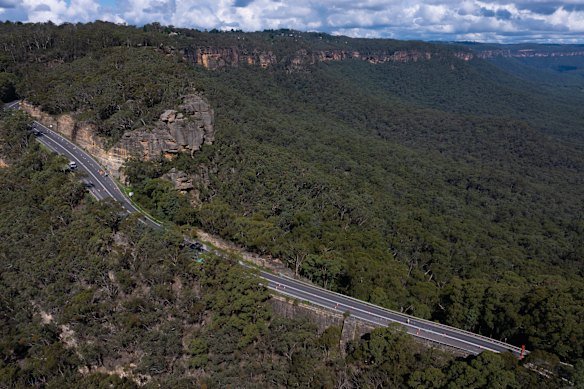
Is there no sense of urgency in Transport for NSW? As it happens, we recently farewelled Brian Pearson, a great bloke and excellent chief bridge engineer for the Department of Main Roads. The large majority of bridges in NSW, including Anzac Bridge, were designed in-house, and I am sure if Mr Pearson and his capable team were still available that work on Victoria Pass would be well under way by now. As the former deputy commissioner for main roads, I agree that any work now contemplated should provide for two lanes in each direction. John Crowe, Cherrybrook
Brain fade
I intended to write a letter at the weekend in response to the Herald article about brain games for improving your memory but it slipped my mind (“Most brain-training hacks don’t work, but a 20-year study found one that does”, July 29). Alicia Dawson, Balmain
I believe writing letters to the editor slows the dust-to-dust process, even though having them published doesn’t enhance longevity or delay dementia. I give that credit to the care embodied in composing and sending the letter. Mark Porter, New Lambton
- To submit a letter to the Sydney Morning Herald, email letters@smh.com.au. Click here for tips on how to submit letters.
- The Opinion newsletter is a weekly wrap of views that will challenge, champion and inform. Sign up here.
Read the full article here