





Everyone knows the price of petrol has jumped, and everyone knows – or thinks they know – why. Because Donald Trump’s war on Iran has prompted it to block the Strait of Hormuz. This has raised the cost of petrol around the world.
Sorry, that’s not quite right. What’s happened is that the producers of oil – and gas, for that matter – saw that blocking the strait would cause the demand for oil and gas to exceed the available supply. This meant they could charge a higher price for their oil without losing many sales of the stuff.
So while it’s true that all the wholesalers and retailers who stand between the oil producers and the final customers – you and me – can put their hand on their heart and say they had to raise their price because their costs had increased, the people who get the oil and gas out of the ground can’t.
They put their prices up for no reason other than that they knew they could get away with charging more. Does that shock you and make you want to rail against their selfishness? Why doesn’t the government stop them doing it?
Well, one reason is that economists know this is what happens in a capitalist economy. What’s more, they think it’s what should happen. It’s good for businesses to raise their prices whenever demand exceeds supply because this is the way the “price mechanism” eventually increases the supply of the more expensive item.
Why does supply increase? Because producing the item is now more profitable than it used to be. And here’s the trick: once demand and supply are back in balance the price should fall back – or so the theory says.
What, no economist has ever explained that to you before? Well, it’s something most economists don’t like talking about. Why not? Because people like you wouldn’t understand and would want to argue the toss.
Much easier to let you go on thinking that businesses put up their prices only because their costs have increased. Economists know the public will always accept this as a legitimate reason for raising prices, whereas people always disapprove of businesses that raise their prices simply to increase their profits.
This, the public calls “gouging”, which is very naughty. Economists never ever use that word because they don’t think there’s anything wrong with just putting your prices up. But they don’t want to argue with you about it.
You may think I’m being pedantic in making this small point, but it leads to a more important point. Why are economists so confident prices will never be excessive? Because the “neoclassical” model of the economy that economists are taught, and now carry in their heads, assumes that competition between businesses will ensure prices never get out of line.
As a greedy – sorry, “profit-motivated” – businessman, I’d love to jack up my prices, but I don’t because I know from experience that, if I did, my competitors would undercut me and take away my customers, leaving me worse off.
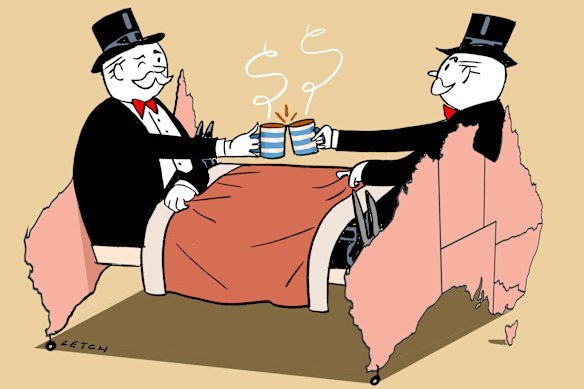
You may think that economists support the capitalist economy – they prefer to call it the “market” economy – because it’s best for their capitalist masters. Wrong. To an economist it’s the other way around.
Economists think the consumer is king. The economy exists to make ordinary people as prosperous as possible, able to meet all their desires. And to give consumers the best deal possible, you want an economy that gives the capitalists a hard time.
A market economy is a con job on the capitalists. They think they’re in charge, but they end up as slaves to their customers. What is it that turns capitalists from top dogs to lapdogs? The intense, unending competition between them. If they don’t give the customers a good deal, they go out of business.
So, the secret sauce of capitalist economies is competition. It’s competition that limits how much businesses can raise their prices and stops them earning excessive profits. It’s competition that drives the price mechanism, ensuring that gaps between demand and supply are only temporary and lowering prices that rose too high.
But that’s another funny thing. Even though strong competition is the key to ensuring capitalist economies end up benefiting customers rather than bosses, economists rarely say much about it.
They don’t give speeches about the need for competition, nor do they put much research effort into seeing how well competition is doing, what factors are limiting the strength of competition and what could be done to intensify it.
This is why I was taken aback to learn that, according to the latest report on our economy by the OECD – the Organisation for Economic Co-operation and Development – competition has waned across the Australian economy over the past two decades.
It says our economy is becoming less dynamic rather than more – less able to adapt and innovate. Markets are becoming concentrated – dominated by a few really big businesses – and profit margins are bigger.
Really? Why wasn’t I told? Why wasn’t the media all over it? Why no sackcloth and ashes in the business district? Why hasn’t the opposition been blaming it all on that terrible Labor government? Why haven’t ministers been apologising and vowing to do better?
I can think of two good reasons why so little has been made of this disheartening news. For a start, it suits business to have higher profits and less competition. What’s happening is that our capitalist economy is being changed to suit the capitalists, not the consumers.
And second, the economists don’t want to talk about it. They don’t want to draw attention to the growing gap between their theoretical ideal and the real world out the window. Nor their failure to narrow that gap.
Ross Gittins is economics editor.
Ross Gittins unpacks the economy in an exclusive subscriber-only newsletter. Sign up to receive it every Tuesday evening.
From our partners
Read the full article here