





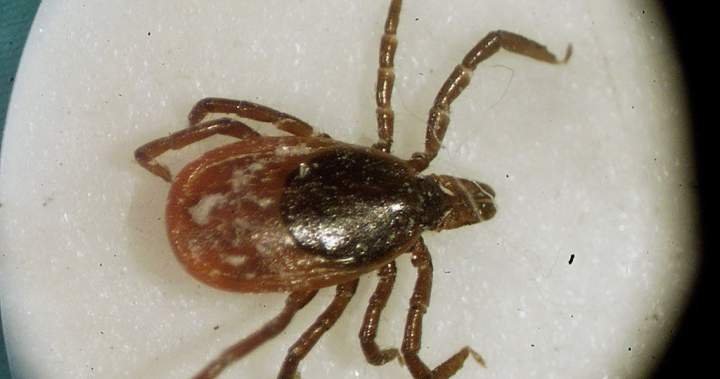
Ticks are no longer just a rare summertime nuisance in Canada.
Experts say warmer winters are helping disease-carrying ticks survive farther north, driving a sharp rise in Lyme disease and other tick-borne illnesses across parts of Ontario, Quebec, New Brunswick and beyond.
Reported Lyme disease cases in Canada climbed from 917 in 2015 to more than 5,200 preliminary cases in 2024, according to the Public Health Agency of Canada (PHAC).
However, experts say the true number is likely much higher because many infections go undiagnosed or unreported.
“We have more and more cases of Lyme disease and other tick-transmitted illnesses in the country,” said Dr. Isaac Bogoch, an infectious diseases specialist at Toronto General Hospital.
“The reason for this is because, in general, our winters have been a bit shorter and not as cold, and this is allowing ticks to survive and to thrive in more northern latitudes.”
The Ontario Vector-Borne Disease Tool shows blacklegged tick risk areas have expanded significantly across Ontario over the past decade, stretching beyond areas once considered the province’s main hotspots.
Bogoch said Lyme disease is no longer the only concern.
“It’s not just Lyme,” he said. “We’re now seeing more cases of infections in Canada that Canadians have never seen before but were well-known to exist in parts of the United States.”
Those illnesses include anaplasmosis and babesiosis, both now reportable diseases in Ontario.
Last summer, Ontario also recorded two human cases of Rocky Mountain spotted fever believed to have been acquired in Long Point, Ont., which Bogoch said had not previously been seen in Central or Eastern Canada.
More than 40 tick species live in Canada, according to PHAC. Blacklegged ticks, also known as deer ticks, can transmit diseases including Lyme disease, Powassan virus disease and babesiosis.
Anaplasmosis and Babesiosis often begins with flu-like symptoms such as fever, chills and muscle aches, though severe cases can become serious if untreated.
Powassan virus disease, while rare, can lead to dangerous neurological complications, including brain inflammation, while Rocky Mountain spotted fever can cause severe fever, rash and organ complications in serious cases.
Federal health officials say climate change is contributing to longer tick seasons, expanding habitats and increased winter survival rates.
“Since around the millennium, there has been a growing concern about the amount of ticks and consequently tick-borne illness entering Canada,” said Dr.Kerry Bowman, a Canadian bioethicist who teaches planetary health at the University of Toronto.


Get daily National news
Get daily Canada news delivered to your inbox so you’ll never miss the day’s top stories.
“There seems to be more and there seems to be more illness associated with it, especially in the last 10 years, even more so,” he told Global News.
Bowman said milder winters linked to climate change appear to be the strongest driver behind the increase, though urbanization and changes in wildlife populations are also contributing.
“The ticks just don’t die off as much because the winters aren’t as deep and cold as they once were,” he said.
He added that growing deer and mice populations, both associated with ticks, may also be helping spread tick habitats farther north.
Outdoor workers and farmers are among those facing increased exposure risks because of the amount of time spent near forests, brush and tall grass.
“Where you once thought you were safe, not so much anymore,” said Peter Sykanda, senior policy analyst with the Ontario Federation of Agriculture.
He added that employers with outdoor workers should provide training on tick prevention and exposure risks under Ontario’s occupational health and safety framework.
Public health agencies recommend Canadians wear long sleeves and pants in wooded or grassy areas, use insect repellents containing DEET and conduct full-body tick checks after spending time outdoors.
Removing a tick quickly can significantly reduce the risk of infection, with transmission risks increasing if a tick remains attached for more than 24 to 36 hours.
Bogoch said Canadians should still enjoy the outdoors despite the growing risks.
“We have the best summers on the planet, and Canadians should be outside enjoying the beautiful Canadian summer as much as possible,” he said. “But of course, if you’re in an area with ticks, you can use insect repellent and do tick checks when you come back inside.”
Online resources such as the Ontario Vector-Borne disease tool are also available to keep informed and track human cases.
The trend is not limited to Ontario.
In Quebec, Montreal public health officials recently warned residents about an uptick in Lyme disease after 161 cases were reported in the city in 2025 — the highest number since the disease became reportable in the province in 2003.
Across Quebec, 869 Lyme disease cases were recorded between January and early November last year.
“We’re not saying you should stay at home,” Montreal public health official Dr. Nicolas Sheppard-Jones said in a recent statement. “Ten to 15 years ago, we didn’t face this same risk in Montreal. Now, that risk is present.”
Meanwhile, in New Brunswick, health officials have also warned residents about increased tick activity this spring as favourable weather conditions continue.
Researchers are also beginning to monitor newer concerns linked to ticks, including alpha-gal syndrome, a rare condition linked to certain tick bites that can trigger an allergy to red meat.
“That’s real,” Bogoch said of the syndrome, which has been more commonly associated with parts of the United States. “Some people will develop a red meat allergy after being bitten by these ticks.”
Bogoch said the condition remains rare and said “we’ll have to see” when asked whether ticks linked to the syndrome will migrate farther north and into Canada.
Researchers and public health officials caution that official case numbers likely capture only part of the problem.
Experts say surveillance is time-consuming, meaning much of what is known about tick-borne illness trends comes from people seeking medical attention after becoming sick.
Earlier this year, Acadia University announced the creation of the Canadian Tick Research and Innovation Centre, the first facility of its kind in the country dedicated to breeding and studying Canadian tick populations.
“We have been seeing ticks very active, blacklegged ticks and American dog ticks, with the very suitable climate at the moment,” said Nicoletta Faraone, the lead doctor and researcher on the initiative.
Faraone said Canadian researchers have historically relied on imported ticks from the United States for some studies, creating challenges when trying to understand local tick populations and disease risks.
“Controlled breeding eliminates environmental and genetic variables, ensuring results are consistent and scientifically valid,” Faraone said in a statement announcing the centre.
Health experts say early symptoms of Lyme disease can include fever, fatigue, headaches, muscle aches and a circular “bull’s-eye” rash near the site of the bite, though not everyone develops the rash.
Symptoms can appear anywhere from three to 30 days after exposure.
Public health officials also recommend identifying the tick species when possible through local health units or online identification tools such as eTick, which can help determine whether the tick may carry diseases such as Lyme disease.
Read the full article here