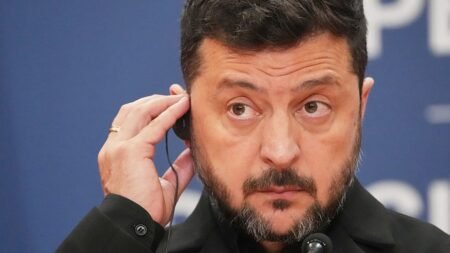




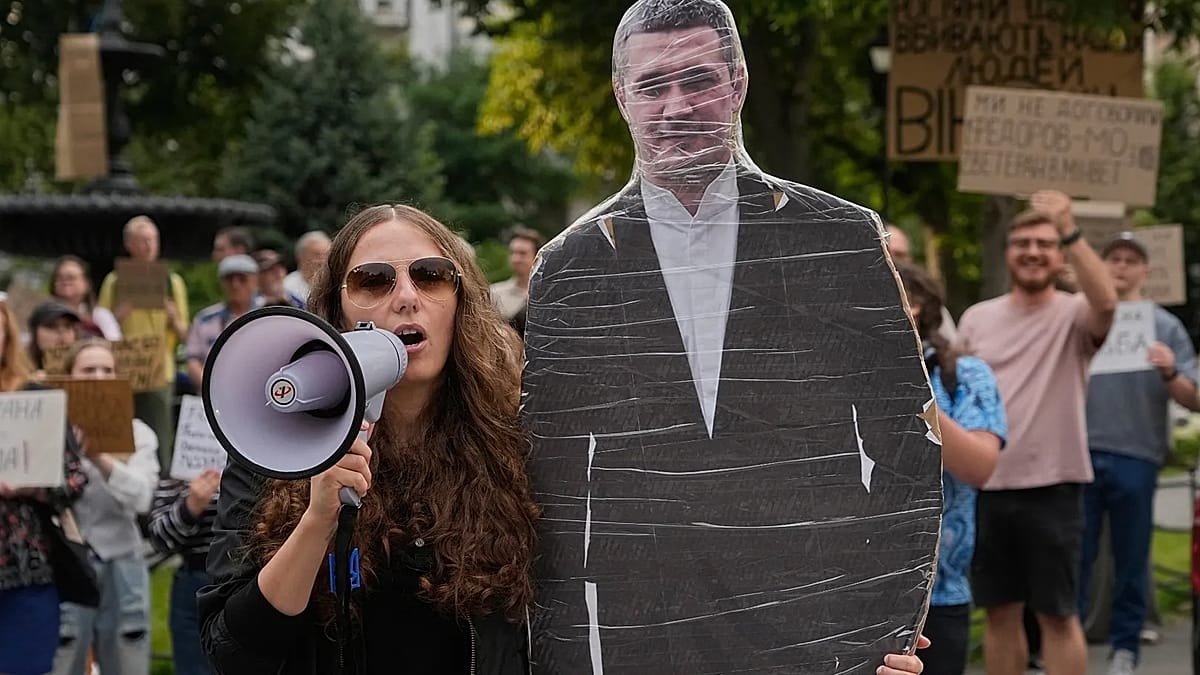
Mykhailo Fedorov’s call for wartime elections has been rejected by protesters who spent the past month campaigning for his return as defence minister.
The former minister’s video address on Tuesday evening marked an unexpected turn for a movement that had rallied behind him since Volodymyr Zelenskyy dismissed him in a wartime government reshuffle.
But leading organisers have opposed the idea of holding elections during the war and signalled an end to the daily demonstrations.
Dmytro Koziatynskyi, a Ukrainian war veteran and one of the protest organisers, said on Wednesday evening that he opposed holding elections while the war continued.
“I view elections during wartime negatively,” he wrote on X, adding that he could not “imagine how to technically enable thousands of soldiers currently on the front lines to vote and run for office”.
Four and a half years into Russia’s full-scale invasion, Koziatynskyi argued, Ukraine could not afford the divisions that an election campaign might create.
“In any case, street protests are definitely not the place for electoral discourse,” he said.
His statement appeared to draw a line under a month of daily demonstrations across Ukraine that began after Zelenskyy dismissed Fedorov from leading the defence ministry in mid-July.
Koziatynskyi stressed that the protests had been about the direction of Ukraine’s defence policy rather than Fedorov’s personal political future.
“These protests were specifically about dialogue and reforms, not about personalities,” he said.
He also offered his support to Yevhen Khmara, whom Zelenskyy formally nominated this week to replace Fedorov permanently.
“I want to wish Mr Khmara success in his new position and sincerely hope that he will continue the course on reforms and the fight against corruption in defence,” Koziatynskyi said.
Thanking those who had joined the demonstrations, he argued that the movement had nevertheless achieved tangible results, pointing to the dismissal of Oleksandr Syrskyi and the appointment of Mykhailo Drapatyi.
“I believe it was all worth it,” he said. “At the very least, we managed to secure the dismissal of Syrskyi and the appointment of Drapatyi, which hardly anyone could have expected just a month ago.”
‘I did not go out for your political ambitions’
Fedorov’s address also prompted thousands of responses on social media, many questioning both the timing of his intervention and his motives for calling for elections only after his hopes of returning to the defence ministry had ended.
“Do you think this is a good time for an election campaign video?” one demonstrator wrote on Threads. Another commented telling Fedorov: “There is a feeling that you have taken too much upon yourself.”
Others questioned why Fedorov, after seven years in Zelenskyy’s team, had chosen to raise concerns about the political system only after the door closed on his possible return.
“So if you had been reinstated, you wouldn’t criticise the system and wouldn’t call for elections?” one user asked.
Some of those who said they had joined the demonstrations sought to distance the protest movement from any broader political ambitions Fedorov might harbour.
“I did not go out for your political ambitions, but for you to stay at the defence ministry,” one wrote.
“You shouldn’t have done it. This is populism,” another said.
Members of the Ukrainian military also questioned how elections could realistically be conducted while hundreds of thousands of troops are fighting off Russia’s invasion.
One serviceman asked Fedorov whether soldiers should cast their ballots in “Kostyantynivka or Pokrovsk” – cities close to some of the heaviest fighting in eastern Ukraine.
The response from Zelenskyy’s administration was brief. Dmytro Lytvyn, a presidential adviser, told reporters in a WhatsApp group chat that Russia’s continuing attacks made the government’s position clear on any possible elections.
“The daily strikes by Russian drones and missiles provide a comprehensive answer.”
Read the full article here