






Published on •Updated
During a visit to the divided island of Cyprus, UN Secretary-General António Guterres announced that he would convene fresh talks in a 5+1 format to end the half-century deadlock.
He invited both the Turkish Cypriot leadership in the north and that of the Republic of Cyprus in the largely Greek-speaking south to take part, along with the country’s three guarantor powers: the United Kingdom, Greece and Turkey.
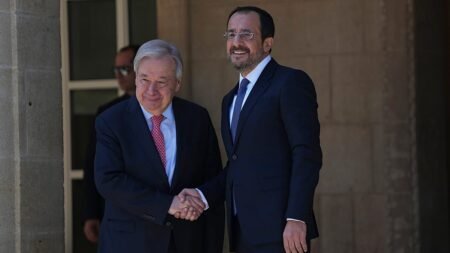
The announcement was made after the joint meeting he held on Wednesday in Nicosia with the president of the internationally recognised Republic of Cyprus Nikos Christodoulides and the Turkish Cypriot leader Tufan Erhürman.
“On the basis of our discussions on the way forward from here, I have decided to convene another 5+1 meeting, following adequate preparation on confidence-building measures, the methodology and the substance, taking into account the convergences already achieved,” Guterres said.
The UN chief did not announce a timeline for the talks, saying that it would depend on “adequate preparation” and progress in confidence-building measures.
He added that the UN will work in consultation with the two sides and the three guarantor powers in order to create the conditions for the meeting to succeed.
‘I do not want more meetings without results’
In response to a question about the timetable for the expanded meeting, Guterres said he had secured the consent of both sides and the guarantor powers, but insisted on the need for substantive preparation.
“I have the consent of both sides and of the guarantor powers to move ahead with a 5+1 meeting, but with sufficient preparation. Preparation on confidence-building measures, the methodology and the substance, because I do not want to have further 5+1 meetings without results,” he said.
The UN secretary-general clarified that no deadline has been set for convening it. “No timetable has been fixed. We will work together as quickly and as effectively as possible,” Guterres said.
Guterres also ruled out holding a meeting on the Cyprus issue during the High-level Week of the UN General Assembly in September.
“There is no meeting on the Cyprus issue scheduled for the High-level Week. We are now focusing our efforts on joint work with the two sides in Cyprus and with the guarantor powers,” he said.
Appeal for confidence-building
Guterres called on the two leaders to step up their efforts to define and implement confidence-building measures that will have a practical impact on the daily lives of Cypriots.
“This is the moment when every effort must be made to restore trust,” he said.
He added that both Christodoulides and Erhürman had assured him of their determination to continue to cooperate substantively with his personal envoy, Maria Angela Holguin.
The UN secretary-general described his separate and joint discussions with the two leaders as “honest and constructive”, and said that in his contacts with citizens from both communities he had heard a clear demand for progress, compromises and completion of the effort to resolve the division of Cyprus.
Guterres underlined the need to respect the mandate and authority of the UN peacekeeping mission, UNFICYP, both within the buffer zone and along the ceasefire lines defined by the international organisation.
He said that UNFICYP has been contributing for more than six decades to maintaining calm and stability, and that its effectiveness depends on the cooperation of all parties.
Guterres also referred to the work of the Committee on Missing Persons in Cyprus and of the Bicommunal Technical Committees, noting that they offer practical solutions and connect the political process with the daily lives of citizens.
He concluded by stressing that a solution to the Cyprus issue is not only about peace and the interests of Cypriots, but could also serve as a stabilising factor in a region facing ongoing conflicts and growing geopolitical risks.
“The United Nations cannot impose peace,” Guterres said. “But they remain fully committed to supporting the people of Cyprus at this critical moment for the island and the wider region.”
Additional sources • AP, AFP
Read the full article here