


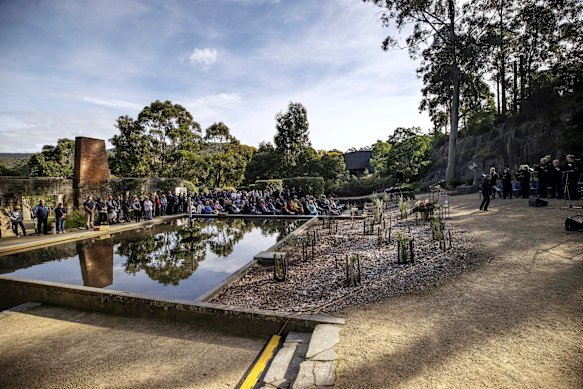
One of Jason Winter’s last acts on this earth was to throw a tray at someone who was pointing a rifle at his wife Joanne and their 15-month-old son. It saved their lives. He was killed shortly afterwards.
Anthony Nightingale’s last words were spent trying to save those around him, “No, no, not here”, he pleaded.
Carol Loughton was shot with her body covering her daughter. Open and exposed to the gunman, trying only to save Sarah’s life. Carol survived her wounds, Sarah did not.
Tony Kistan died as he desperately helped his wife escape; Peter Crosswell dragged his two companions to the floor.
Nannette Mikac was a tour guide at Port Arthur. She’d brought her children that day for a picnic. When the shots began she was heard trying to comfort her daughter as they ran, “We’re safe now pumpkin”.
A short time later her final words tried only to save the lives of her children.
There were at least 60 people in and around the Broad Arrow café at that moment. Australia’s deadliest mass shooting could in fact have been much worse.
How many lives did Ian Kingston or Brigid Cook save? We can never know. But they ushered and shouted and treated and calmed anyone they could. Other people ran back to the café when the shooting stopped. Into the blood and chaos to see who they could help.
How many lives were saved in moments that are lost in time, because the stories and the selflessness and the courage died with the people whose last breaths were spent in acts of service and love?
The stories we choose to tell
“Don’t say his name on the radio.”
“Really?”
“If you ever say his name your text line will light up with listeners telling you exactly that: don’t say his name.”
Long before I began researching mass shootings I had an ABC radio show that broadcast across regional Western Australia.
As an immigrant to this country, it was a place I was still trying to find the rhythm of. My colleague (and now wife) said it to me. I honestly don’t even remember why or when. But it stuck.
Then, the more I looked at the spectre of mass murder through the prism of how it was reported, the force of it grew – with every examination of every killing and every horror and every desperate search for understanding this monstrous crime.
I have studied 2000 years of mass random murder. From the earliest mass shootings: 1903 in Kansas to 1913 in Germany to 1924 in Melbourne.
To the “first” modern mass shooting: 60 years ago (this August), the University of Texas.
To Christchurch and Bondi Junction and Bondi Beach.
I’ll tell you the secret: We never really know why.
For every deep dive into background and mental state and manifestos and social media posts and remembered comments and diaries and letters and family and friends. We never really get to find out.
We guess. It’s a noble goal. But we never get there. We guess. And, to help us guess, we tell you everything about the killer – we deep dive into background and mental state and manifestos and social media posts and remembered comments and diaries and letters and family and friends.
If we tell you about the killer are we telling you why this happened?
No. We are only ever speculating. And the way we’re doing it is the problem.
“Seems the more people you kill, the more you’re in the limelight,” wrote the perpetrator of the mass shooting at Umpqua Community College, Oregon, 2015 (9 people killed).
“When you see me on the news, you’ll know who I am,” wrote the perpetrator of the mass shooting at Marjory Stoneman Douglas High School, Florida, 2018 (17 people killed).
The victims of the Port Arthur Massacre
- Winifred Joyce Aplin, 58
- Walter John Bennett, 66
- Nicole Louise Burgess, 17
- Sou Leng Chung, 32
- Elva Rhonda Gaylard, 48
- Zoe Anne Hall, 28
- Elizabeth Jayne Howard, 26
- Mary Elizabeth Howard, 57
- Mervyn John Howard, 55
- Ronald Noel Jary, 71
- Tony Vadivelu Kistan, 51
- Leslie Dennis Lever, 53
- Sarah Kate Loughton, 15
- David Martin, 72
- Noelene “Sally” Joyce Martin, 69
- Pauline Virjeana Masters, 49
- Alannah Louise Mikac, 6
- Madeline Grace Mikac, 3
- Nanette Patricia Mikac, 36
- Andrew Bruce Mills, 39
- Peter Brenton Nash, 32
- Gwenda Joan Neander, 67
- Moh Yee (William) Ng, 48
- Anthony Nightingale, 44
- Mary Rose Nixon, 60
- Glenn Roy Pears, 35
- Russell James Pollard, 72
- Janette Kathleen Quin, 50
- Helene Maria Salzmann, 50
- Robert Graham Salzmann, 57
- Kate Elizabeth Scott, 21
- Kevin Vincent Sharp, 68
- Raymond John Sharp, 67
- Royce William Thompson, 59
- Jason Bernard Winter, 29
The only certainty we have about motive is the one the killers have told us, repeatedly. If you are a loner with a gun, if you believe you are worth more than your society has given you, if you want to be remembered, we have provided a clear and apparent path.
Mass shooting researchers call it the script of coverage. Who was the killer? Why did he do it? Here is everything we know about them.
It created the phenomenon. It can be disrupted. It was disrupted, here.
After Port Arthur, there was a general revulsion across the country, led by grieving Tasmanians seeking to keep the focus where it belonged: on the victims; the survivors; the families; the community healing; the legislative response.
After The Mercury published a picture of the killer on the front page of the paper, with the headline “This is the man”, two things happened: the Director of Public Prosecutions threatened them with a contempt of court charge if the coverage caused a mistrial; and a member of the paper’s leadership team told me the phone rang off the hook.
Readers from across the state were furious.
“Get that bastard off the front page,” they said.
There was, in the horror and the grief, a steely resolve. It seeped into the wider public consciousness, and the killer became what he was: pathetic, reviled, ignored.
Instead of what he wanted to be: monstrous, powerful, remembered.
That script disruption saved lives. It told potential killers they would not get the notoriety they sought. It can and should be seen as being as meaningful and impactful as gun control.
Which matters now more than ever.
There are more guns in Australia now than at the time of the Port Arthur massacre. Mass murder has returned to this country.
We are losing the legacy of the response to that day 30 years ago.
The changes
It’s easy to view media coverage and culture as a rabid free-for-all. It is far from it. The best outlets are thoughtful, evidence-based. They seek to serve the public interest.
Changes to editorial policies have been made by several major outlets over the years, thanks in part to increased global research on the relationship between media coverage and mass shooting motivation.
They include, here in Australia:
ABC Editorial Policies
As much as possible, the focus of reporting should be on victims and survivors.
Avoid inadvertently glorifying terrorists or mass killers.
Use the perpetrator’s photo and name sparingly, especially in follow-up stories.
MEAA Code of Ethics
Extremists seek to use the media as a platform for their actions. Do your utmost to prevent this.
Ask yourself if it is necessary to identify perpetrators and, if so, how much?
In New Zealand, after Christchurch, five news organisations came together in unprecedented fashion to coordinate the coverage of the trial, and avoid giving the killer the platform he sought.
Change has happened, and it has undoubtedly saved lives.
After Bondi Beach and Christchurch and the sovereign citizen movement and the return of widespread gun ownership, today is a good day to remember what the response to Port Arthur taught us: we get to choose which stories we tell.


From our partners
Read the full article here