






Kit Prendergast is so passionate about bees she often dresses like one, has a circus act called The Birds and the Bees that she performs at fringe festivals, and goes by moniker the Bee Babette online.
But honeybees are not her main focus.
Dr Prendergast is a wild bee scientist who has studied native bee biodiversity, urban pollination networks, native bee conservation and the impact of introduced honeybees on native pollinators.
In 2022, she made international headlines after discovering a new native bee species in Kings Park and naming it after her pet dog, Zephyr, because of the bee’s unusual dog-like snout.
She also discovered another species, named “Lucifer” for its devil-like horns, in the Goldfields in 2025.
“Many people think of honeybees when they hear the word bee, but Australia has an extraordinary diversity of native bees living around us in parks, gardens, bushland and urban spaces,” Prendergast said.
“They are small, often overlooked and incredibly important.
“If we want people to protect native bees, we first need them to notice them.”
Prendergast said part of the reason native bees had fewer resources allocated to them was because they did not have the same economic backing as honeybees.
“There is an economic ideology around saving the bees, but we need a greater appreciation for biodiversity,” Prendergast said.
“We still don’t know all the roles native bees play because it is such an underfunded area of research, but we do know that the loss of little interactions could lead to the collapse of whole ecosystems.
“We need more funding because they are at risk of extinction.
“We also have a huge knowledge gap – nationally, there are around 1730 different species but 400 of them are undescribed.”
Prendergast believes getting the public engaged and informed was a great way to encourage more funding and research.
She will join other scientists on Saturday at the University of Western Australia, for a National Science Week showcase designed to bring research out of the lab and into the hands of the public.
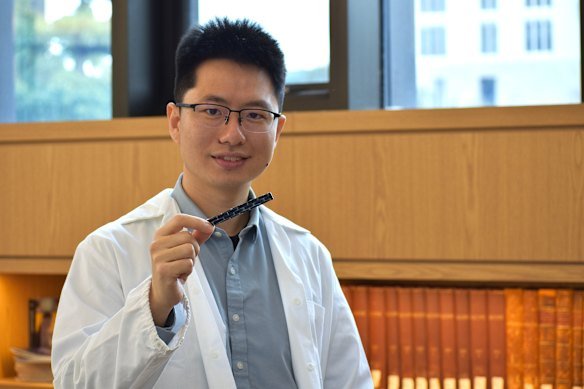
The scientists are all current or former Forrest Research Foundation scholars, and while Prendergast is in the latter category, mechanical engineer Mingxin Ye is currently involved in the program and has a plan to develop “bulletproof bones”.
His research has shown Kevlar – the material best known for its use in bulletproof vests – can make a carbon-fibre composite that could be used for future medical implants.
Ye was inspired by his father’s bone condition that, at its worst, meant he could not work for months.
“Seeing the mental and physical toll it took made me realise how much progress is still needed in bone repair, and it inspired me to move into mechanical engineering (from civil),” he said.
“Currently, what we use is those metal implants, but they come with a couple of problems such as loosening of the bone or obscuring X-rays which means that the surgeon cannot see properly how the bone is healing, and we also have problems with the metal implant failing.”
Ye said the industry was transitioning away from metal and towards carbon fibre polymers to solve the first two problems.
“We can see how the bone is healing using x-rays, and also the bone will not weaken over time because we can customise how strong the implant is to a specific bone density so that is awesome,” he said.
“But still in the industry we cannot solve the implant failing problem so this is where my research comes in – if Kevlar can be used to stop a bullet, then we can surely stop an implant from failing.
“I’m using Kevlar fibres as a special recipe or additive in the carbon fibre implant to make sure it’s more resistant to failures, and what we’re seeing is that it’s 50 per cent more resistant to impact damage.”
Carbon fibres are also used in sports cars, bicycles and tennis rackets, with epoxy as a binding agent instead of the Kevlar.
Ye said eventually it was possible that his research would result in Kevlar being used to build the next generation of aircraft, sports car, or “rockets that can land people on the moon”.
“So any lightweight and high strength activity that you can imagine of, we can use the carbon fibre to make it happen,” he said.
Forrest Research Foundation director, Professor James Arvanitakis, said at a time when misinformation could travel quickly, “opportunities like this matter”.
“By encouraging people to engage in open dialogue with researchers, we can help foster trust in science and create a deeper understanding of the role research and curiosity plays in our everyday lives,” he said.
Throughout the afternoon, 18 scholars will be stationed across Forrest Hall at the university, inviting visitors to explore hands-on science displays and ask questions about research spanning health, biodiversity, climate, technology and the natural world.
Supersonic Science will also bring science to life through fireballs, static electricity experiments and other live demonstrations.
Read the full article here