







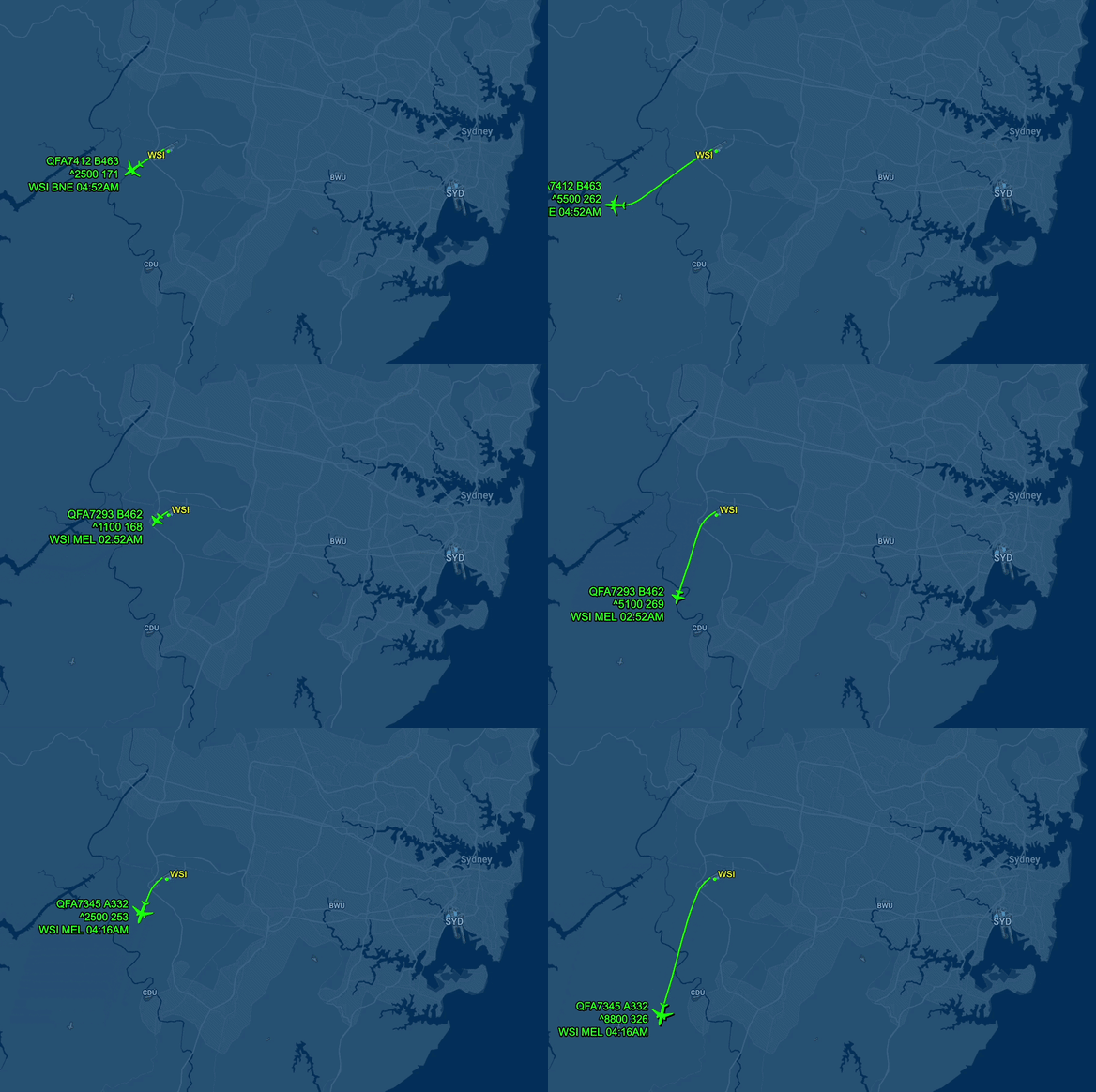
It was 3am on Tuesday when Sharon Robertson was woken by the muffled sound of roaring engines near her home in the Oaks, a semi-rural town in Macarthur, south-west Sydney.
“I thought, ‘That’s not a truck. That’s an aeroplane,’” said Robertson. She rolled over and opened the flight radar app on her phone, which confirmed the noise: she was experiencing the first night of 24/7 cargo flights departing and arriving at the new Western Sydney International Airport.
The flights began on Monday with the feted launch of TFX6319, a freight plane owned by logistics company Team Global Express that was travelling to Adelaide. Between 9am Monday and 9am Tuesday, 12 flights departed the airport and nine arrived. Flight data shows eight planes took off between 1am and 5am.
The flights were the first real test of the impact of flight noise for the tens of thousands of residents living in various parts of Sydney – some of whom had complained or campaigned against the coming changes to flight paths for years. So what was it really like to sleep under Sydney’s first no-curfew flight paths?
“At night-time, we don’t have any other noise around us. So we hear everything,” Robertson said. She described the noise of planes travelling south, as they did on Monday night towards Melbourne or Adelaide, as being louder than a truck nearby. Robertson, who is in her 50s, added her latest hearing test showed she had the ability of an 18-year-old.
But Robertson was not expecting to hear the noise as much as she did: the Oaks is well outside most of the noise maps produced ahead of the airport’s opening and 25 kilometres from the airport as the crow flies.
“We’re pretty relaxed in Wollondilly, and it’s like, whatever. But if you don’t say something now [authorities] will think that it’s not affecting anyone … they will get away with it. If this is going to keep happening, we should get soundproofing.”
But for others in western Sydney, day one of the cargo flights was uneventful. Luddenham Progress Association president Wayne Willmington said he was expecting the noise to be worse in Luddenham Village, which sits one kilometre from the airport, but was surprised to hear very little.
“I wasn’t woken by any aircraft noise at all last night,” he said. “I think the advantage for the people of Luddenham is we’re beside the runway and we’re not under any of the flight paths.”
‘Tale of two Sydneys’
The flight paths were authorised in June 2025, when federal Infrastructure and Transport Minister Catherine King stepped out on the newly completed runway and announced a total of five changes had been made to help minimise aircraft noise following feedback from the community.
“We’ve learnt lessons from other airports, which is why I have imposed a number of additional conditions that will reduce our aircraft noise,” King said at the time.
On Monday, King said the noise amelioration plan for Western Sydney International Airport is “really state-of-the-art” and that Airservices Australia would continue to monitor the impact on noise in the community.
Approximately 288 residential and noise-sensitive non-residential buildings, such as schools, childcare centres, health and medical facilities, and places of worship, have been identified as eligible for the noise insulation program.
But for many in greater western Sydney, the noise mitigation plan and changes to the flight paths aren’t enough. Federal Member for Lindsay Melissa McIntosh said the federal government had ignored the pleas of the Lindsay community, including suburbs such as Penrith and St Marys, for fairer flight paths and proper support for residents impacted by aircraft noise from the airport. “They’ve pushed ahead with flight paths that impact Lindsay the most and rolled out a noise insulation program that only includes roughly 250 homes,” she said.
For years, a sign displayed on the Great Western Highway in Glenbrook read “clear blue sky over Blue Mountains” and featured an image of a plane slashed out. That sign still remains, despite planes from the Western Sydney International Airport now being able to fly over the region.
Blue Mountains City Council Labor Mayor Mark Greenhill has long campaigned for the flight paths to change to avoid impacting the Blue Mountains, the only area in Australia wholly enclosed in a World Heritage National Park. He believes the flight paths show western Sydney is treated differently by policymakers.
“You can’t escape the conclusion that there are two Sydneys in the eyes of the policymakers: one Sydney that deserves a curfew … that deserves to have uninterrupted sleep, and one Sydney that deserves neither,” he said.
“It’s hard for us to conclude that western Sydney and the Blue Mountains aren’t second-class citizens when it comes to aircraft noise, because we are treated differently, and that’s an inescapable conclusion.”


From our partners
Read the full article here


