





Skopje, North Macedonia’s capital, is a city in a constant state of reinvention.
Found near a seismic fault between the African and Eurasian tectonic plates, major earthquakes razed the city to the ground in 518, 1555, and most recently in 1963.
With more than 80% of the Balkan city destroyed, relief poured in from 78 countries around the globe – including troops from both the United States and the Soviet Union, who met here for the first time since Elbe Day in 1945.
That event gave Skopje one of its nicknames – the city of international solidarity – and you can still see the impact in both its many brutalist buildings and the street names which pay tribute to those involved in the rebuilding effort.
Another seismic shift, this time manmade, hit the city in the 2010s: The Skopje 2014 project.
Supposedly meant to return the city to its pre-1963 look, several modernist buildings were given a neo-classical makeover, hundreds of statues were erected, and three fake ships were installed on the Vardar River (although what the majority of the statues and the galleons have to do with Skopje is anyone’s guess).
That too earned the city a nickname, this time far less complimentary – Europe’s “capital of kitsch”.
More shifts are coming: Skopje will be one of three European Capitals of Culture in 2028. To discover more about what visitors can expect, I headed there in May on a two-day trip.
Things to see and do in Skopje
Visit the Alexander the Great statue
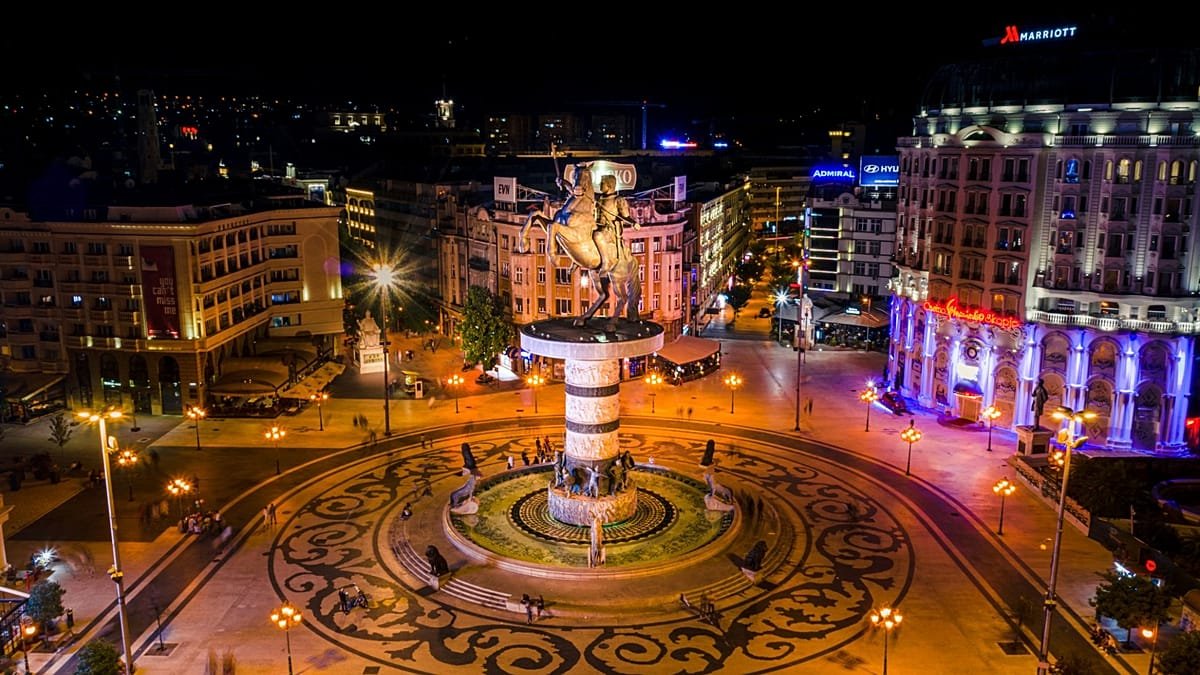
Macedonia Square, next to the banks of the Vardar River, is the heart of the city, and it’s here that you’ll find one of the grandest statues installed as part of Skopje 2014.
While officially called “Warrior on a Horse”, the 12-metre bronze statue, which sits atop a 10-metre pedestal surrounded by water fountains, depicts Alexander the Great.
The famed conqueror ruled over the ancient kingdom of Macedon, and the country’s use of the name Macedonia caused a major dispute with Greece. In 2018, the two sides signed the Prespa Agreement, which saw the country’s name change to North Macedonia, and a plaque was added to the base of the statue to say that Alexander “belongs to ancient Hellenic history and civilisation”.
Cross the city’s various bridges
The river splits the city into old and new, and its bridges are a mix of the two as well.
The Stone Bridge, one of the symbols of the city, dates back to the Ottoman period, while the Art Bridge and the Bridge of Civilisations in Macedonia were constructed during Skopje 2014.
Both the Art Bridge and Bridge of Civilisations in Macedonia are lined with – you guessed it – statues, with the former highlighting famous creatives while the latter pays tribute to various rulers and notable historical figures.
Stroll around the Old Bazaar
Skopje’s main tourist attraction is undoubtedly the Old Bazaar. Dating back to the 12th century, the area was developed under both the Byzantine and Ottoman Empires.
Having catered to merchants for centuries, the Old Bazaar is home to mosques, caravanserais, and hammams, although many of these buildings have since been converted for different purposes.
This includes the National Gallery, found in the former Daut Pasha Baths, and the Kapan Han, which is now home to a restaurant serving traditional local dishes.
If you’re looking for souvenirs, this is where you want to head. Just remember to bring cash, as only a few of the retailers will accept card payments.
Learn about the country’s history at the Museum of Macedonian Struggle
Nature isn’t the only force to have impacted North Macedonia’s history, and you can learn about the country’s struggle for independence at this museum.
Exhibitions here cover the 19th and 20th centuries, including the resistance against the Ottoman Empire, the Balkan Wars and both World Wars through wax figures and historical artefacts.
See the old railway station
One of the few buildings that wasn’t completely destroyed during the earthquake in 1963 was the Old Railway Station.
Now housing the Museum of the City of Skopje, the clock outside serves as a permanent reminder of that devastating day, having broken at the exact time the earthquake struck – 5.17 am.
Inside, the museum covers the city’s history from the earliest settlements up until the modern day, looking at archaeology, history, ethnology and art history.
Take a brutalist architecture tour
While many building façades were changed, there are still plenty of brutalist buildings dotted around the capital, though many are outside of the main tourist areas.
Book onto a brutalist architecture tour led by local guide Aleksandra Georgieva and you’ll discover some of the most striking (and, in my opinion, beautiful) examples, from the Macedonian Academy of Sciences and Arts to the Post Office’s headquarters.
Even if you don’t appreciate the architectural style, you’ll see a different part of the city, and you’ll be able to ask a local any of your burning questions.
Shop at the green market
Snackpacking is a huge trend at the moment, and if you’re looking to try local delights, look no further than the green market.
Open daily, you’ll be able to grab fresh produce, cheeses and spices, and try dishes like burek or tavče gravče, aka Macedonian baked beans.
Admire the city from above at Skopje Fortress
Originally built in the sixth century from the ruins of the Roman city of Skupi, which was destroyed in the earthquake of 518, Skopje Fortress is found in the highest point of the city.
There aren’t any information boards around the site, so those after an archaeology lesson will have to look elsewhere, but the view is fabulous.
Check out the frescoes at the Church of Saint Panteleimon
Another spot above the city, the Church of Saint Panteleimon, dates back to the Byzantine Empire.
The church is notable for its frescos, including the lamentation of Christ, as they show the emotions of those depicted, which was quite rare for the time.
Still a working church, you should be aware that you might have to wait for access while baptisms and weddings take place.
Day trips from Skopje
Matka Canyon
One of the top tourist attractions in the country, Matka Canyon, is under an hour’s drive away from Skopje.
You can hike around the artificial lake or take an hour-long boat ride, which includes a visit to Vrelo Cave, which is known for its pine cone-shaped stalactite.
The area is home to a number of caves, including one which is believed to be among the deepest in Europe, although you’ll only be able to get a glimpse of its entrance on your visit.
What to eat and drink in Skopje
If you’re looking to try traditional plates like tavče gravče, Macedonian salad, the red pepper paste pindjur or burek, the Old Bazaar is the place for you.
Outside of the Old Bazaar, Debar Maalo, the city’s bohemian district, is full of restaurants and bars. Be sure to order a glass of Vranec as the region is known for it.
While it’s not traditional Macedonian food, I’d highly recommend a visit to Matto Napoletano. The Italian restaurant was named among the top 50 best pizza restaurants in the world in 2024, and having tried the five cheese pizza, which now lives rent-free in my head, I can attest that the food here is unbelievably good.
In terms of nightlife, Skopje has plenty of bars to choose from. It should be noted that a nightclub fire in 2025 has meant that many venues have closed their doors due to safety concerns.
Next time I’ll visit for…
Aside from the European Capital of Culture programme, I’m looking forward to returning to experience the cable car up to the Vodno Millennium Cross, which was closed during my visit.
Towering above the city, the Millennium Cross was unveiled in 2002 to celebrate 2,000 years of Christianity in Macedonia.
I’d also like to pay a visit to Lake Ohrid, which is a three-hour bus journey away.
How to get there
Direct flights to Skopje Airport are available from many destinations with budget carrier Wizz Air, including Barcelona, Berlin, Ljubljana, London Luton, Madrid and Rome Fiumicino, but the airport is also served by airlines including Austrian Airlines, easyJet and Turkish Airlines.
Alternatively, you can fly into Tirana in Albania and take a four-hour-and-40-minute bus, or take a four-hour bus from Bulgaria’s capital, Sofia.
Top tips
If you’re taking public transport to Matka Canyon, ask the driver where the bus will pick you up for the return journey. Matka Canyon can get busy, and the bus might not be able to reach the same point where you were dropped off.
Planning on exploring more of the Balkans by bus? You can book tickets online through services like FlixBus or Gjirafa Travel, or at the bus station in person. If you do buy online, you’ll need to pay the bus station fee of 50 denars, or 85 cents, to access the platforms.
Read the full article here