



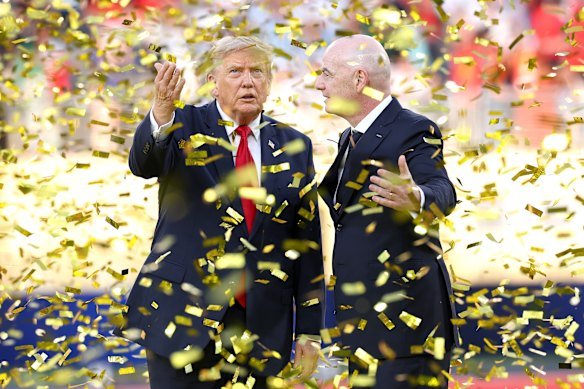
The Spanish team’s joy and refined restraint in their well-deserved victory in the World Cup was beautiful to behold. There was no grandstanding over the brokenhearted Argentinian team, and the winners were dignified and sportsmanlike. Nothing is perfect, though. The presentation of medals by the USA’s invited “gatecrasher” was nearly as entertaining as the match (“Oops, he did it again: Trump hogs the stage, crashes World Cup trophy lift”, July 20). As always, Donald Trump tried hard to make it about himself. He unsuccessfully attempted his prolonged power handshake on the first players on the podium. Many of the Spanish team were clearly ambivalent as he handed over their medals. The sore loser president then tried to insert himself into the team’s celebrations as they lifted the World Cup above their heads. FIFA president Gianni Infantino had to pull him out of the photo. America’s “it’s always about me” president was sidelined. Spain won in more ways than one. Gerardine Grace, Leura
Of course Trump was reluctant to leave the stage and the reflected glory. It wasn’t until Infantino whispered to him, “come, my precious – I have gold” that he left. Barrington Salter, Elanora (Qld)
Oh, the irony of Trump having to present the World Cup to Spain, a nation that resolutely defied his bullying demand to help with his war on Iran. Congratulations to Spain! Graham Watson, Woollahra
A big, big thank you to everyone at SBS for their exceptional 2026 FIFA World Cup coverage. I would go as far to say the final score was SBS 1, One Nation 0. Tristan Milani, Mosman
‘Messiah’ doubt
Maureen Dowd gives this most damning assessment of Donald Trump’s prime-time address on the “stolen” 2020 presidential election: “He puts his own ego above everything else, even democracy” (“Trump reduces the grandeur of obsession into complaints – about the time he was president”, July 20). More worrying than Trump’s ego is his deep-seated fear of seeing the support of his MAGA base crumble, especially over his total mishandling of the war in Iran. According to their own Biblical interpretation of the prophesied End Times, this cult-like base of fundamentalist Christians believe his presidency is preordained by God to save Israel from its enemies. But Iran’s intransigence in the face of America’s military might gives them cause to seriously doubt whether Trump is the answer to their prayers, or whether he is indeed their political messiah. In the absence of such divine assurance from MAGA, this leaves Trump having to confront a fear he may never have had to confront before: that the only person to blame is himself. Rev Vincent Zankin, Rivett (ACT)
Michael Koziol writes that “Trump has weighed escalating the conflict, publicly stating that he was considering attacks on Pickaxe Mountain, a key Iranian nuclear site” (“Trump launches retaliatory strikes after Iran kills two US troops in Jordan”, July 20). Wait a minute: didn’t Trump claim some months ago that Iran’s nuclear capacity had been “obliterated”? How have the Iranians so quickly ramped up again? It couldn’t be that Trump was not telling the truth, could it? David Gordon, Cranebrook
AI limits unknown
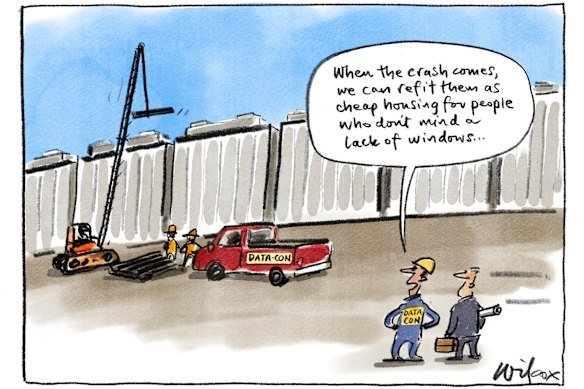
After watching big tech’s deference to Trump’s style of politics, I find it hard to contemplate that they would do anything in the best interests of the Australian public (Letters, July 20). It’s usually about scale, efficiencies, shareholder returns and CEO egos. I’d imagine most wouldn’t care about the communities in which these monolithic data centres reside. So the PM’s proposal to tightly regulate such centres has merit, but if it’s as effective as his government’s regulation of the gambling industry, we have a reason to be concerned (“Nothing artificial about Albanese’s intelligent intervention, and the urgency is real”, July 18). Peter Singer, Hamilton South

A new way to prevent malaria – now that is how AI should be used, not for harvesting, storing and using our personal data but for a localised, immediate warning of a lurking danger (“The device detecting the world’s deadliest creature”, July 19). Peter Butler, Wyongah
Don’t be stupid
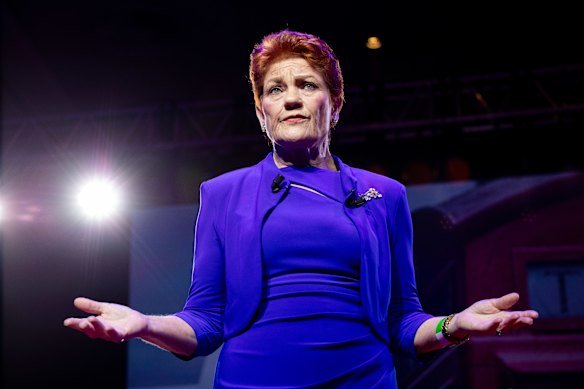
Pauline Hanson has taken to belittling Australia on a foreign stage, telling a London audience “We don’t learn. We’re too stupid over there” (“Hanson takes aim at privilege and trans rights”, July 18). It is an extraordinary claim from a senator representing a nation renowned for world-leading scientists, doctors, engineers, innovators and artists, home to the world’s oldest continuing culture and one of the world’s most successful multicultural societies. If Hanson is searching for stupidity, she might begin a little closer to home. One Nation has spent years flirting with conspiracy theories, showing an unhealthy admiration for authoritarians such as Donald Trump and Vladimir Putin, and dismissing Australian workers as “lazy”. Hanson’s disdain for multiculturalism is particularly rich, given she delivered her speech between stays at a luxury hotel in Taormina, a city shaped over centuries by Greek, Arab, Norman and Spanish cultures, whose diversity and hospitality she seemed perfectly happy to enjoy. Hanson should know that patriotism does not involve flying overseas to denigrate your own country, even if it is in front of a tiny audience. In Italy, they have a word for that sort of performance: antipatico. Vivien Clark- Ferraino, Duckmaloi
Your correspondent Max Redmayne (Letters, July 20) is quite right when he identifies the problem with “that woman” receiving “free marketing every day, with commentators ever keen to report on her latest outrage”. You only need to look at the speech she gave in London recently before a meagre audience about the size of a Saturday afternoon bowlo meeting. Yet, for that outing she got front-page coverage back home in Australia. According to AI, that coverage gives her exposure to more than 8 million Australians. Her approval rating might possibly also receive a boost simply by being mentioned in such a respectable publication as yours. And while I am at it, I should remind Max and your other more progressive correspondents that identifying her in the national media in their letters also gives her more oxygen. It needs to stop, preferably sooner rather than later. Rob Reitano, Lane Cove West
I am a retiree and full-time carer for my wife, who has dementia. We have been living in this fair land for 50 years and not once have we considered protesting in the streets. My wife’s cognitive ability is now seriously impaired but as soon as she sees Pauline Hanson on television she raises her fist, shouts, and asks why this woman is allowed to blurt out anything on live television without being charged with racism. I just shake my head and wonder whether to laugh or cry; laugh at her moments of lucidity in joining me in my disgust at Hanson, or cry at the possibility of losing multiculturalism, the very thing that made us fall in love with Australia in the first place. On that basis, I would be willing to sacrifice a day, leave my wife with a paid carer and join a rally protesting against the division that this woman sows. I’m completely cognisant, as is my wife albeit quite infrequently, about the danger of being governed by people who are driven by anything more than bigotry. Felix Orcullo, Wahroonga
By George, he’s right
I must admit that agreeing with George Brandis has not been a habit of mine over the years. However, in this case I would unconditionally like to thank George for highlighting a problem of national concern and specifically rural concern, should Pauline Hanson get her way (“When Hanson’s supporters examine all her policies, what they find could ‘horrify’ them”, July 20). In his opinion piece, Brandis explains that Hanson’s policy of mandatory sale of all foreign-owned agricultural land will lead to a glut of farmland and a significant reduction in the value of rural land holdings held by Australians. This would be the simple economics of supply exceeding demand. Ironically, as Brandis points out, some of Hanson’s most ardent supporters are rural folk who appear not to have grasped their impending self-inflicted pain should they naively support Hanson. Rather than rolling with political populism, Brandis presents an insightful evaluation of the policies which underpin Hanson’s anti-foreigner nonsense. Never thought the day would come, but may I say “Well done, by George”. Warren Marks, Long Beach
Brandis highlights many of Pauline Hanson’s negative and divisive policies. He fails to mention his own attempts in 2014 and 2017 to amend section 18C of the Racial Discrimination Act on the basis of free speech. These attempts are in accordance and rest side by side with Hanson’s own views. Brandis needs to come clean; call out such action now as totally inappropriate. History will be the judge for both of them. Michael Blissenden, Dural
Need for scapegoats
Denis Minehan’s letter reminded me of working in TAFE in the 1980s at Blacktown and Bankstown with a large and varied migrant population (Letters, July 20). I then moved to a country TAFE in a very white town with an Indigenous population who were seen as the source of many problems there. I realised very quickly that people need an easy scapegoat, from new arrivals to Indigenous inhabitants. It soon taught me that what separates us is not the colour of our skin or our country of origin, but some psychological need to feel superior to those different from ourselves, something that has always been exploited by governments for their own benefit. Is education the answer? I don’t know. Sally Shepard, Nelson Bay
Fair gas tax
Excellent news that the Labor National Conference may be a launching pad for a gas export tax (“Labor factions to debate key policies”, July 20). Currently, multinational gas corporations contribute less through company tax and the Petroleum Resource Rent Tax than nurses pay in personal income tax. Their operations also generate the greenhouse pollution driving climate impacts that already cost Australia an estimated $4.5 billion a year in extreme weather damage. As Anthony Albanese’s Labor Party has acknowledged, Australians deserve a fairer return from our natural resources, but we also need those resources managed responsibly and humanely. Tax fairness would be a start, but accountability for climate damage must follow. Larni Dibben, Glen Iris (Vic)
Personal price
ASIC has been busy in the past year (“Record $830m in fines against banks, financial firms”, July 20), but we’ve seen it before with massive fines for Westpac, Commonwealth Bank and others. This is unlikely to have much impact because the people responsible for the negligent actions – the senior managers and directors of the companies – lose nothing. The fines come out of profits, paid by shareholders, who are not the ones committing the offences. The managers and directors responsible simply see the fines as a cost of business, ultimately paid by somebody else. Our consumer protection and corporations laws need to sheet home responsibility to managers and directors and fine them and even jail them when a company is found guilty of illegal behaviour. Steven Lee, Faulconbridge
Paid to discriminate
The recent vote by the Presbyterian Church of Australia NSW General Assembly to bar women from becoming elders is deeply disturbing. What makes this decision particularly offensive is that it was passed inside the theatre of the Presbyterian Ladies’ College in Croydon – an elite, private school ostensibly dedicated to the empowerment of young women. As a non-member of the church, I might otherwise view this as an internal theological matter, but PLC Sydney receives millions of dollars in state and federal government funding every year. Taxpayers are effectively subsidising an institution whose governing body openly declares that women are unfit for leadership. A room made up of 90 per cent men voted to strip women of roles they have held for more than 60 years. It sends a damaging message to the students at PLC and to the broader community. If a church chooses to entrench discrimination, the public should seriously question whether its educational institutions deserve a single cent of public funding. Shaun Davies, St Peters
Drone judgment
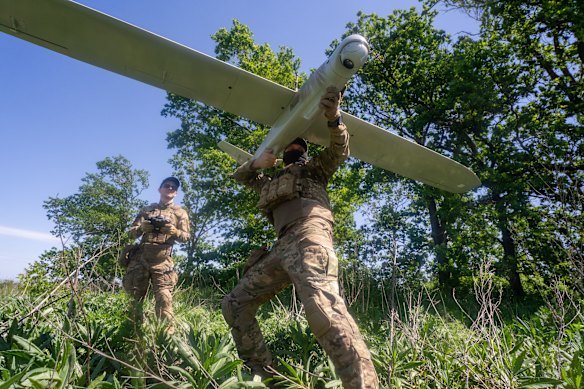
It’s a sign of the times that you can watch online videos of Ukrainian drone operators killing Russian soldiers in a deadly battle orchestrated far from the front line. It struck me that every drone operator plays God by taking real people’s lives with the click of a tiny joystick. Ukraine has set a target of 50,000 Russians a month to be eliminated from the battlefield, making it impossible to sustain troop replenishment levels. One Ukrainian soldier was but 20 years old, talking about 10 to 14-hour missions hitting targets in Russia or the occupied Donbas. His drone identifies, tracks, stalks, seeks surrender or simply executes enemy soldiers, or blows up buildings with them inside. It’s literally reduced war to a video game. Rob Buchanan, Kerikeri (NZ)
Canine crazy
Your correspondent has evidently never been a dog owner (Letters, July 20). I have been surrounded by dogs and cats all my life, and to me, dogs win hands down. Our canine friends give unbridled, enthusiastic, boisterous and relentless love. They love companionship and social interaction and pour it out in bucketloads. On the other hand, cats are nocturnal, reserved, independent and tolerate affection on their terms. To quote author Mary Bly: “Dogs come when they’re called, cats take a message and get back to you.” Probably explains why I’m a dog lover. Elizabeth Maher, Gordon
On my walk the other day, I met a very striking but small Pomsky – an unlikely cross between a Pomeranian and Siberian husky. I tried not wonder about the practicalities involved in producing such a breed. Viv Munter, Tumbi Umbi
- To submit a letter to the Sydney Morning Herald, email letters@smh.com.au. Click here for tips on how to submit letters.
- The Opinion newsletter is a weekly wrap of views that will challenge, champion and inform. Sign up here.
Read the full article here