





Updated ,first published
Anthony Albanese will seek to drive forward another Pacific treaty after he and key Asia-Pacific leaders united to condemn China’s intercontinental ballistic missile launch, labelling it a provocative, threatening and unfriendly act undertaken without sufficient notice.
Albanese will host three Pacific leaders – Papua New Guinea Prime Minister James Marape, Tongan Prime Minister Lord Fakafanua and Samoan Prime Minister Laʻauli Leuatea Schmidt – in Brisbane on Wednesday, where they will attend the State of Origin decider after a series of bilateral meetings.
Australia and Fiji have said they would welcome more nations joining the Ocean of Peace military alliance they struck this week, which commits the parties to come to each other’s aid if under attack. Tonga would be a logical partner to join the alliance given it is one of the few Pacific nations with a defence force.
Australia and Tonga are also seeking to finalise a comprehensive treaty known as the Kaume’a Ofi (close friendship) agreement, which the nations last year said would be “transformational” and “write the next chapter of regional integration”.
“Joining together is not expedient, short-term or transactional. It is our duty,” the nations said in a statement of intent last year.
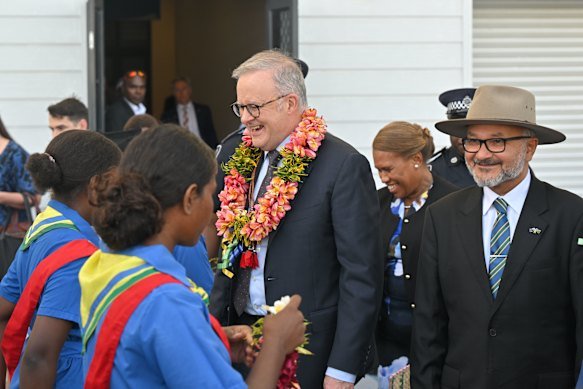
In his first public comments since China announced it had fired a long-range ballistic missile from a submarine over the Pacific Ocean on Monday, Albanese told reporters in Solomon Islands capital Honiara: “We have made clear our concerns to China in both Beijing and in Canberra, and I’m making our concerns clear here as well.”
Albanese said there was “no doubt that this is a provocative act by China, which does destabilise the region, and therefore we will put forward our strong view”.
“This is one of those occasions where we must disagree with this action, and in particular, we point out that it is standard procedure for tests such as this, for there to be given 48 hours’ notice,” Albanese said. Defence Minister Richard Marles earlier said Australia was warned just two hours before the launch.
Solomon Islands Prime Minister Matthew Wale, who was elected in May, said at the same press conference: “China is a good friend of Solomon Islands, but this is not something a friend does. This is not good in our region.”
Wale added: “Be our friend, but don’t threaten us.”
Wale, the current chair of the Pacific Islands Forum, said he had registered a “strong protest” with China’s ambassador in Honiara.
Noting that the United States also conducts missile testing in the Pacific, Wale said his “bottom line” was that he didn’t want to see any long-range missile launches in the region.
Wale said the missile test would not deter his efforts to create a Pacific-wide security pact, and that it only added to the need for a regional platform.
Solomon Islands and China signed a security pact in 2022, alarming officials in Canberra. Albanese and Wale are hoping to strike a comprehensive security treaty by the end of the year.
The Philippines issued an angry response to the missile launch, which passed over the northern tip of the country on Monday afternoon, calling it “a reckless display of military power that shows little regard for smaller countries and the fragile ecological systems that sustain their people.”
“This launch serves no peaceful purpose and is a calculated act of taunting and provocation against those who reject China’s illegal expansionism and coercive conduct,” Philippines Department of National Defence Spokesman Arsenio Andolong said.
Marape, the PNG leader, issued a statement in which he “respectfully” urged China to make this its last missile test in the region, extending the message to other nations such as the US, Japan and France.
The Fijian government issued a muted response, acknowledging China had provided notice of the test and saying Fiji was assured it was not targeted at any particular country.
Senior Labor and Coalition figures united to condemn the missile launch, while saying they did not believe it was a direct response to the defence alliance Australia signed with Fiji just hours earlier.
China’s People’s Liberation Army is believed to have fired either a JL-2 or JL-3 intercontinental ballistic missile fitted with a dummy warhead. The missiles have ranges of 9000 and 12,000 kilometres respectively.
The US State Department said it had monitored China’s submarine test launch of an unarmed intercontinental-range ballistic missile, which landed in the southern Pacific Ocean on Monday afternoon.
“At a time when the United States is working harder than ever to prevent nuclear proliferation, China is doing the opposite,” spokesman Thomas Pigott said.
“We continue to urge China to engage in meaningful arms control discussions.”
Pacific Minister Pat Conroy rejected Beijing’s claim that the test complied with international law and practice, saying: “It’s not consistent with The Hague convention on ballistic missile testing, which would require more notice and greater information provided to countries.”
Conroy said Australian authorities had been tracking the Chinese Navy task force that launched a missile, meaning the launch was likely planned well before the finalisation of the treaty with Fiji.
“I think it’s more likely to be coincidence rather than linked, but obviously that’s ultimately a question for the Chinese government,” he told ABC radio.
The missile fired from a submarine off the coast of China, crossed over the Philippines and landed near the island nation of Nauru, according to the secretary-general of Taiwan’s National Security Council, Joseph Wu.
He posted a map on X in the early hours of Tuesday morning showing what he said was the trajectory of the ICBM in a post labelling China a “bully”.
Wu’s post said China had fired a JL-2 missile while China’s state-owned Global Times quoted military analysts saying it was likely a newer and longer-range JL-3 missile, which was formally unveiled at a lavish military parade in Beijing last year. Maritime expert Jennifer Parker said she believed it was most likely a JL-2 missile.
NATO Secretary General Mark Rutte said the test-firing by China of a missile from a nuclear-powered submarine into the Pacific sent a message to the alliance.
“This, again, is evidence that we cannot be naive,” Rutte told reporters on the eve of a NATO leaders’ summit in Ankara. “And we are not.”
Opposition defence spokesman James Paterson said on ABC radio on Tuesday morning that he shared the government’s concern that China’s behaviour was not best practice.
Cut through the noise of federal politics with news, views and expert analysis. Subscribers can sign up to our weekly Inside Politics newsletter.


From our partners
Read the full article here