





Canadian researchers are calling for a more coordinated response by G7 countries to counter “systemic” Chinese foreign interference, particularly as technology and tactics evolve and Beijing’s agents embed themselves further into societies.
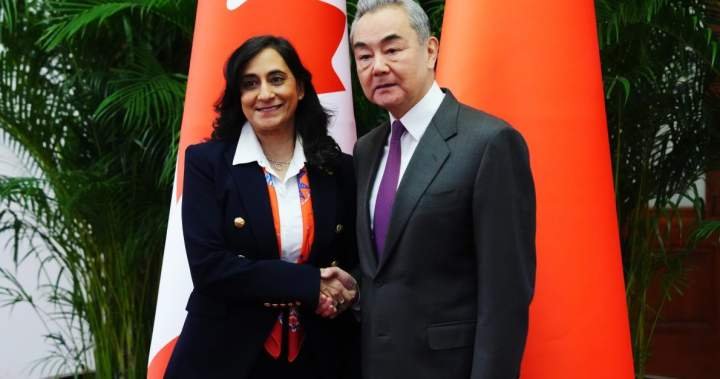
Wednesday’s report by the Montreal Institute for Global Security comes a day before Canada is set to welcome China’s foreign minister to Ottawa for the first time in a decade.
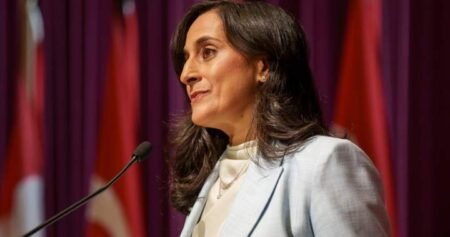
Speaking alongside the report’s authors on Parliament Hill, former member of Parliament John McKay urged Foreign Affairs Minister Anita Anand to raise the issue of foreign interference with her counterpart Wang Yi during his visit.
“As this is an opportunity for a reset of our relationships between Canada and China, I hope that both ministers will take the opportunity to operationalize that reset so that this level of interference ceases,” he said.
McKay also called on journalists to press Anand and Wang on any commitments by the Chinese government to stop foreign interference in Canada.
When he last visited Canada in late May of 2016, Wang unleashed a tirade on a Canadian reporter who asked about human rights in China at a joint press conference with then-foreign affairs minister Stephane Dion.
Global News has asked Anand’s office and Global Affairs Canada whether foreign interference will be discussed.
The ministers are expected to discuss the recently updated Canada-China Strategic Partnership, as well as trade, investment and global security, according to a statement released by Anand’s office last week.
Carney, who travelled to Beijing in January to cement the new agreement, told reporters Wednesday he looks forward to Wang’s visit and will meet with him personally.


Get daily National news
Get daily Canada news delivered to your inbox so you’ll never miss the day’s top stories.
He said the visit will offer a “valuable exchange of views.”
Kyle Matthews, executive director of the Montreal Institute for Global Affairs, said he and other experts support Canada pursuing trade with China and other countries like India that have been accused of foreign interference, but “we cannot be naive.”
“We’re dealing with states that have murdered Canadian citizens, that have harassed Canadian citizens, states that have stolen some of our top intellectual property,” Matthews said.
“We do have economic interests to expand. However, we cannot be blind.”
Dan Stanton, a former official with the Canadian Security Intelligence Service who is now the director of the national security program at the University of Ottawa, said the federal government needs to be transparent with Canadians — especially diaspora communities — that it still recognizes the risk of foreign interference.
“Canadians need to understand that the government has not forgotten, one hopes, and the government is still going to hold countries to account for what they’re doing,” he said.
The report draws on open-source research and interviews to present case studies of Chinese interference in each G7 country: Canada, the U.S., the U.K., Italy, Germany, France and Japan.
Particular attention is paid to China’s United Front Work Department, which the report says coordinates a broad ecosystem of political, business, academic, media and civil society groups in democratic countries.
While those groups operate legally and often pursue legitimate relationships, the report’s authors say they are pursuing long-term narrative influence that further China’s interests abroad.
“It’s a little bit like the ancient Chinese game ‘wei chi,’” said Marie Lamensch, the director of global affairs at the Montreal Institute for Global Security. “It takes space over a long time, it is adaptive, and the government basically takes its time.”
The report included examples in European nations of politicians being targeted with covert influence campaigns from the national to the local levels.
In one case study in Italy, the report describes the sister-city agreement between the small Italian municipality of Asti and Nanyang, a Chinese city of over one million people, which came after increased business and trade exchanges between officials and trips to China by Asti authorities.
The report describes the relationship as “surprising” given Asti’s wine- and tourism-based economy, while Nanyang is focused on advanced industries like artificial intelligence. The agreement has since led to plans for a leading Chinese surveillance firm to explore future projects in Asti, according to the report.
Lamensch said G7 universities are also susceptible to partnerships with Chinese academics and schools that, while legal and legitimate, are being pursued for ulterior motives. Britain is particularly vulnerable, she noted, as it has come to rely more on foreign students since Brexit.
The report also covers instances of transnational repression, including intimidation of Chinese diasporas through so-called “police stations” set up in Canadian cities and other methods.
The authors say intelligence sharing, foreign influence registries, and coordinated national strategies on managing foreign partnerships across society are needed to counter China’s influence activities.
Matthews said the report acknowledges that “it’s a tumultuous time for the G7” given the “rupture” created by the U.S. under President Donald Trump, as well as the broader geopolitical climate.
However, he added, “We still have to stay the course with some of our key economic and democratic allies to work to protect our democracies from Chinese foreign interference and influence.
“It’s a major problem.”
—with files from the Canadian Press
Read the full article here