





European Parliament majority may not be a centrist coalition, according to new data.
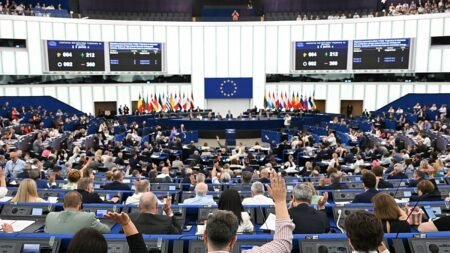
The three parties — the centre-right European People’s Party (EPP), the centrist Renew Europe, and the centre-left Socialists and Democrats (S&D) — which have formed a parliamentary majority since its creation would fail to secure one for the first time.
The seat projection was published on Wednesday by Europe Elects, an election data platform, which drew on voting intentions from each EU member state and modelled seat allocations based on each country’s electoral law.
In recent years, Europe’s mainstream political forces have been on a downward trajectory.
This latest projection marks a significant milestone: the centrist forces that have dominated European politics since the Second World War are, for the first time, projected to fall short of a majority at the EU level.
Parliamentary changes
The 2024 European Parliament elections already saw a significant shift in the political barycentre to the right, with right-of-centre parties gaining almost 60 MEPs, much of it driven by far-right, conservative and national-populist forces.
Europe Elects projects the S&D would suffer the largest loss, shedding 18 MEPs, followed by the EPP with 15 and Renew with nine. The Greens/EFA group, which has often propped up the parliamentary majority in the current term, would be further reduced, losing 14 seats.
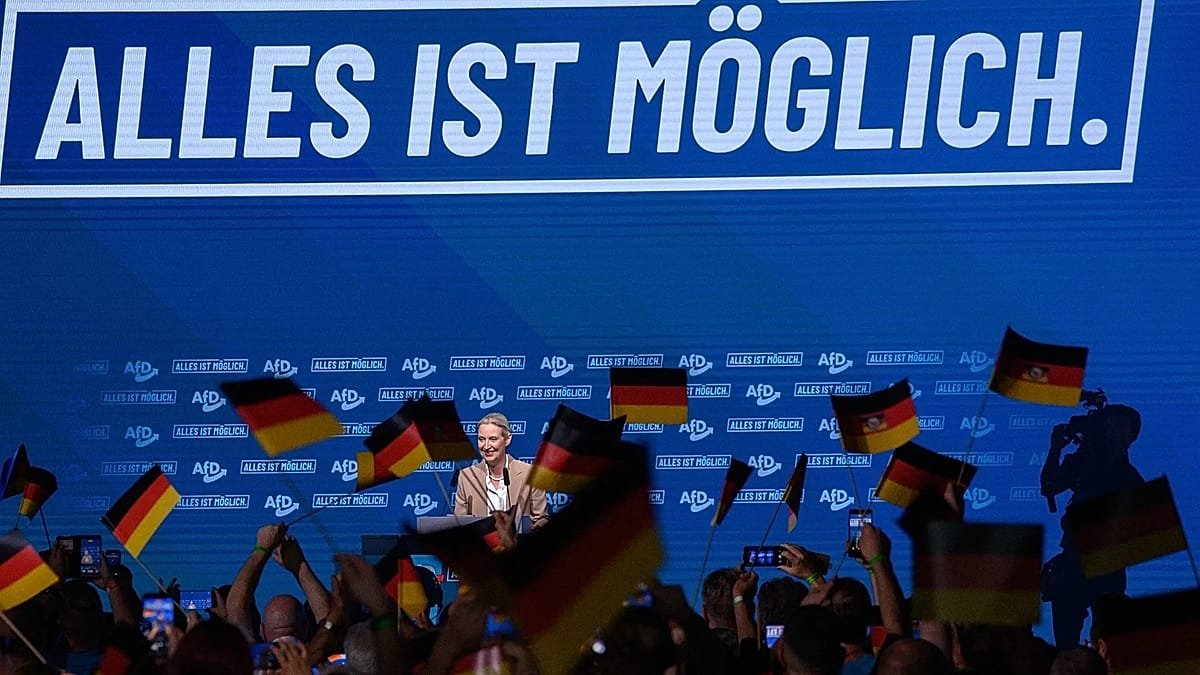
Meanwhile, the hard-right Europe of Sovereign Nations (ESN) group, which includes Alternative for Germany, currently projected as the leading German party, would gain 19 seats.
The far-left group The Left is also projected to gain 19 seats, driven largely by leftist parties in France and Germany — a sign the political trend favours not just the right, but anti-establishment forces more broadly.
Still, most of the projected gains sit on the right of the chamber. Patriots for Europe (PfE), which includes Marine Le Pen’s National Rally, is projected to gain 12 seats, driven by Spain’s Vox and Austria’s Freedom Party.
The European Conservatives and Reformists (ECR), dominated by Giorgia Meloni’s Brothers of Italy, is due to remain largely stable, with three additional MEPs.
Group positioning
The hierarchy of political groups by size would largely hold, with the EPP remaining first, followed by the S&D, PfE, ECR and Renew. But the gap between the two main centrist forces and the largest right-wing group would narrow sharply, and Renew’s position would be increasingly challenged by The Left.
The Greens/EFA group would slip behind The Left and the far-right ESN, becoming the smallest force in the Parliament — even as its votes become more pivotal than ever, since centrist parties would need the Greens more than at any point to form a majority.
One of the most significant shifts would occur within the EPP itself, where Spain’s Popular Party and Poland’s Civic Platform would become the largest national delegations, ending the German Christian Democratic Union’s decade-long dominance of the group.
At the same time, the EPP would likely strengthen its position further, retaining the ability to form an alternative majority with right-wing parties, already a source of significant leverage for the centre-right group in day-to-day negotiations.
The ECR’s standing could also be bolstered, having already gained significant institutional roles and legislative influence in the current term, potentially becoming more mainstream in the next.
Political trends
According to Europe Elects’ director Tobias Gerhard Schminke, the latest projections confirm political trends that have defined the EU’s electoral landscape in recent years.
“The first one that’s often overlooked is that we see a fragmentation in the political system. So the EPP has about 21% support now in Europe. So, it will require a lot of political families to come together to form a majority,” Gerhard Schminke told Euronews.
He also pointed to eroding support for the political centre, part of a broader decline in consensus around liberal democracy, human rights and cooperation between European states within the EU framework.
Another trend he noted is that within the radical-right camp, forces like Meloni’s Brothers of Italy and Le Pen’s National Rally have reached a plateau, while most growth is coming from the more extreme forces gathered under the ESN umbrella.
The next European Parliament elections are not due until June 2029, and three years is a long time in politics. Parliamentary groups can also shift before or after elections, which inevitably affects the distribution of power in the chamber.
Still, if these trends hold through the next elections, they would further test the EU’s unwritten cordon sanitaire: the agreement among mainstream parties to keep extremist forces from power.
“What we still see is an incremental increase of the radical right camp overall. And we’re now at the point where it is difficult to ignore these parties when it comes to coalition dynamics, be it in the European Parliament or at the national level,” Gerhard Schminke said.
Read the full article here