




Updated ,first published
Nineteen Australian women and children linked to Islamic State have been quietly processed at Sydney and Melbourne airports and allowed out into the community after more than seven years trapped in camps in Syria, with no charges being laid.
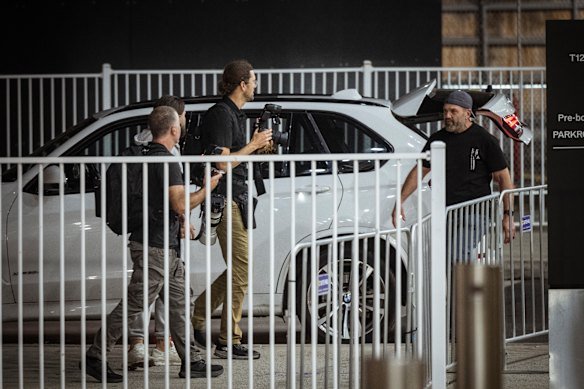
At Melbourne airport, video taken by a News Corporation photographer appeared to show Abraham Abbas, the brother of so-called ISIS bride Kawsar Abbas, pushing the camera into the photographer’s face as he captured returning woman Kirsty Rosse-Emile and her two children.
It’s the second time that Melbourne-based family members of the ISIS returnees have been involved in altercations with the media, after another scuffle when a group of women arrived on May 7.
In a statement, NSW and Victoria joint counter-terrorism teams said the women and children had been “subject to a range of operational responses, including the searching of belongings and the downloading of their devices for investigative purposes.
“No one arriving within this cohort has been charged, however, investigations into the activities of Australians who travelled to Syria – including those who have since returned – are ongoing.
“Police and the JCTTs will continue to engage with relevant stakeholders to ensure community safety is upheld.”
Government sources who cannot be named because they are not authorised to speak have told this masthead some women may be charged in coming days. When the previous cohort arrived on May 7, they were arrested at the airport and removed by police.
Flights carrying the seven women and 12 children arrived on Tuesday at about 4.30pm in Melbourne and 5.30pm in Sydney from Damascus, via Doha.
In Sydney, NSW Police told waiting reporters the women had been given the option of leaving the airport with the help of the NSW Department of Communities and Justice, or going out the public entrance.
All the women took the quiet option and were released from the airport before 8pm.
In Melbourne, the Australian Federal Police told reporters about two hours after the women and children arrived that they’d been processed and let out a side door rather than through the usual arrivals gate where media were waiting. Melbourne Airport said the operation was handled by Australian Border Force, which was approached for comment.
The kid-gloves treatment by authorities is a tacit admission that they mishandled the previous return of women and children on May 7, when frenzied scenes included airport arrests, private security guards and a significant scuffle in Melbourne.
Sources close to the returned families say those events had traumatised children already fragile after growing up for seven years in camps.
The return of this group means that, apart from one woman subject to a temporary exclusion order, Hodan Abby, and her child, all the Australian so-called “ISIS brides” are now out of Syria for the first time since the end of the so-called Islamic State caliphate in March 2019.
The women returning to Sydney are Nesrine Zahab, who was 21 when she claims she was tricked into going into Syria by her cousin and IS recruiter Muhammad Zahab; Aminah Zahab, Muhammad’s wife, and Sumaya Zahab, Muhammad’s sister.
Hyam Raad, about whom little is known, is the fourth woman returning to Sydney.
Two more women, accompanied by seven children, landed in Melbourne.
They are Kawsar Kanj, about whom little is known, and Kirsty Rosse-Emile, the daughter of two former Christians who converted to Islam when she was nine. Kirsty’s sister Krystle told the ABC in February that Kirsty was married at 14 to a much older man who was a friend of her father’s. Krystle said her sister had been groomed to go to Syria.
The Australian citizens left the al-Roj camp in north-eastern Syria late last week in a trip organised and funded by family members. Among them was one young woman who just turned 18 and who is the daughter of one of the so-called “ISIS brides”.
Abby and her nine-year-old daughter – who requires medical treatment for a series of shrapnel wounds – were denied permission to board the flight in Damascus. They had tickets to Sydney, but the airline turned them back because the Albanese government had imposed a two-year temporary exclusion order on the mother.
Abby elected to keep her child with her, even though her daughter has serious medical issues caused by shrapnel wounds she suffered as a baby.
The child has shrapnel in her head, neck and hip, which this masthead reported in 2021 made it difficult for her to walk and caused delayed speech and development.
Sources close to the family group but unwilling to speak publicly say the child needs medical attention and was experiencing ongoing physical disabilities. Abby herself also has a piece of shrapnel in her chest.
Australian government sources have said they will not provide consular assistance to Abby and her child.
Sources close to the families have confirmed Abby will challenge the permit in the federal courts, though that application has not yet been lodged. They also have the option of applying for a return permit. Lawyers for the family group declined to comment.
Prime Minister Anthony Albanese said in question time he had “nothing but contempt for anyone who has any sympathy with ISIS”. He added the government had provided no assistance, and that they would face “the full force of the law, to the extent available, upon the advice of the security agencies”.
Opposition home affairs spokesman Jonno Duniam told the ABC the government “have gone from actually controlling who comes into our country and making determinations about who they want to let in and who they want to keep out, to outsourcing this stuff.
“These self-managed returns … That is not what they should be doing, and these people are bringing back, as far as we know, great degrees of risk.”
In a statement early on Tuesday, Home Affairs Minister Tony Burke reiterated that the Australian government “has not and will not provide any assistance to this group”.
“Our world-class law enforcement and intelligence agencies have been preparing for their return since 2014 and have long-standing plans in place to manage and monitor them,” he said.
He has made no comment about the group’s arrival.
When a group of women in Australia earlier this month from the camps, three out of four of them were immediately arrested, some on slavery charges. Their return prompted chaotic scenes at Melbourne Airport.
Abby, the woman left behind, escaped from her home in western Sydney with a friend when she was 18 and entered Syria in 2015 with the hope of becoming a jihadist bride. The young women told their parents they were going on holiday. Abby’s friend was killed in Syria in 2015.
The exclusion order extends for two years unless a court strikes it down or the minister issues a return permit.
An exclusion order is placed on ASIO advice and on narrow grounds relating to the fear of a terror attack. It can be challenged on even narrower grounds including that the minister acted outside the scope of his powers or that ASIO’s assessment was legally flawed.
Save the Children Australia chief executive Mat Tinkler said on Tuesday the safety and wellbeing of the returning children – who make up two-thirds of the group – should be the priority.
“The political debate surrounding their future in Australia has been deeply disappointing,” Tinkler said.
Start the day with a summary of the day’s most important and interesting stories, analysis and insights. Sign up for our Morning Edition newsletter.


From our partners
Read the full article here